Showing posts with label books - biography. Show all posts

Tuesday, February 24, 2026

Man's Search for Meaning

Man’s Search for Meaning, Viktor E. Frankl
 
This small volume is divided into two main parts. The first tells of Frankl’s experiences in German concentration camps during WWII. The second is called Logotherapy in a Nutshell, and provides a summary of his existential approach to psychotherapy. Both are under 100 pages, but are packed full of narrative and insight.

As the years increase since WWII and the horror of that history fades, it seems even more important to ensure these accounts remain shared and available. Frankl spent over three years in Auschwitz, Dachau and other concentration camps. As with all such stories, there is horror and mundanity, as well as cruelty and kindness. Years of toil, hunger, and sickness surrounded by constant death. Yet, also moments of love, support and care. His account focuses more on how he and others responded to imprisonment, how people coped or not, and how people’s characters were evident. It’s not so much an orderly account, but rather a series of impressions and reflections. He concludes: 
“But for one of the liberated prisoners, the day comes when, looking back on his camp experiences, he can no longer understand how he endured it all. As the day of his liberation eventually came, when everything seemed to him like a beautiful dream, so also the day comes when all his camp experiences seem to him nothing but a nightmare. The crowning experience of all, for the homecoming man, is the wonderful feeling that, after he has suffered, there is nothing he need fear any more – except his God.”
Frankl was already an experienced psychiatrist when he was sent to the camps. Unsurprisingly, his observations greatly impacted his thinking about humanity and where people find meaning. This led to a whole school of psychotherapy (logotherapy) that explored a person’s search for meaning as a central motivational force. He posited that people need a purposeful goal, something that provides a reason to continue, and enables one to endure suffering. As Nietzsche said, “He who has a why to live for can bear almost any how.”

The question of overall meaning is important for many - what am I here? What is the purpose of life? Yet Frankly pushes this further, noting that people need more than that, they need specific meaning at a given moment:
“One should not search for an abstract meaning of life. Everyone has his own specific vocation or mission in life to carry out a concrete assignment which demands fulfilment… Thus, everyone's task is as unique as a specific opportunity to implement it.
He suggests that we can discover meaning in three different ways:
  • creating a work or deed 
  • experiencing something (such as goodness, truth & beauty) or encountering someone (by loving them) 
  • the attitude we have towards unavoidable suffering
Much of Frankl’s approach resonates with me: 
“When a patient stands upon the firm ground of religious belief, there can be no objection to making use of the therapeutic effect of his religious convictions and therefore drawing upon his spiritual resources.”
This little book has numerous observations that may be more interesting to those working in the therapeutic space. Yet, there is also a wider appeal, as Frankl explores humanity and a reality that’s rarely examined today. 
“A human being is not one thing among others; things determine each other, but man is ultimately self determining. What he becomes – within the limits of endowment and environment – he has made out of himself. In the concentration camps, for example, in this living laboratory and on this testing ground, we watched and witnessed some of our comrades behave like swine while others behave like saints. Man has both potentialities within himself; which one is actualised depends on decisions but not on conditions.

Our generation is realistic, for we have come to know man as he really is. After all, man is that being who invented the gas chambers of Auschwitz; however, he is also that being who entered those gas chambers upright, with the Lord's Prayer or the Shema Yisrael on his lips.”
A moving and insightful read.

Monday, February 22, 2021

Mini-reviews

The Survivors, Jane Harper

I enjoyed this new offering by Jane Harper, and thought it was as good as The Dry and The Lost Man. It’s a similar style story, with a historical incident that has shaped a community, and a current crime that has occurred. In this case, Kieran has returned to his childhood home in a coastal Tasmanian town with his girlfriend and infant daughter, where the guilt that he carries resurfaces over the death of two men in a major storm years ago. When a girl is found murdered on the beach, tensions in the town start to rise, as people start to remember the past, and point fingers at each other. Harper is skilled storyteller, with realistic and multi-faceted characters, and a depth of narrative.


The Dictionary of Lost Words, Pip Williams 


This wonderful debut novel charts the history of the creation of the first Oxford English Dictionary through the eyes of Esme, the young daughter of one of the lexicographers. As a child she spends her time on the floor the scriptorium, where words are sorted and gathered. As the grows up, she realises there are words not included in the dictionary, those considered vulgar but also many that describe the experiences of everyday women. Williams has skilfully interwoven much of the actual history of the dictionary compilation, including the people involved, with the life experience, joys and struggles of Esme over the decades it takes to publish. What I enjoyed about this book is that is wasn’t predictable. There were a couple of points where I thought I could tell she would take the narrative, but it turned another (and in my opinion) better way. An impressive, enjoyable and insightful book.


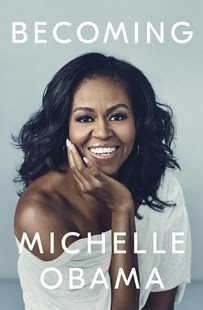
Becoming, Michelle Obama 

A couple of friends mentioned they enjoyed this and I was pleased to finally get to it. Broken into three
sections, Michelle Obama outlines her childhood (Becoming Me), her relationship with Barack (Becoming Us) and the years as First Lady (Becoming More). I knew very little details about her, for he came to office when I was in the midst of baby years, and it wasn’t really on my radar. She’s given a relatively open and insightful account, with details of her own childhood, loving family and early working years. She shares about their marriage, and the ups and downs of campaigning and life in the White House. It is generally gracious, with overwhelmingly positive comments about all her friends and family. It’s not particularly partisan, although as you might expect there are some digs at Republicans, especially Trump. I enjoyed the insight into life in the White House, and how they tried to care for their girls while living there. I appreciated some of her observations about people and relationships, especially marriage: “I understand now that even a happy marriage can be a vexation, that it’s a contract best renewed and renewed again, even quietly and privately - even alone.” Alongside the story, she weaves in her thoughts on race, gender, poverty, education, politics and numerous other topics. Keeping in mind this is an autobiography rather than an analysis, this is still an interesting and thought-provoking read no matter what side of politics you are on.

Monday, January 11, 2021

The Dingo's Got My Baby

The Dingo’s Got My Baby, Lindy Chamberlain-Creighton

Probably every Australian over thirty will have heard of the Chamberlains. (I have established my children had not). Michael and Lindy became household names when in 1980 their nine-week old daughter Azaria was taken by a dingo from a tent in a camping ground near Ayers Rock. While the initial inquest upheld the finding of death by dingo, the Northern Territory government later accused Lindy Chamberlain of murder, and she was sentenced to life in prison. After numerous appeals, she was finally remitted and released after about three years of imprisonment. Later followed a Royal Commission and finally an official acknowledgement of baby Azaria’s cause of death.

It was a case that caused strong emotion and opinions, with many believing the media coverage that Lindy had killed Azaria, while others campaigned for justice to a hostile audience. She notes later:
"Many people were not game to stand up and say what they believed. There was no sitting on the fence in our case, and people who had the guts to stand up and make a public stand for the Chamberlains’ innocence certainly needed the guts to live with the flak that came afterwards." 
I never knew much beyond the basic facts, being a child myself at the time. However, the phrase “a dingo’s got my baby” became part of the Australian lexicon and was often used to get a laugh, much to our shame. I remember it being a joke on a Seinfeld episode.

She is clear from the beginning this is her story, not Michael’s and his story is for him to tell. It’s very detailed, the ebook I read was 900+ pages. There are detailed sections on the camping trip itself and the first inquest, the second investigation and trial, the prison years, and then once she was released and the ongoing fight for justice. So it’s very long, and probably would have benefited from a stronger edit. However, I can see why it was kept as is - this is her opportunity to say everything she wants to say. She was denied justice, falsely accused, treated dreadfully by the Northern Territory government and police, and was talked about in virtually every household in Australia (and many overseas). This is one opportunity to put everything in one place and make it her record. She has no hesitation with fully naming and including photographs of everyone on both sides - lawyers, police, forensic scientists. She wasn’t nasty, but didn’t hesitate to name incompetence, unkindness and mismanagement. She is open about prison, both the kindness of some guards and the sheer unpleasantness of others, as well as the variety of prisoners she lived with.

Even with the length, it is an engrossing read. I read it solidly for a week on holidays and struggled to put it down.

Lindy is a Christian, a seventh-day Adventist, and that shines through clearly. There are numerous times she refers to her faith, or her reliance on God. She has confidence that God has been with her through this time, and how crucial that has been.
“It is only when your faith is tested that you know whether you have any or not. It is only when your temper is teased and provoked to the limit and you manage to control it, that you know you have succeeded. It is no use saying, ‘I have got self control’ when there is nothing to provoke it."
“I thought of Job, who suffered horribly without knowing why, only remaining faithful to God, his Lord and Master. God rewarded him in the end, but still he did not know why. Maybe we will never find out in this world either. I'm sure Job has many questions to ask God when he sees him. I have a few to ask Him, too. Maybe we can queue up together. But suffering is not God's will. He will help us to bear what we must, and to hang on until the end, but it's not something he delights in."
Reflecting on prison:
“When the doors clang shut behind you, locking you in, and you have nothing to rely on except your own strength of body and mind, it can be terrifying if you let it. At a time like this, if you thought God was a figment of your imagination, He now either becomes a very real and personal friend, or is totally disregarded as a mirage only relevant to a distant Biblical past. Like others before me, I came to that knowledge while in prison. There is no way that one can put this into words, it is simply something that slowly but surely happens. Time and time when there was no one else to turn to, nowhere else to go, I could turn to God and say, ‘Lord you've got to help me here. I can't manage on my own’.”
“There is no doubt in my mind that if it hadn't been for God's help and strength, plus grit and determination, I would have landed up in a mental asylum. At times I felt myself so low I knew I was losing my grip, not only on life but on reality. I knew I had to find it again in a hurry; only God could give me the strength and courage I needed for that and calm me down." 
There are strong words throughout about the problems with the justice system, and the pointlessness of much incarceration: “I believe the only thing ever taught in prisons is the perfecting of old and the learning of new criminal skills."

Throughout is woven the story of the family and how they were affected: the two older boys, baby Kahlia born while she was in custody, her and Michael’s divorce and then her marriage to Rick, about whom she fondly says:
“To have a supportive man who is both gentle and strong behind you who loves you for who you are without a desire to change you is the most empowering thing I know. To know you are loved and supported even when you make mistakes and are no longer young or glamorous lets you become a whole person."
The book was first published in 1990, but it’s had later additions and the version I read was published in 2015, as more things have happened in the case and to this family. Azaria would have been 40 this year, and this case is still fresh in many people’s minds and part of public life. Yet, as Lindy says:
“People forget that my family has a private life. We have gone through a private hell as well as a private happiness in our battle to survive the last twenty-four years and most of our biggest battles have been fought in private."
No matter what you think of the Chamberlains or the case, this is a book well worth reading. This is part of our nation’s history, and not a proud one, and these are real people who have gone through immense suffering, yet have come out of it stronger and completely reliant on God.

Thursday, April 23, 2020

For the Joy

For The Joy, edited by Miriam Chan and Sophia Russell 

As clearly explained in the subtitle, this book contains “21 Australian Missionary Mother Stories on Cross-Cultural Parenting and Life”.

Editors Miriam Chan and Sophia Russell, have skilfully drawn together a marvellous range of women to speak of their experience being mothers on the mission field, across different circumstances. Some are dwelling in large cities in Asia or South America, others live rurally in Africa or South-east Asia. Some are retired and are reflecting on years of service with now adult children, and others are still on the field in the midst of parenting young ones. Some are homeschooling, others are working in paid ministry roles.

Within that range however, some things unite them all. They all have a trusting faith that they are saved by God’s grace alone and they share a conviction to serve the Lord overseas. All have been humbled to realise their own weakness in situations that have been challenging. All call Australia their home country, or their sending country. They are all mothers, and write from their perspective as mothers. All have had cause to reflect on parenting in a cross-cultural context - to see the benefits and the challenges of raising “third culture” kids. And every story finishes with a confirmation that God is good, that God is faithful, that he is with us in all circumstances, and that serving him has been worth it.

Some stories invite us into the ordinariness of parenting, the little people that you care for, love, protect and teach. These are similar wherever you are, even if still in Australia. Other stories will cause you to wonder, “how did she live through that?” “How did they keep going?”. You may find yourself weeping for the loss and grief some families have experienced, while also noting that some of the tragedies could still have happened in Australia.

Although all the contributors are Australian missionary mothers, it would be a great shame if only other Australian missionary mothers read this book. There is much here to encourage and challenge all Christian mothers as we think about parenting with faith. But men too should be reading this, to appreciate the service, faithfulness and challenges facing mothers serving overseas. I’m sure this is being put in the hands of many women planning to go on the field as well, although my word of caution would be to read it with others prayerfully and talk about it together, rather than read it solo imagining yourself in all the situations.

Anyone who supports missionaries should read it to gain insight into the potential joys and challenges for families on the field. Indeed, if you are like me, and have been in Australian Christian circles for a while supporting and encouraging mission, there’s every chance you’ll know some of these women personally, maybe your church has been supporting them, or you may have been praying for them for years through mission organisation prayer diaries.

Some mothers might worry that “the average Christian mother” reading it would end up feeling “not good enough”. That is, thinking our life is not that hard and yet we really struggle, or that we could never be that faithful, or that trusting in God, or that prayerful. But that would be missing the point. These are stories about women in various encouraging and challenging circumstances, but who all have had to trust in God in their weakness, lack of support, or despair. I found them incredibly encouraging, and a helpful challenge to my own faithfulness in parenting.

I usually include lots of quotes when I review a book, but I decided just to read and appreciate this one. Having said that, I’ll include one from Penny’s story that sums up what many of the women indicated:
“[God] slowly broke down the expectations I’d had for myself around what living missionally looked like, and taught me the value of forming genuine friendships and unconditional love. Missional living wasn’t about me being a hero. It was about me walking humbly with God, allowing Him to set the priorities - kingdom and gospel priorities - for how I could respond to my family and community.”
Yes, this is an honest, challenging, and sometimes confronting collection of stories. But it is also a refreshing way to see God’s goodness in all circumstances and to be reminded that parenting is a God-given gift that we do well not to squander. Most of all, this is a collection that bears testimony to our faithful Lord and Saviour Jesus Christ and his work both in individual people and across the nations of the world.

This post first appeared on The Gosopel Coalition Australia website

Monday, March 2, 2020

Educated

Educated, Tara Westover

This is a book that will stay on your mind long after you have read it. Westover has provided a riveting and very challenging account of her childhood and early adult years. If it was a fiction book you would think the author had gone a bit overboard, but the fact that it is autobiography supports the saying that truth is stranger than fiction, and in this case, often much worse as well.

Westover was born into a strict Mormon family in Idaho where the father was convinced at various points that the end of the world was imminent and they needed to prepare. They were against the government educating their children and provided no real homeschooling at all. They were completely against medical care, despite family members suffering numerous major life threatening injuries, all treated entirely with the mother’s ointments and herbal remedies. Her father is strict and reckless, although kind at times. He dominates and controls all of those who do not follow his ways, and Westover later ponders whether he was either bipolar or schizophrenic. Older brother Shawn was very physically and verbally abusive in later years, which is possibly linked to when Tara hit puberty. He was nasty and vindictive, and no one in the family ever stood up to him.

She wanted to go to college, and was encouraged by older brother Tyler to do so:
"There is a world out there, Tara," he said. "And it will look a lot different once Dad is no longer whispering his view of it in your ear."
She teaches herself Maths and English from textbooks (with some help from her brother). After two attempts at the entrance test, she got a high enough mark to be accepted into BYU in Utah, a mostly Mormon college.

Once she gets to college she is almost unable to comprehend the differences between herself and others:
"I’d always known that my father believed in a different God. As a child, I’d been aware that although my family attended the same church as everyone in our town, our religion was not the same. They believed in modesty; we practised it. They believed in God‘s power to heal; we left our injuries in God’s hands. They believed in preparing for the Second Coming; we were actually prepared. For as long as I could remember, I’ve known that members of my own family were the only true Mormons I have ever known, and yet for some reason, here at this university, in this chapel, for the first time I felt the intensity of the gap. I understood now: I could stand with my family, or with the gentiles, on the one side or the other, but there was no foothold in between."
She comes to realise how little education she has about everything, and is drawn to history subjects.

Now two concurrent storylines emerge: Westover’s life as she studies and shows remarkable gifts, eventually ending up at Cambridge for graduate study; and then the realities of what happens every time she returns home to Idaho, where patterns of abuse and control reign.

In the end, she concludes it is education that makes the difference. Three of the children left home, got educated and broke the patterns of their children. Four were never educated at all, never left the area and all still operate under the dominating control of the men in their family. She is quick not to denounce Mormonism entirely, and this is no doubt an extreme version of it, yet the warning is there. A man-made version of religion can produce dangerous men, who twist and turn things their way. Of course this can happen without religion too.

This is a gripping story, but it probably needs a bit of a warning about the explicit themes of domestic violence in it. I kept pondering afterwards, what happens to the people in these situations who do not get out? Tara got out. She will live with the consequences for the rest of her life, but chose to be removed from it. What about Shawn’s wife, his sisters and now his children? Fiction you can put down, non-fiction you are left pondering about the real people affected. A sobering but compelling read.

Monday, February 17, 2020

Metanoia

Metanoia, Anna McGahan

I find it very hard to know how to review this book. On one hand, it’s a beautifully written, creative, honest account of a young woman’s artistic life from her teenage years to age 30. It tells of her coming to faith in Christ and how that changes all aspects of her life. At the same time, I found she expressed that faith in language and with concepts so different from my own that I struggled to connect with it.

Anna McGahan is a well known Australian actor and writer who many will recognise from shows like House Husbands and ANZAC Girls. She begins with a story of her at age 8 writing a letter to God, asking him to prove his existence to her. The next account is at age 14, which starts 10 years of eating disorders. She develops an acting career and fully submerges herself into an artistic lifestyle, which includes pursuing Buddhism, sexual expression with most both men and women, and drugtaking. The book is structured around six different sections noting different aspects of the body. This first section is called “The body is a marketplace”. It’s searingly honest but by no means salacious.

She tells how she started going to church, read the Bible in detail, and eventually came to faith. It’s an experiential and charismatic conversion as she identifies the Holy Spirit speaking to her, she speaks in tongues, and she is instantly healed from 10 years of eating disorder and body image issues. One thing that she finds particularly freeing is the realisation that she does not need to have sex any more.

It is not an easy road over the next few years, she develops a relationship with a man but is distraught to discover he lives out same-sex attraction. She continues to wonder at her own attraction to women. She explores what it means to have platonic loving friendships with women. The considerations as she works through Christian views on homosexuality are kindly measured,
“The way I had shamed and decried any religious view point on queerness as automatic hate speech felt unsubstantiated and crude. I knew now, first hand, that most Christians were gently working out how to reconcile their faith with the complexities of sexual expression, not spitting homophobia. People I had previously considered ‘bigots’ were now my friends. They had conservative views on sex, yes, but they were generous and open. They listened. They were not disgusted by gayness, and they did not mock or belittle it. They wrestled with the topic on my behalf. They make choices about their own bodies and did not impose these choices on me.”
When given money for an acting scholarship in LA, God tells her who to give it away to, how much, and when. It’s remarkably specific. She joins faith based artistic communities in Los Angeles, experiencing great joy at living with others, worshipping God and together trying to reach out to the artistic professions. It’s seems to be quite spirit-led, with prophecy and interpretive expressions of faith.

Coming back to Australia was a rude shock, as she comes to realise the disparity between the church and the artistic communities,
“The Australian church didn’t seem to want artists. It didn’t understand them, didn’t really try to. And secular Australia certainly didn’t want Jesus. Christian artists were stuck on the bridge connecting the church and the secular, their commission to tell the truth designed to not the two worlds but instead locking them out of both. They were captives of the in-between.”
So she starts The Fireplace, a group of Australian artists on journeys of faith. Later chapters explore her marriage and birth of her first child. I found these final accounts quite arresting.

This is a book that shares experience. It tells the story of how God has been at work Anna’s life and in the lives of those around her. And it’s a powerful story. Yet at the same time, as I said, I found it tricky reading. If one was looking for the gospel explained, it is not there. If you gave it to someone who had questions about faith or was exploring Christianity, there is very little to hang on to. There is almost no bible content, beyond a few quotes and very little thought out theology. In fact, the only times she adds interpretive theological comments, it’s more in the vein of perhaps the Holy Spirit is feminine, or “God is gender neutral to me”.

It did widen my view of Christian expression and see how God can indeed work in varied and remarkable ways, sometimes expressly directly and moving his people to action. I suspect some (maybe including some in the creative arts industries) will find something here to put some words to their faith. Yet, others may find themselves wondering at the spiritual experiences she has been given, and find disparity with their own more cerebral connections to faith, God, Jesus, and scripture. That was probably my own reaction.

I read this book in response to a review on TGCA. It’s worth reading for an additional perspective.

Monday, May 6, 2019

Homes

Homes, Abu Bakr al Rabeeah with Winnie Yeung

Homes: A Refugee Story is written by now 18-year-old Abu Bakr al Rabeeah, with the assistance of his teacher Winnie Yeung, charting his childhood as a refugee. Born in Iraq in 2001, his memories of his homeland are happy:
“My childhood in Iraq was a sweet one. There was laughter and joy: rich, just like the syrupy knafa cheese pastries I loved so much. And my red bike… That’s what life was: friends and soccer.” 
Abu Bakr’s father’s family was Shi’a, but he raised his own family as Sunni, and “where we lived the divisions between the two denominations of Islam hung heavy in the air...He couldn’t ward off the disapproving grumbles of his own family; instead, he taught us to meet those painful arrows with love and acceptance, to leave it in God’s hands.”

When the neighbours started finding bullets taped to their front door, threats of beheading came to extended family, and finally a death threat that named Abu Bakr arrived on the doorstep, his father decided it was time to leave and they moved to Homs in Syria. Syria was an interim step assuming things were likely to get worse and the family applied for refugee status, and then opened a bakery in Homs.

The next four years were spent in Syria as things slowly unravelled. The family were there for massacres, bombings and multiple shootings:
“That’s how it was in Syria: when we heard an explosion, we ran towards the chaos. Often the police and ambulance was late arriving, if they arrived at all, so we took care of each other. After every explosion, streets were clotted with civilians doing whatever they could to help, binding wounds, driving the worst cases to hospital.”
“When most people hear massacre, they picture body bags and blood. But this is what massacres felt like for me: the tense, stale air of a bedroom with too many breathing bodies in it. Finding quiet ways to pass the frightful hours, trying your best to block the sounds from flooding your brain.”
The times of violence are intertwined with daily life: school soccer, video frames, mosque and family.  Cousins played FIFA 13 and Grand Theft Auto and texted regularly. There was a time he collected the bullet casings he found on the street. When his father found out he said “Do you know what this casing means? It means someone shot a gun. They shot at another person. That bullet might have hurt someone, or killed someone... I don’t want you playing with the anymore. I don’t want any of these in our home, in the bakery. This is not who we are.”

There is an honesty as he came to terms with what was around him:
“The sad truth was, you could not live in Syria and have a clean heart. How could you, when you live in a place where you’re randomly shot at and car bombs explode outside your home? I wanted my heart to be pure, but already I hated people and I hated parts of my life. Sometime I even hated my family. I questioned my faith and my religion.”
“Knowledge that we never really wanted to know filtered into our lives. Our ears could pick the out the differences between mortars, Grad rockets, and car bombs. We could tell the high notes of the metallic smell of fresh blood on the streets from the low reek of a corpse waiting for days to be found in the rubble… We became sensitive gazelles, always stopping to scan and listen. It wasn’t a conscious choice – it simply became part of our walking and being.”
In 2014, the family’s refugee status was approved and the UN arranged their resettlement in Canada. Their travel, new schools and language learning are described as the family tried to make a new home:
“Even though Father was doing his best to hold us together, we were each so wrapped in our own kinds of loneliness that we got used to our little islands of grief… It was a relief to be in a place free of the shabiha and snipers, but none of us had ever imagined the solitude we would face. We had traded the raucous, tearing war for a suffocating, quiet safety. No one could tell which was better, which was worse. It was both and neither.”
In Year 9, Ms Yeung is his ESL teacher, and having started to grow in his English language confidence, she asks him, “what is your secret wish?” After admitting it is to be a soccer player, he then confides, remembering “my friends, the soccer games, the bombs, my cousins who are my brothers. How they told me to never forget. I realize I carry Syria in my heart. I’m not sure if I’m ready to do this yet but I decide to trust and so, softy, I tell Ms. Yeung, “I want to share my story.””

This is an honest, raw, short, heart-warming account from the perspective of a boy growing up in a war-torn nation. As such, at times it was simpler than I was expecting when I started. Upon reflection though, he has provided just what we need to know – what life is like for children in these regions. For those of us (and our children) who have absolutely no understanding of what it would be like to live in a place like Syria, it is still a childhood we recognise, but through a very different lens of experience. He has written with a pervasive hope and optimism despite the situation, and portrays his own faith in a positive, tolerant way. I highly recommend this for young teens right up to adults, and I imagine it will soon be placed on many high school reading lists.

Monday, July 16, 2018

Her Story

Her Story, Diana Lynn Severance

This collection of 366 readings is a mostly chronological covering of women of faith from Mary, the mother of Jesus, to present day. Severance has sorted and collated a massive amount of historical material, and made each reading one page of basic information about the woman and how her faith played out in her life.

I did indeed read one day for a year and found it to be an encouragement and challenge to consider how other women have lived in various times and places and circumstances, yet remained faithful to the Lord.

If a collection is made of women of faith, you can tend to pick the women who will be there: Sarah Edwards, Hannah More, Monica (mother of Augustine), Susanna Wesley and Joni Eareckson Tada. Most collections cover the same women again and again. All are great to learn about, but the advantage of this is the breadth of women included. Even if you are reasonably well versed in biographies of Christian women, chances are there will be hundreds here you have never heard of.

The early readings about women of antiquity and the Middle Ages were so encouraging: women who were queens, or faithful mothers, or early authors. Of course, there is less information for these ages, so by February you are into the Reformation and that becomes harder reading, with numerous accounts of persecution and martyrdom. We are into the 1800s by July and well into the 1900s by October. Only a handful of women included are still alive.

It was an encouraging way to spend a year, learning more about faithful women from over two millenia. There is a joy to see people who have chosen to live for Christ in every age and this is a wonderful example for us to follow. At the same time, because each account was so brief, and much of it presented in a measured, factual way, it felt like a surface treatment. Many truly tragic circumstances were presented so baldly that it didn’t give you chance to fully appreciate the gravity of what was being described. I would have loved more details for many. For those who would like to delve further into historical writing covering more details of some women, you could try Severance’s other work Feminine Threads: Women in the Tapestry of Christian History.

There wasn’t enough time to analyse real faults and failings, many were presented with an awkward sort of perfection, and so increasingly they set a standard that many women would struggle to emulate. Many of the women of the reformation onwards were highly educated, very pious, spoke numerous languages, translated the bible and still had families, which could well leave the modern women thinking: how is that even possible?

It is true that numerous women who struggled with ill health and hard circumstances were included, but the challenges of sin and maintaining godly living weren’t really present. I didn’t get the sense that these women struggled with the same sins I do.

I imagine collating any list of women of faith over that time would require limits. I was surprised some women warranted two entries, for example Queen Elizabeth I, Florence Nightingale and Sarah Edwards, yet some were obviously missed out such as Queen Elizabeth II or perhaps Nancy Guthrie. I wonder whether permission was needed to include women who are still alive, because I suspect more could be found for the current ages. It also felt like a very Europe and America centred list. Few women from Asia or Africa rated a mention, I think there was one Pacific Islander and one woman who was born in Australia.

The final month or so were mainly missionaries, which is a great encouragement. However, surely there are also many faithful women living in the 20-21st centuries who did not end up on the mission field? It felt a little unbalanced. Admittedly, these are the women that are known and able to be researched, rather than your average faithful Christian women known only in her local context.

One of the real blessings for me was the collections of hymns and poems that were included, written by various women over the ages. I now have a list of these written out for my own encouragement and for use in prayer. I feel very indebted to anyone who can express the truths of the gospel in poetic form, something that I feel very ill equipped to even try. That has been one of the benefits for me personally.

In summary, it’s an encouraging book that reminds us that women, and of course men, have carried their crosses for Christ in faith from his death and ascension for two thousand years to today. We can read and be encouraged, as well as educated and inspired by those who have come before us. But we should also read with a sense of reality, these are just snippets of information and only represent each woman in part. If you want to find women to truly emulate and model your life on, find a godly Christian woman in your context, talk to her, and get to know her story.

This was first published on The Gospel Coalition, Australia website.

Monday, July 31, 2017

Born to Run

Born to Run, Bruce Springsteen

Considering the fan base in this house, it was pretty certain we were going to read this autobiography of Bruce Springsteen’s.

Born to Run chronicles the 65+ years of Springsteen’s life to date, starting with his rather odd childhood in Freehold, New Jersey. Born as many were in that neighbourhood, to a mix of Irish and Italian blood and seeped in Catholicism; he had a completely overprotective and controlling grandmother, a mother who had to give way, and a complicated relationship with his mentally unwell, alcohol laden and distant father. It was a working class life, with real poverty and grind, yet joy and happiness at times as well.

Inspired by Elvis and the Beatles; he wanted to play guitar and be in a band from very early on.
“…we’d been born at exactly the right moment. We were teenagers in the sixties, when rock and radio had their golden age, when the best pop music was also the most popular, when a new language was being formed and spoken to young people all across the world, when it remained an alien dialect to most parents, when it defined a community of souls wrapped in the ecstasy and confusions of their time but connected in a blood brotherhoods by the disciples; voice of their local deejay” (p429)
By his mid-teens he was doing exactly that. Self-taught, unable to read music, but persistent in learning, practicing and copying, he would play for hours and hours to perfect a song. A succession of band groups followed, with him ending up lead singer.
“I was twenty-three and I was making a living playing music! Friends, there’s a reason they don’t call it “working”, it’s called PLAYING … It’s a life-giving, joyful, sweat-drenched, muscle-aching, voice-blowing, mind-clearing, exhausting, soul-invigorating, cathartic pleasure and privilege every night” (p186)
He charts the formation of various bands and their members, including the definitive E Street Band. Numerous songs are explained along the way including the classics Born to Run, Born in the USA and the Ghost of Tom Joad. I would often go back and listen to the songs again to hear what he was explaining. Sadly for me (!), there’s no explanation of who Wendy is in Born to Run, but what was interesting was how both that song and Born in the USA were defining songs of his career and led to super-stardom:
“Onstage, this music swept over my audience with joyful abandon. We had hit after hit and in 1985, along with Madonna, Prince, Michael Jackson and the stars of disco, I was a bona fide mainstream radio “superstar”… Born in the USA changed my life, gave me my largest audience, forced me to think harder about the way I presented my music, and set me briefly at the centre of the pop world.” (p317)
Each album is chronicled and enabled me to appreciate the overarching theme developed for each. I came late to the fan club, not until The Rising album, released after September 11, and I enjoyed reading the story behind that and the later albums. Telling the story of people’s lives was often the impetus for songs, and many reflect on working class realities, the American way of life, struggles for war veterans and race inequality.

He is honest about his relationship with band members and management, including his missteps and idiosyncrasies. He honestly chronicles his first brief marriage and his failings in it. After this it becomes patently clear that his wife Patti is his true partner, confidante and love:
“We could fight, surprise, disappoint, raise up, bring down, withhold, surrender, hurt, heal, fight again, love, refit, then go at it one more time. We were both broken in a lot of ways but we hoped, with work, our broken pieces might fit together in a way that would create something workable, wonderful. They did.” (p372)
He speaks with love and affection for each of his three children and the way they have made their way in the world, creating names for themselves in their own area (his daughter is a champion show jumper).
“Making life fills you with humility, balls, arrogance, a mighty manliness, confidence, terror, joy, dread, love, and sense of calm and reckless adventure. Isn’t anything possible now? … The endorphin high of birth will fade, but its trace remains with you forever, its fingerprints indelible proof of love’s presence and daily grandeur… Whatever the morrow brings, these things, these people, will be with you always” (p368-9)
In the final chapters, he grieves the loss of band members, including saxophonist Clarence Clemons. He opens up about episodes of depression, both in his thirties and, more debilitating, in his sixties. He attributes years of speaking to his doctor as the heart of the book.

Too often, autobiographies are written too early (eg most political and showbusiness tomes). Here, you are glad he has waited to this age (67) to write the book, and took seven years doing so. His writing is poetic and lyrical at times, which shouldn’t be surprising considering the number of great lyrics he’s written over the years. Even so, it was more descriptive, overflowing with emotion, and had more insight and self-analysis than I was expecting. The most poignant and returned-to theme throughout is his relationship with his father, it overrides the book, his music and clearly his life:
“We honour our parents by not accepting as the final equation the most troubling characteristics of our relationship. I decided between my father and me that the sum of our troubles would not be the summation of our lives together. In analysis you work to turn the ghosts that haunt you into ancestors who accompany you. That takes hard work and a lot of love, but it’s the way we lessen the burdens our children have to carry.” (p503)
This is not just the story of a rock and roll life, although as that it’s a good read. But it’s much more – the analysis of a life through the lens of the people that raise us, the opportunities that we are both given and that we take, and the chance we have to write a new script for ourselves and those who come after us. A very enjoyable and informative read.

Monday, July 11, 2016

The Secret Thoughts of an Unlikely Convert

The Secret Thoughts of an Unlikely Convert, Rosario Champagne Butterfield

This book has been recommended to me by friends for a number of years, but I had never managed to read it. In the meantime, Husband bought it, read it, and handed it to me!

It is the story of a university professor’s almost unwilling conversion to Christ. Rosario was a tenured English professor specialising in gender studies and queer theory, living in a lesbian relationship and a key supporter and advocate for the LGBT community.

After publishing a critique of a religious group in the local paper, one pastor write to her a letter she couldn’t ignore. It was a letter that asked her gently how she arrived at her theories, what her presuppositions were, and whether she believed in God. Intrigued by its tone and content, she got in touch with the author. It started a deep friendship with him and his wife, in which they talked about what they both believed over meals and time together.

In time she came to believe in Christ: “Although grateful, I did not perceive conversion to be “a blessing.” It was a train wreck.” (p25)

“This word - conversion - is simply too tame and too refined to capture the train wreck that I experienced in coming to terms with the Living God. I know of only one word to describe this time-released encounter: impact.” (xi) It is an open and honest account of how coming to know God completely altered her life.

She details her life prior to conversion, but only in an informative and descriptive way. At once everything changes - partner, friends, teaching, writing, lifestyle, clothes, speech and thoughts. In time, she marries a pastor, they adopt and foster four children and currently home-school them.

You never know when you read a book like this quite what it is going to say. It could obviously go in many directions. It could be lewd. It could be judgemental. It could be shocking. It could be self-aggrandizing. It is none of these.

She is honest about her struggles, open about her questions, and clear that she had much to learn. She is never hostile to the gay community, and continues to love and serve friends who are part of it.

If there is any group who come under her critique - it is those of the Christian faith who are unthought in their responses and unloving in their words and actions, those who are unable to remove the speck in their own eyes before they remove the planks in others. She challenges those in the church to see our own blinkers and blindness and judgmentalism. She challenges church prejudices, the failure to love and to serve.

It’s a biography - one woman’s account of her own experience. At the same time, it is a clear challenge to think deeper on a number of issues. How well do we really love the outsider? How hospitable are we really? Do we know how casual comments and unwise words can cause deep hurt? Are we willing to cross the bridge of culture and belief and talk with anyone, kindly and gently, about what we both believe?

For Christians - this is a book worth reading, it might challenge you and make you uncomfortable - hopefully about yourself. And that is a good thing.


One quote (almost random considering the rest of the subject matter) stayed with me – her comments on being a pastor’s wife and they echo my own thoughts:
I believe… there is a little known secret about the inner spiritual lives of pastors’ wives. The experience of really knowing the man behind the pulpit, counting the costs of his week, palpably knowing how deeply Satan wants the gospel to simply die from lack of interest, and seeing the Holy Spirit triumph in his preaching even when just the hour before all looked grim, is a great shot in the arm to enduring faith. I wish that others knew this: Pastor’s wives get the cream of the ministry, even as we sacrifice certain aspects of our personal, private and family lives to have this. I have found my life as Kent’s wife to be full, rich, amusing, edifying, and exciting. I have tasted a small bit of the gospel of Jesus Christ. I would not trade this for anything. (p129-130)

Monday, March 14, 2016

Seven Women

Seven Women and the secret of their greatness, Eric Metaxas

I was quite excited to pick up this book recently, thinking it was time to read another biography.  I enjoyed Metaxas’ biography of Dietrich Bonhoeffer about 4 years ago, so was keen to read more of his work.   He has also written Seven Men, after which he was encouraged to write a similar version about seven women.

It was a good read and was also very interesting.  Unless you spend your life in history and biographies, chances are there will be women in here you do not know much about.   His introductory chapter explains the process he went about in choosing which women to include, which was insightful.  He did not choose women because they were compared to men (such as the first woman to do something).   Rather:
When I consider the seven women I chose, I see that most of them were great for reasons that derive precisely for their being women, not in spite of it; and what made them great has nothing to so with their being measured against or competing with men. In other words, their accomplishments are not gender-neutral but are rooted in their singularity as women.  All of them existed and thrived as women…  (p. xv)
He also goes on to talk about how pitting women against men does both a disservice and I found these comments refreshing.   He finishes saying that biographies enable us to look at a different era and time and to realise that we all come to these accounts with our own cultural blinkers, and we can still learn a great deal from people of the past.   All very helpful and illustrative to know how someone has thought about their writing.

Then onto the stories of the seven women.  He has included:  Jean of Arc, Susanna Wesley, Hannah More, Saint Maria of Paris, Corrie ten Boom, Rosa Parks and Mother Teresa.  In doing so he has included women from the Catholic, Orthodox and Reformed faith.   I felt each chapter got better as I read along, meaning I found Joan of Arc and even Susannah Wesley much weaker chapters than the later ones.  I wonder if sometimes stories of people from long ago are so alien to our cultural understanding they are much hard to interact with, which is an interesting conclusion, I realise, considering Metaxas’ opening remarks.  

The one I struggled with the most was the chapter on Joan of Arc.  It is clearly a fascinating story and one I did not know the details about.  However, oddly I thought for a biography, there was no analysis of her at all.   This was a young woman who claimed voices from God were clearly speaking to her about helping the rightful king of France regain the throne.   The whole story and setting is so foreign to us, an attempt at interpretation would have been helpful for the reader.  I can only assume even Metaxas did not feel up to the task.


Each of the following chapters presented a woman and her life and faith in more detail, with a little bit of analysis along the way.   I had either no or only basic knowledge about most of these women and I finished the book encouraged by the lives of women of the past.    In the end because only one chapter was given to each woman, it was really only a taste.  They are some I would definitely like to read about in more detail in the future.  A good read to get a brief insight to seven remarkable women.