Showing posts with label books - marriage. Show all posts

Thursday, April 23, 2026

The Marriage You Want

The Marriage You Want, Sheila Wray Gregoire and Dr Keith Gregoire (Baker Books, 2025) 

I have read most of the Gregoires’ books over the years and my reviews are very similar each time. There are positive elements to them and they have real benefits. Yet, some less appealing aspects undermine their value.

On the positive side: there is insightful discussion about the risks of stereotypes, biblical misuse, and unhelpful patterns in marriage. There is encouragement to make your marriage great, with helpful strategies that many couples will benefit from. The concepts of teamwork, mutuality, and sharing the load, yet taking responsibility for yourself are expounded in practical and realistic ways.

On the negative side: the Gregoires continue to have a combative stance in the Christian marriage space, setting themselves up as the experts who tear down others. While the subtitle suggests this book is built on scripture, in reality, verses are included as needed to support their views, with less attempt to interact with scripture that does not. I would have liked to see a genuine theology of marriage presented and use that as anchor, rather than responding to the messaging of others. Yet again, a huge amount of research data is included, which will cause most people’s eyes to glaze over. It could have been simplified in ways that could have reached the average reader much better.

They have structured the book around BARE marriage.

Balance - using your unique giftings and strengths to run towards Jesus together. They use a triangle model of two people under God (which is not new, we use it with couples as well) and it’s a helpful concept. Chapters address unity and teamwork, and explore the risk of gender stereotypes, problems with the view that the man is the tie-breaker in decisions, and the challenge of entitlement in a relationship (it’s not about your needs, rather the needs of the relationship).

Affection - finding joy and passion in being together. The friendship chapter encourages doing life together, responding to bids for connection, and making time for each other, solid and useful principles. The passion chapter is strong on intimacy being mutual and pleasurable for both, and addresses consent, sexual pain, desire discrepancy, spontaneous vs responsive desire, and encourages making orgasm for each a priority. The issues with pornography are openly discussed, and their argument is helpful - porn is a user system, so it wires our brains to think not about wanting to know the other, but wanting to use the other.

Responsibility - functioning as a team as you bear each other’s burdens, each carrying your own load. I really liked this section. It addressed the reality of the mental load of life and the impact on relationships when one person carries most of it. There was lots of practical wisdom here about how this could look, but a great measurement tool was to consider whether each partner has a similar amount of rest and downtime (rather than perhaps comparing hours worked and in what capacity). While that chapter was about sharing the load as a team, the next was about taking responsibility for yourself - learn how to do everything that needs to be done. Take care of your own needs - health management, appointments, etc. Essentially, if you would have to do that task if you were single, learn how to do it now.

Emotional Connection - being truly seen and feeling like you are home. Chapters cover speaking up, communicating and managing conflict better, sharing emotions and being responsible for your own regulation.

There is much in here of value. Lots of it is common sense. Other parts of it are solidly backed by evidence additional to their own research.

For those who are interested in such things: while the books don’t make this clear nor use the language, a quick look over their website/blogs/podcasts shows a strongly anti-complementarian stance. The stance does not concern me so much as the tone around it - rude, alarmist, and insulting. Conversations about errors and the consequences of some teachings need to be had and acknowledged, but I would prefer to see it done more graciously and in a way that allowed room for difference and interaction. (I’ve made similar comments about this tone in previous reviews.) 

So, while I liked the book and what it has to offer, my broader hesitations are strong enough that I'm more reserved in my recommendation of it.

Tuesday, April 7, 2026

Sex and Self-forgetfulness

Sex and Self-Forgetfulness: Honoring Each Other in Marriage, Doug Hanna (New Growth Press, 2026)

Hanna’s goal is to apply Jesus’s vision for the Christian life to sex within marriage - that is, his call of self-forgetful discipleship and serving others. 
“Sexual satisfaction is found by serving your spouse, not by insisting on your own way. The way to find real joy in bed is laying your life down, thinking less about yourself and more about your spouse.” (p2)
He is clear that this book is neither a detailed theology of sex nor a how-to manual. Others like Weerakoon, and Gregoire have done these well. Rather, he wants readers to understand God’s design for sex and marriage to approach it in the right way (p3). He also strongly recommends couples read it together, so they can talk it through and be unified.

It’s divided into three sections:

1. Understanding God’s Design

Chapters explore how sex is for marriage, pleasure, serving and women. Key ideas like safety, consent, enjoyment, and caring for the other are all explored here: 
“If you are struggling to make sex a pure, unifying, fulfilling, satisfying, and really, really pleasurable experience in your marriage, safety may be the missing ingredient.” (p20)
Hanna strongly counters what he calls “sex-is-for-men theology”: that men need sex, it’s the wife’s responsibility to provide it to enable his release, which is an obligation on her. He labels it a lie from the pit of hell, more attributable to atheists like Freud, but still misused by some Christian teaching today, “This flies in the face of the Bible’s teaching that sex is meant to be mutually satisfying, not a demand from a husband to a wife.” (p33)

2. Responding to Sexual Brokenness

Hanna then explores how strongly the fall, our sin and the sins of others have impacted our sexuality. He is open and direct about the struggles faced in different areas, whether through selfishness, pornography, adultery, or hard-heartedness. He urges openness, confession, and working towards forgiveness. He also compassionately addresses those who have been sinned against. These are challenging chapters, but for those who are willing to explore them honestly, they could provide a path of hope moving forward.

3. Pursuing Sexual Satisfaction

This is about half of the book. Hanna wants to broaden the understanding of sex and intimacy, as well as to encourage each partner towards serving the other lovingly and joyously: 
“In every sexual encounter with your spouse, your focus should be on closeness and intimacy as you celebrate what God has done in bringing you together, rather than on a particular physical act.” (p92)
“All of your readiness to serve your spouse in your bedroom is worthless if you aren’t also serving your spouse in the kitchen and the living room. You can’t have heat in the bedroom without warmth in your marriage.” (p113)
“When we genuinely adopt self-forgetfulness as our attitude and understand our spouse’s sexual satisfaction as our obligation, it motivates us to grow. If sex isn’t amazing for your spouse, that should bother you.” (p120)
“As you seek to forget yourself and pursue your spouse sexually, you need to devote yourself to studying the primary source (your spouse). Truthful secondary sources (helpful books) aren’t enough and false conspiracy theory propaganda (pornography) is downright harmful. You aren’t sleeping with the idea of sex; you are sleeping with your spouse.” (144)
He encourages self-awareness, willingness to learn from each other, and lots of conversation & honesty. Some chapters are specifically about intimacy, others are broader (e.g., about communication). All of them weave together well, and if couples are reading it together, the conversations would build on each other as they progress.

The book is quite short, and each of the thirty chapters is only about 5 pages. Each has a bible verse, an example, some application, things to talk about together, and things to pray about. Appendix 2 (52 conversation starters for discussing sex with your spouse) is excellent and would be a great way in to many of these conversations.

While I didn’t agree with everything in it, it’s a good resource that could help many. Recommended for couples who want a biblical foundation for their marriage, who want to serve one another, and who are willing to be open and honest with each other as they move towards greater intimacy.


I received an ecopy of this book in exchange for an honest review. 

Thursday, May 8, 2025

A Seasoned Marriage

A Seasoned Marriage: Living the Gospel in the Middle Years and Beyond,  Larry E. McCall (New Growth Press, 2025) 

I really like the title of this book. McCall has managed to incorporate two key ideas about long-term marriage:
  • It seasons us. A long-term marriage is a major shaper of our character and actions. 
  • It has passed through the seasons, not only of marriage, but of life. Pain and joy, heartache and rejoicing, birth and death, closeness and distance. 
Aimed at those in the “second half of life”, he suggests it’s for those over 40. Yet, since the first life stage mentioned is launching kids into adulthood, it’s more for those 50+. It becomes increasingly applicable as the years go on - addressing challenges of retirement, ageing and preparing for death. That’s potentially another 40+ years for some couples! It’s also not assumed that every marriage at these ages will have been long-term, perhaps due to remarriage or a later start.

McCall underpins every chapter with a solid gospel foundation. He points the reader to God’s character, to what Christ has done, and encourages us to mould every aspect of our maturing years to it. While this is somewhat simplistic, the application of almost every chapter is: pray, review God’s teaching on the topic, discuss it, and make wise decisions together. See the opportunities God has given you and continue to serve him faithfully as you are able.

Considering the amount of material covered, it’s relatively short (160 pages). McCall writes clearly and succinctly, enabling him to address many topics in a digestible way. These include: 
  • Building strong relationships with adult children, and being intentional grandparents (McCall has already written a great book about grandparenting) 
  • Considering the purpose of retirement? “What are you working toward? What are you retiring to?” 
  • The challenges of caring for aging parents 
  • Facing the reality of aging bodies with grace and acceptance, in ourselves and each other 
  • Opportunities for developing purposeful friendships - with peers, those older and younger, and unbelievers 
  • Being faithful stewards with our money, and moving from anxiety to contentment with our finances. 
  • Preparing well for the end of life. 
As such, the content will have different relevance over the decades - first, when you have young adult children, later when thinking about retirement, and then again as you get much older. While it is succinct and clear, some areas seemed quite prescriptive and perhaps too detailed, such as how to balance a budget and manage your debt, what types of help aging parents might need, and what to organise for your funeral. Yet for those who do not already think about these things, perhaps they are helpful prompts. Note that if neither of you has children, the chapters about adult children and grandchildren will not be as relevant, although could be adapted for other important relationships.

The practical details of later years aside, the early chapters provide a solid foundation for the years ahead: 

1. Reflect on why you got married and the purpose of marriage. Our vision of marriage is to showcase Christ, and love our spouse, rather than to be happy. 

2. Be ready for change - in ourselves, in our spouses, and in our relationship. Yet, 
“Let us anchor our souls in this glorious, reassuring truth: “Jesus Christ is the same yesterday and today and forever” (Hebrews 13:8). We are safe in his hands.”
“I may not know what the future holds, but I know who holds the future.”
3. Resist marital monotony. Continue to prioritise one another, confessing and forgiving one another, listening, honouring and delighting in one another.

I also appreciated the encouragement to use the moments of life transitions well: 
“Major transitions in life — such as entering the empty nest years — provide wonderful opportunities to slow down and evaluate who you are and where God might be taking you in the years ahead. Take time to prayerfully process these relationships.”
McCall highlights your relationship with God, with your spouse, with your adult children. I would also include relationships with living parents and siblings.

This is a helpful encouragement and guide for those in their “second half of life” about how to have a God-honouring, other-person-focused marriage.


I received an ecopy of this book in exchange for an honest review. 

Monday, June 3, 2024

Fight Right

Fight Right: How Successful Couples Turn Conflict into Connection, Julie & John Gottman (Penguin, 2024)

For over fifty years, John and Julie Gottman have been researching couples and using their discoveries to develop books and tools to help couples grow their relationships.

Earlier books, such as The Seven Principles for Making Marriage Work  and Eight Dates cover multiple aspects of relationships - friendship, conflict, communication, sex, hopes & dreams, and so on. This great new book, Fight Right, focuses on conflict, particularly the conflicts that couples get stuck in. If you are familiar with the Gottman’s work and materials, none of it will be particularly new, but the re-presentation of it structured around conflict is very helpful.

I particularly liked their focus on conflict being a way to connection: 
“Conflict is connection. It’s how we figure out who we are, what we want, who our partners are and who they are becoming, and what they want. It’s how we bridge our differences and find our similarities, our points of connection.” (p9)
There is a recognition that every relationship contains conflict, for all couples will fight in some way or another. It’s how to do it that matters: 
“When we fight, we should be trying to create something better. That’s the ultimate goal of conflict: to create something better for yourself, for you and your partner as a couple, and for the world.“ (p 17).
The first section explores conflict itself - why we fight, how we fight, and what we fight about. In the end, we fight because we are two different people with different personalities, desires, goals, hopes and dreams. As Christians, I think we would add that we also fight because we are two sinners living together, we can be self-centred and unwilling to serve each other.

They explore different conflict styles in a relationship - avoidant, validating and volatile. While the categorisations were helpful, I didn’t see myself clearly defined by any of them. I could see overlap and bits of each. I’m not sure this mattered that much though, because they suggest that your conflict style is less important when compared to how you fight. Their research indicates that you need a ratio of 5:1 positive to negative interactions in conflict (and much more positive overall in your relationship).

They see a conflict as a bid for connection. It’s an attempt to bridge the gap when something is wrong between you. They suggest that the common denominator in every fight that goes wrong is dismissing our partner’s negative emotions, rather than being willing to explore them. Ideally, we want to approach each other with curiosity over what is happening, rather than hostility. 
“When we choose someone for life, in addition to choosing someone to love, we’re choosing a set of forever conflicts, points of friction that will always heat up from time to time and sometimes maybe start a little fire. There is no magical, conflict-free relationship out there - it simply doesn’t exist. The goal then is to live well with the points of conflict - to accept that they are there and approach them with compassion and curiosity rather than defensiveness and criticism.” (94)
This book is aimed at couples willing to work on their marriage. However, they say three circumstances are usually dealbreakers: abuse, refusal to seek help for addiction, and differences around having children. While the warnings about abuse are present, they are a little limited. I was surprised they didn’t add ongoing infidelity to this list. Elsewhere they have identified this as a contra-indication to successful couples counselling.* 

The second section explores the five fights everyone has, and how to do them better:
  1. The harsh-start up. The first 3 minutes of a fight are critical to how it goes. They suggest a different way: I feel x, the problem is y, I need z. It’s about you, not the other person. 
  2. Attacking, withdrawing, defending and flooding. We need to solve the moment, not the fight. Here they talk more about expressing needs, and repair attempts mid-fight. 
  3. Staying shallow - not addressing the real issue underneath. We must understand what is really going on before we can seek to deal with it. 
  4. Competing to win, rather than being flexible together and trying to find a way forward. 
  5. Stewing about past fights. Unresolved conflicts fester, so a way is provided to process unresolved past arguments and explore what happened. 
This book gives couples some of the same tools that a Gottman-accredited therapist would use. Seeing a therapist together is still a great idea, especially for couples struggling in conflict gridlock. However, this is a great option for couples who want to try on their own or have circumstances that make it difficult to see a therapist. It requires both of you to be fully committed to the process. If that’s the case, I see much benefit for couples that apply the principles here.

The book is probably a little longer than it needed to be. However, some will appreciate knowing what their research found and what their methods are based on. The numerous illustrations and examples sprinkled throughout will help many to grasp and implement the suggestions. It’s a secular book, so those who want a Christian framework need to look elsewhere. I would have appreciated a bit more detail about what forgiveness can look like within a relationship. However, this is still some of the best research-backed work in the field. I like the Gottmans’ style. They are realistic and they offer hope. 
“Our conflicts are endless mirrors of our deeper humanity. They compel us to see and accept the full complex humanity of our partner – both the wonderful parts and the deeply human flaws. That means accepting their vulnerabilities, their baggage, their trauma, and their weaknesses - all the nuances that create the whole individual, the heart and soul, of this person you fell in love with.” (p. 298)

*10 Principles for Doing Effective Couples Therapy, Julie & John Gottman (Norton & Co, 2015)

Friday, October 7, 2022

Build a Stronger Marriage

Build a Stronger Marriage: The Path to Oneness, Bob Lepine (New Growth Press, 2022)

I have had the opportunity to review a new series of books by New Growth Press called Ask The Christian Counselor and I’ll tell you about them over coming weeks.

First up is Build a Stronger Marriage: The Path to Oneness, Bob Lepine

Aimed at couples in struggling marriages, Lepine has written a gospel-focussed book that gives hope and guidance for those that may have lost their way. He starts considering the wrong reasons and expectations many have when they marry, then brings the reader back to remind them of their true purpose:
“If your goal is to have a marriage that pleases you, you will face ongoing, perpetual frustration and disappointment. But when your goal is to have a marriage that is pleasing to God, each challenge you face along the way will be a fresh opportunity to fix what’s broken and make ongoing progress toward that goal.”
He explores the four main problem areas of the past that influence a marriage: family of origin issues, childhood trauma, issues of shame and guilt related to sex, and unaddressed relational wounds. These are not dealt with in depth, but have enough content for you to identify whether you are impacted by them and may need additional help in working through them. The reader is then brought back to their restoration in Christ, and the encouragement that our past does not define our future.

Lepine proposes that the essentials in any marriage are: putting anger to death, determining when to overlook things and when to confront, and the crucial role of repentance, confession, and forgiveness. These were honest chapters laying responsibility for our behaviour clearly at our own feet. I was also pleased to see the caveat that gracious forgiveness does not extend to abusive or controlling relationships without repentance.

Encouraging us to put off sin, and put on the fruits of the spirit, he posits four best practices of marriage - generous forgiveness, extravagant love, enthusiastic encouragement, and common convictions.

Considering the length of the book (100 pages), I was surprised by the amount of quality content. Each chapter is punchily short, but with enough to consider, challenge, and engage with, as well as illustrations and examples to make his points clearer.

Each chapter ends with a section “Practical steps for real change” where the real work is done personally, with the encouragement to write answers to the questions. The focus is on you, the reader, and Lepine asks you to honestly consider the part you play in your marriage, not your spouse - for the only person you can change is you. Obviously, couples that work through this together with a desire for change will reap the most benefit.

An excellent short book for those wanting godly guidance, wisdom and suggestions for growth and change.


Monday, September 26, 2022

This is how your marriage ends

This is How Your Marriage Ends, Matthew Fray (Souvenir Press, 2022)

This new relationship book stands out with its raw honesty and frank assessment of just how awful divorce is. Fray’s life came apart when his wife left with their young son. Once he worked through his anger and blame of her, he started to think more about his role in the breakdown of their marriage. This led to a blog, relationship coaching, and now a book.
“My overarching premise is that good people who want to be married accidentally hurt one another and betray each other's trust without either partner being aware of it as it is happening until their marriage slowly becomes toxic and/or ends.” (p8)
Fray thought he was a good guy - he never hurt people intentionally, he provided, and he cared. But he came to the conclusion that good people can make bad spouses when they do not try to understand their partner’s emotions. He frames one of his key concepts around the “invalidation triple threat”.

#1 - My wife’s thoughts were wrong - what she thinks happened is wrong.
#2 - My wife’s feelings were wrong - how she feels about it is wrong.
#3 - The justifiable defence - defending or explaining your actions to justify the two things above.
“Constantly, and most of the time unconsciously, we invalidate the lived experiences of the people we love. With great conviction, we tell them to their faces that their thoughts and beliefs are wrong. We tell them that their feelings are wrong. And we tell them that their treatment of us is wrong - that it’s unfair.” (p127)
Rather, he has come to realise:
“I want to be a person who chooses to comfort and support the people I love when they feel hurt or sad or afraid rather than try to convince them that they SHOULDN’T feel these things. (p147)
“If any of us want to succeed in dating, marriage, parenting, or friendship, we need to replace this habit of judgment with something else. Curiosity. Empathy. Encouragement.” (p122)

He proposes with 6 key relationship skills to practice and master:

#1 - Choosing safety and trust over being ”right”
#2 - Know your partner almost as well as you know yourself
#3 - Differentiating between character flaws and habits
#4 - Arguing or criticising effectively - goal is not to win, but to arrive at truth.
#5 - Connection rituals
#6 - Move the dots closer
“Every day - every conversation, every moment - is an opportunity to move closer to one another or further apart. You get to choose.” (171)

Some things I liked about this book:
  • His raw honesty. A man who will share in detail his emotional and physical reactions when his wife left, and his owning of his own mistakes as a result is worth listening to. It has value if it stops a divorce that could have been prevented by alarming people so much as to the consequences. (Note: he thinks his wife was right to leave him, but he grieves that it had to be that way). 
  • His assessment that people are not taught how to relate well, have few skills at it, and this is something that is crucial for youth and young adults. 
“One of the ways we can make this world a better place is by getting collectively serious about educating both ourselves and younger generations about the knowledge and skills we will need to excel in our human relationships." (p39)
“We are not taught, nor are we teaching our kids the truth that nothing in life will affect us more profoundly as our closest interpersonal relationships - namely, marriage or a romantic relationship that looks and feels like marriage.” (p79)
  • He challenges couples to honestly consider that their marriage should come before their kids. 
  • He challenges men never to put their wife in the position of having to do something for them that their mother did. So, work together to manage the mental load, the second shift, and the emotional labour in the home. 
Other things to note:
  • It’s written from a secular point of view. Which is totally fine, just different from most relationship books I review here. He is somewhat ambivalent about pornography use. It’s crass at points and includes a fair amount of swearing. I’m not convinced all concepts are referenced (e.g., his 6 second hug is very close to Gottman’s 6 second kiss). Practically, it was a bit too wordy and could have used a cleaner edit. At the same time, some more specific relationship examples might have been beneficial (often examples were about other aspects of life). 
  • It really is aimed at men and how they fail their wives. Because he is a man who has done so, it has credibility, but it does seem very one-sided. I’m not sure how well it would go for a wife to read this, decide it describes her husband, and then put it in his hands. So, perhaps men need to recommend it to men. 
  • On a broader note - it continues the stereotype that women are emotional and men are rational, and neither can do the other well. 
  • I can see it’s usefulness for those relationships with regular conflict and with accusations of not understanding each other. It could be of help to those who are new to considering emotions and their partner’s point of view.
In conclusion, it was an interesting read. I am appreciative of extra voices in the relationship space, and there is something refreshing about someone openly admitting their failings and learnings. Having said that, if you need relationship help and want to use a book to guide you, I’d probably suggest Gottman over this (either The Seven Principles for Making Marriage Work) or his newer one with his wife Schwartz Gottman: Eight Dates.

Monday, September 5, 2022

The Good Girl's Guide to Great Sex (updated)

The Good Girl's Guide to Great Sex, Sheila Wray Gregoire (Zondervan, 2022)

Some readers may recall that I have reviewed a number of Gregoire's books over the last 12 months - The Great Sex Rescue, The Good Guy's Guide to Great Sex & The Good Girl's Guide to Great Sex. 

When I reviewed the Good Girl's Guide I noted how it was likely travelling back in time in an author's mind, seeing I first read her newer writing, then turned to what was written in 2012. Thankfully, Gregoire has done a complete update, re-releasing this book alongside the new one with her husband - The Good Guy's Guide - for men. 

As such, this is not a detailed review, because much of the content from 10 years ago is similar, and I have already reviewed it, Having said that, every question I raised with the last book has pretty much been addressed or changed. I'm still uncertain whether two books are needed to cover married Christian sex. I feel like one addressed to both partners could have more value. However, the Gregoires have chosen this path, and they've done it well.   

With the overarching premise that great sex is pleasurable, intimate, and mutual, Gregoire helpfully explores three aspects of intimacy – physical, spiritual, and relational. She covers sexual intimacy, orgasm, differences in libido, and challenges that couples face, and ways to grow in love, service, and pleasure with each other. It addresses many common questions and issues, as well as areas of disappointment or concern. 

I noted that at a number of points her message to women is "you're not broken". It's sad to consider how  often she must have heard this sentiment in order to keep addressing it.

An appendix covers honeymoon sex in detail, with lots of helpful tips and guidance, without being overly prescriptive. 

This is a detailed, frank, balanced, and honest book that promotes mutual pleasure in the bedroom. It works well on its own, but will have most value being read alongside the companion volume (and in fact, the questions for couples to work through are the same in each). 

My hesitations raised at the end of The Good Guy's review remain, especially regarding the Gregoire's online presence.

Despite that, these two books are now solidly near to the top of my recommended reading for married intimacy. 

Monday, March 7, 2022

The Good Guy's Guide to Great Sex

The Good Guy’s Guide to Great Sex, Sheila Wray Gregoire and Dr Keith Gregoire (Zondervan, 2022)

Warning: this is a reasonably long review, with detailed discussion of marital sex.

Regular readers will know I have read a few of Gregoire’s books in recent months. The Great Sex Rescue (2021) focussed on problems with evangelical teaching on sex and tried to change the message. It was good, but also combative, and tried to do a bit too much. That led me to Gregoire’s earlier book The Good Girl's Guide to Great Sex (2012). My review of that was very positive, but also noted that she seemed to have changed in her thinking in the intervening decade, and I would have been keen to know what she would alter now.

So, I am very pleased to hear that Gregoire is re-releasing a completely updated version of The Good Girl’s Guide next month, and has also written this companion guide for men with her husband: The Good Guy’s Guide to Great Sex.

Both Husband and I have read it and think it’s very good and has a lot to offer. There are three main sections and I’ll go through each.

Up close and personal (Part 1) - talks about what great sex is:
“Vulnerability, intimacy, orgasm – they're all designed to go together. That's what great sex is supposed to be, something that is at once physical, emotional, and spiritual. Emotional intimacy (trust and vulnerability), spiritual intimacy (feeling like you're one), and physical intimacy (the fireworks) – lose any one aspect, and you miss great sex entirely." (p.8)
They explain both the medical and practical aspects of how sex works, including a list of terms defined, details of how a woman’s monthly cycle works, and various types of contraception. I was surprised they didn’t include some basic diagrams here of male and female anatomy, obviously assuming more than just basic knowledge now exists in the general populace.

They then turn to the sexual response cycle, and how it can vary. For some (often men) desire leads to excitement, then arousal (called spontaneous desire), for others (often women) excitement leads to desire, then arousal (responsive desire). For couples to figure this out can be especially helpful. For if one is turned on and wants to have sex prior to any touch, and the other needs the touch to be interested and aroused, it can create tension if the difference is not understood.

There is a fair focus on the woman in these chapters:
“It works best for her if she can stop multitasking in her head, start concentrating on what’s happening in her own body, and just let herself experience it… For sex to work well, a women usually has to be a little “selfish” and pay attention to what’s going on in her body, and a man has to be unselfish and also pay attention to what’s going on in her body.” (pp. 25-26)
Part 2 considers in depth the three components of great sex: “sublimely pleasurable, totally mutual, and completely intimate” (p. 36), or in more words “learning how everything works physically, creating a great friendship that fuels your passion, and experiencing deep connection while you make love.” (p. 122).

The bulk of the book explores the three areas in depth.

Chapters on physical pleasure look at orgasm in detail, particularly for women. In fact, it was highly focussed on orgasm, stating women should orgasm most of the time, that it’s the husband’s job to make this a priority, and that sex works better when women orgasm first. My husband agreed that the responsibility falls to the man to ensure her pleasure, yet also wondered whether this could put more pressure on the wife to enjoy sex. There’s a careful balance point needed here, which we think they mostly got right. They also address some issues in this area, such as painful sex and erectile dysfunction.


Next, they turn to emotional companionship and closeness, and how this is much more important that the mechanics of sex. One of the helpful aspects of this discussion was the concept of the mental load that women bear. If men want to connect with their wife, help shoulder that load. You shoulder the load together because you are a team. They confront the idea that a husband should help in order to get sex - which makes sex transactional rather than relational. No, he helps because he cares, and it’s his home too:
“He isn’t doing dishes to get sex. He's doing dishes because that's what he should do. He's an adult. He eats. He dirties dishes. So he does dishes because he's a decent, mature, responsible human being – and women tend to be attracted to decent, mature, responsible human beings!” (p. 102)
They also consider how kids impact marriage, and give helpful suggestions for husbands to help in this area, enabling their wife to not always be only “mum”.
“But you can’t wait for vacations to nurture sex in marriage. If your relationship is going to be strong, sex has to be good even in the middle of the chaos. Yes, life is tiring. Yes, you have tons of competing demands on your time. Yes, kids are exhausting. But your relationship can be the anchor that helps you give you energy to handle all those other parts of your life. So grow your friendship. Shoulder your share of the load. And be thankful that, even in the chaos, you’re in this together.” (p. 109)
The third and largest section explores spiritual intimacy and oneness, noting that true connection cannot happen when there is shame or secrets between you, turning to the common areas that can be roadblocks. These include past trauma, triggers, and when we make sex sound ugly rather than loving and connected. I think the next three chapters are the most valuable and helpful for men:

1. Is sex a need? Considering the false idea that men need sex and that wives have been encouraged to make sure they provide it.
“When we make sex an obligation, then it’s no longer about a knowing. Rather, it becomes an owing. And that doesn’t build intimacy, it destroys it.” (p. 137)
Gregoire is frank here and appropriately so. He points out the complete wrongness of marital rape or any sexual coercion. In considering times when sex is off the table, such as for a period or postpartum, he notes: her pain is not a difficult time for you, this is a difficult time for her.
“If you were bleeding out of your genitals, would your first thought be how difficult it might be for your wife not to have access to them?” (p.142)
2. Considering the myths and facts of pornography. 
“Just because you used porn in the past does not mean your marriage is doomed. Keep using porn today, though? You’ll create a world of hurt.” (p. 147)
Again, bluntly, they state the realities of pornography use including: it is a betrayal of your wife, if you deflect responsibility to her you make everything worse, that the majority of Christian men experience victory over porn, and most past porn users recover. So, an equal measure of warning and hope.

3. Lust, which is often framed as problem with men’s purity but rather than an assault on women’s personhood, teaching that female bodies are sources of evil. In addition, if we say that every man lusts, we have normalised lewd behaviour.
“Men, we are capable of treating women with dignity. And when we do that, women will feel safer. Women will feel valued. And our marriages will fare better than if we portray lust as a never-ending battle that we will always be fighting - and losing.” (p. 173)

Finally, they turn to the chapter that is in every sex book - about spicing things up. There were wise boundaries here: for the key to passion in the bedroom for her is safety - knowing her comfort level matters to you, that your relationship is safe, and she doesn’t have to perform to keep your interest.
“Spicing things up has to be done not because you’re dissatisfied with her but because you want to experience more of her.” (p. 175)

Putting it all together
(part 3) focusses on libido differences, “when you want more”.

They divide libido differences here into two categories - preference differences and when it is a problem. With preference differences, especially when sex is still happening quite frequently, they encourage the practicing of contentment, for:
“lack of contentment with frequency of sex, when sex is objectively frequent can create major problems in the long run.” (p. 189)
When libido differences become a problem though, they have a useful list of tough self-analysis questions for husbands, which include:
  • do you ensure she feels pleasure?
  • has sex been depersonalising?
  • have you broken trust with your wife?
  • do you practice good hygiene?
  • are you emotionally vulnerable with your wife?

Appendix 1 helps the husband-to-be get ready for the honeymoon, with some wise and measured advice about expectations and starting out well, whether or not you have any sexual experience. Having said that, it really felt like a book aimed at those already in the married relationship.

Appendix 2 has some great questions for husbands and wives to work through together (apparently there are sets in both books). Throughout the book, they strongly encourage the use of skilled counsellors and experts (e.g., in overcoming pornography) when needed.


There are a few big picture things that could have been done better:
  1. An overarching theological framework of sex would have been a great starting point. Something like: God made sex, sex is good, it’s a gift for a couple to enjoy together. Sin has marred it, and changed it. Yet, through Christ we have both forgiveness and redemption, and our sex lives can grow as we grow in Christ. 
  2. The starting point was a little problem focussed, it started with the concerns about sex: “I don’t get enough, it’s not how I want it, my wife and I are on a different page”, etc. In fact, early on it is worded around helping your wife enjoy sex so that she wants it as much as you. And so, 
  3. Sometimes I found the different messages for him vs her less helpful, even though they may often be true. They say: the wife gets the “rah-rah” book and he gets the “here’s how you can be her knight in shining armor book - because you can be your wife’s hero in the bedroom” (p. 4). There was a tendency to make it all about her (which frankly is a nice change, but I wasn’t sure if it didn’t swing too far in that direction). 
And a few minor things that weren’t as great:
  1. Research is included to back up their position. This can be helpful, but they haven’t found the best way to present it. There are (thankfully) less tables and figures than The Great Sex Rescue, but they still aren’t easy to interpret. While some statistics are useful, quoting stats to a decimal point is overkill. (e.g. it’s much more readable to say 53% of women orgasm this way, rather than 55.3%).
  2. This is being picky - but one statement really sat uneasily with me. Talking about multiple orgasm - i.e. once you figure it out, “you can thrust to your heart’s content (or to the content of other body parts), and she can keep climaxing the whole time!” (p. 58). It still seemed to turn her pleasure into being about him, and at a deeper level creates a level of expectation on women that not all may be able to or desire to fulfil. 
Having said that, this was one of only a few statements that sat uneasily, which means that we felt the majority of the book was a helpful tone, balanced, acknowledging issues and frankly addressing them, but giving hope for change and growth in a marriage that enjoys safe and secure sex.

Overall this is a very helpful wise and measured book for husbands who want both to love and honour their wives, and to care for them in and out of the bedroom. I recommend it for all husbands and look forward to reading the new updated version for women.


***

Extra note:
I feel it’s important to say that while I really like and will recommended this book, and suspect I will feel the same about the updated book for women, I am uncomfortable with the way the authors speak about other people. Their blog is increasingly combative and rude. They identify other Christian authors that have spoken about sex in a way that they disagree with, and attack them frequently. I agree that much of the church’s teaching has been unhelpful and that has been exacerbated by some writings on sex in marriage, however the Gregoires now seem to be painting themselves as the saviours of the evangelical sexual message, and decrying others who have different messages. They are neither gracious nor kind, and that is disappointing.

Monday, January 24, 2022

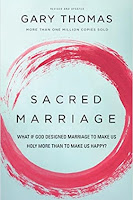
Sacred Marriage

Sacred Marriage, Gary Thomas (Revised ed. Zondervan, 2015)

Most marriage books fall into one of two categories:
Sacred Marriage is in the first category - exploring how marriage can make us more godly, and what it means to live in a way that honours Christ in our marriage. Thomas espouses a high, God-honouring view of marriage that esteems love, grace, forgiveness, and patience, as well as recognising the realities of sin, pain, and conflict.
“I believe that much of the dissatisfaction we experience in marriage comes from expecting too much from it.… God didn’t design marriage to compete with himself but to point us to himself.” (p. 27)
Christians are encouraged to see how God is using their marriage to grow them in Christ, in both the joys and the challenges.

It is not structured around the usual marriage topics (e.g. communication, conflict, intimacy), but rather around the ways we are shaped in marriage, e.g.:
  • marriage teaches us to love 
  • marriage teaches us to respect others 
  • marriage exposes our sin 
  • marriage builds perseverance 
  • marriage teaches us to forgive 
“What’s so fascinating about all of this is that what we need to develop to enjoy an intimate marriage – commitment, tenacity, perseverance – is exactly what scripture says we need to develop as faithful servants of God.“ (p. 103)
One things that struck me about this book was its applicability across the entire range of Christian marriage - new or mature, strong or struggling, growing well or close to shattering. It is relevant to each.

There are wonderful positive encouragements about what a God-honouring, long term, maturing marriage can be like:
  • “It’s wonderful when a husband and wife enjoy rich, fulfilling, and even exciting for sexual relations. And there is nothing wrong with having this as one of your goals. But alongside this goal – in fact, above this goal – should be the desire to become a better Christian. Use the marriage bed to learn how to serve another and how to deny yourself, and the spiritual benefits will be many“. (p. 181) 
  • “if we engage in marriage thoughtfully, purposefully, and with godly intentions, our wedlock will shape us in a way that few other life experiences can. It will usher us into God’s own presence.“ (p. 227) 
  • “It’s a journey that never really ends, but it takes at least the span of a decade for the sense of intimacy to really display itself in the marriage relationship.” (p. 102) 
  • “The stronger we grow as spouses, persevering and pressing further into our marriage, the more we’ll develop the very character traits we need to become mature believers” (p. 104) 
  • “If there is one thing young engaged couples need to hear, it’s that a good marriage is not something you find; it’s something you work for. It takes struggle. You must crucify your selfishness. You must at times confront and at other times confess. The practice of forgiveness is essential.” (p. 128) 
He is clear about how we are to treat each other, with love and respect, and is quite direct towards men (and women) who fail in this regard.
  • He argues that there is a case for viewing God as your heavenly father-in-law, because your spouse is a child of God. So, are we treating them that way? Aware of how much God loves them and cares for them, and notices how we treat them. 
  • In a marriage breakdown, to say “I never loved you”, is essentially to say, “I’ve never acted as a Christian”. (p. 41) 
  • “There are times when I must sacrifice my ambition to succeed in God service so I can be fully present and involved in the lives of my wife and children. Most assuredly, the tension should lead us to ask the question, “if I ignore God’s daughter (God’s son) to do God’s work, am I honouring God?”” (p. 231) 
His honesty about hard marriage could help those who struggle with whether it is worth it. He addresses many complex situations, including major conflict, betrayal, divorce and remarriage, and notes that a hard marriage can drive one to personal growth and reliance on Christ. He deals with these situations frankly but sensitively, also acknowledging that some marriages will rightfully end because of abuse, addition or adultery.
  • “Suffering is a necessary part of the Christian life… yet most of those who leave marriage and break its sacred history do so precisely because it’s tough… This tendency to avoid difficulty is a grave spiritual failing that can and often does keep us in Christian infancy.” (p. 124) 
  • “If your marriage is tough, get down on your knees and thank God that he has given you an opportunity for unparalleled spiritual growth. You have the prime potential to excel in Christian character and obedience.” (p. 125) 
  • The mature response “is not to leave a sinner (our spouse); it’s to change a sinner (ourselves). (p. 95) 
  • Second and later marriages are hard because “You’re not just marrying a new person; you’re neurologically trying to unmarry the previous spouse.” (p. 103) 
I realise these quotes might sound harsh, but they are not while reading in context. Some may want to hear that this season of struggle could still bear fruit.

While Thomas is real and honest about challenges, he overwhelmingly presents a positive view of marriage, hoping to increase our desire to serve Christ and grow in him, as we serve our spouse. It’s probably a touch on the long side, including numerous other writers and their opinions, sometimes at length. However, I found it easy to read, and very applicable. Obviously, it’s really only relevant for believers and those that are committed to their own spiritual growth as well as that of their spouses. Overall, an excellent encouragement that marriage is worth it, and that persisting through the joys and struggles will bear fruit now and into eternity.


Monday, January 4, 2021

I Still Do

I Still Do, Dave Harvey 

As far as I can tell, there aren’t many marriage books that focus on later life. For that reason, I was very excited to read this book and see how Harvey addressed the challenges that marriages face over the long haul.

While it is good and helpful, it isn’t as strong a treatment as I was hoping for. Harvey has also written When sinners say "I do", and this appears to be partially a corrective, noting that yes, two sinners are living together but that not all struggles in a marriage can be narrowed down to sin. 
"I want to help you identify profound factors that shape your marriage – influences that can’t so easily be traced back to sinful desires. We often encounter weaknesses or personality differences in marriage and instantly try to moralise them. We assign motives and then ascribe sin to spouse’s actions and omissions. But cultivating a durable marriage involves recognising that our brokenness is broader than sin."
"To thrive in marriage over the long haul we need to care for our spouse as a whole person. That means seeing how God’s good news speaks not only to their sin but also to their suffering, weakness, family history, disappointed dreams, physical limitations, and changes in sexual appetite."
He breaks the books into three sections: starting together, sticking together and ending together. He has structured chapters around the idea of ‘defining moments’, when you realise something crucial about your marriage, yourself or your partner.

Early chapters consider the realisation that our brokenness (and our spouse’s) is broader than sin and how we need to see our spouse as a whole person:
“The need to see our spouse as a whole person – a person full of sin and grace, weakness and strength; a person with a broken and beautiful human body wrapped around an eternal soul.”
He then looks at how we manage and accept blame and weakness in marriage, as he says: “Marriage is the union of two people on a journey to discover their weakness.”

The central section considers the moment when you realise family can’t replace church, which was helpful but focussed on the nuclear family (how you manage your children etc). It would have been interesting to see this extended to parents, in-laws and extended family and what it means to for us to prioritise the family of God.

I found this section the most helpful including how you face your spouse’s suffering, what it means for sex to change with age, and what it means to really understand mercy,
"Marriage, particularly an ageing one, becomes an awakening to the mercy of God. A place of safety where we see each other as God sees us (as we are, without any masks) and where we learn to respond to the way he does (with kindness and compassion). In this way, marriage becomes a sanctuary. For two people growing older together, it’s a reprieve from the world, a place of refuge – a home where two sinners can dwell peaceably in the comfort of mercy."
The final section considers when dreams disappoint as well as when the children leave. It was a shame that the focus in this chapter was on children who leave to marry, it could have been written in a way that made it broader, rather than just passing references to single children also moving out. Many couples have children leave home long before they are married, if they ever do, and it seemed a missed opportunity to consider that it more depth.
"Letting go of a son or daughter is a significant test. It reveals how much we trust God’s sovereignty in our kids’ lives; it reveals where our own emotional security is rooted; and it reveals, in a significant way, what we truly understand about leadership."

He finishes with the idea that closure is overrated.
“What does a married couple do when hard things continue, when the problems seem hopelessly open-ended? How do we make sense of situations where resolution would appear to bring so much glory to God? How do we go on when that experience remains elusive and unreachable, taunting our hopes? How should we respond when a lack of resolution becomes so oppressive and burdensome that a marriage risks collapsing under the strain?”
There is an honesty here about the struggles that some face over the course of a marriage, and an encouragement to realise some things never get tied up neatly in a bow.

In the end, there are good things covered here and these are certainly issues long term couples need to consider, but I felt the way it was written at times hindered rather than helped.

Firstly, while there are good principles, I felt the whole book stays one step away from hard practical application. The tables at the end of each chapter help to consider the content of each chapter, but there could have been more questions or things for couples to work through together. For example I think many readers would want more detail about the implications of their sex life changing, what it might look like and what continuing to love and serve each other with grace could look like in later years.

Secondly, while the topics he covers are good, I’m not convinced the wording used is the most helpful. I wonder if some Christians looking at the chapter headings might not immediately see the relevance for themselves.

Thirdly, there is an over-reliance on illustrations, and they often muddy the application rather than clarifying it. At one point over about five pages, he references King Tut’s beard, a hurricane, Star Wars, Hillbilly Elegy, CS Lewis, King Lear and John Owen. The final chapter is an extended retelling of Leo Tolstoy’s The Death of Ivan Ilyich, which seemed a convoluted way to finish. It might be readily applicable if you have read it and appreciated it but otherwise you have to do the work to understand that story and then figure out why it is being used. It would have been much more powerful and helpful if numerous illustrations and stories were dropped and instead direct use of God’s word and then application to marriage was prioritised.

This is a helpful treatment on marriage into later life, and one I will probably return to again in future years. Harvey has certainly emphasised the gospel of grace and mercy and how that can affect all aspects of marriage and life together. Taking time to identify and work though some of the defining moments of a marriage will have benefit for every couple, whether they have been married five years or fifty.

Monday, June 1, 2020

Where did my libido go?

Where did my libido go? Dr Rosie King

Please note: this review contains reasonably direct references to the sexual life of a married couple.

While not universal, it is not uncommon for wives to note that their desire for sex is lower than that of their husband. Australian doctor and sex therapist, Dr Rosie King has written this book to help women understand and address the differences in their sexual desire to that of their partners.

Her aim is to help women and their partners understand:
  • How sexual desire works
  • How to maximise libido
  • How to increase their sexual enjoyment and
  • How to create a regular, satisfying sex life even if they have low desire
She identifies the desire complaints she regularly receives, which fall into three categories:
  • I don’t want as much sex as I used to
  • I want sex, but not with my partner
  • I don’t want sex as often as my partner does
She then considers three cornerstones for overcoming low libido, so together with your husband you can work together to:
  • Maximise your sexual desire
  • Ensure your relationship is happy and healthy
  • Make your sexual activity as enjoyable as possible
King then explores the natural range of desire that women feel, and how it can be affected by life circumstances and stages of a relationship. She analyses some of the chemistry and biology behind desire, and what generally are the inhibitors or enhancers of desire for both men and women.

She explores the question that many women ask: “what’s wrong with my libido?”, especially when they compare it to their partner’s. She helpfully explores the following statements:
  • For him sex is relaxing, for her it’s hard work
  • His desire is robust, for her it’s conditional
  • Stress kills off her sex drive, but not his
She explores medicinal options including testosterone therapy, although concludes it should only be used with reasonable caution. She also considers how the media has unhelpfully contributed to the idea that all women should be interested in sex (much of what she is referring to is mainstream media as well as pornography). She notes how the pendulum has swung completely, for pre-1960s it was assumed women were not interested in sex, in fact there were thought odd if they were. Now with the sexual revolution it has gone completely the other way, with the assumption that all women want and get great sex. As she dryly notes, “we have progressed from the Victorian idea of sex as a marital obligation to be endured by women to the modern notion that all women should be sex-crazy.”

She spends some time considering that numerous women in happy relationships are open to sex, and enjoy it when it happens, but rarely pursue it: “they no longer feel levels of lust high enough to motivate them to initiate sex with their partners. This is such a common scenario it must be considered normal.” In this case, often desire comes after arousal, not before, and so changing expectations around desire can help, as “it is not a prerequisite for enjoyable sex”. This is one of the most helpful observations of the book, along with the further explanation and mindset that accompanies it.

She introduces the idea of the pursuer-distancer cycle, and its impacts on a couple. There are helpful analyses here of how both pursuers and distances relate, and what happens when ‘mercy sex’ is granted, when the distancer does not want it but does so out of guilt or other motivations. She encourages both partners to stop blaming and rather establish goodwill, being able to see the situation from both perspectives.

Part 2 turns towards maximising your desire and arousal. When considering desire, she encourages couples to consider the physical, psychological and contextual factors that inhibit their desire, and then turns to relationship and sexual inhibitors, considering ways to address each.

This includes healing your relationship, by fostering goodwill: “Goodwill is the key to a happy relationship and a fulfilling sex life.” There are ways provided to assess your relationship, how much goodwill you have and whether you really need professional help. Then she progresses to ways to increase goodwill, including an attitude of gratitude and appreciation, identifying and avoiding resentment, and communicating love. She considers Chapman’s love languages as well as some of Gottman’s ideas here. Obviously, increasing the overall quality of relationship comes prior to re-establishing a satisfying sex life.

There is a chapter about the male and female bodies, including considering one’s own sex-related inhibitors, with detailed explanations of the form and function of the male and female genitals.

She then works through three things to help:
  • Create the right conditions for sex
  • Create a strong focus on erotic pleasure (she is open to pornography use here), and there are detailed exercises for individuals and couples to use (there are some similarities here to what Patricia Weerakoon suggests for couples)
  • Ensure one is adequately stimulated (she supports fantasy and pornography use)
Part Three turns to balancing your sex drives, and stopping the pursuer-distancer cycle. This will be helpful for couples who are able to communicate about these things. She then consider why we have sex at all, and how to make it easier to say yes to sex, including the concept of good enough sex, being "an enjoyable emotional and physical connection between two people who care for each other".

I don’t tend to read many non-Christian books about sexual intimacy, as there are likely to be numerous things I disagree with or would not recommend. At some points this is the case, including her suggestions to potentially use pornography and fantasy as stimulation, regular use of masturbation for the higher desire partner, a brief comment about the possibility of open marriages (although she acknowledges few people can actually do this) and the suggestion that ‘outercourse’ is a good safe-sex option for teens. But, these are not the main parts of the book, and all her suggestions can be utilised without these options.

However, taking those things into consideration, this is a very helpful book. For those women that experience a ‘desire discrepancy’ from that of their husband, they are likely to find much here to be of help. Whether it’s her honest assessment of some situations (there will be couples who have not have sex for years, and the wife does not want to at all) or her openness about the benefit of change, couples who are stuck in their sexual relationship (or lack of it) may find much of help here.

Monday, February 24, 2020

With These Words

With These Words, Rob Flood

Marriage books abound, indeed our own shelves are loaded with them. Yet, Rob Flood has made a valuable addition to the collection, with this focussed look at communication. He opens with an honest account of the hard early years of his own marriage, that started with a dreadful fight on their honeymoon. It took a concerted effort and lots of time, but he now reports 20 years later:
“Let me be clear: God saved our marriage; we did not. God grew our communication; the tools did not. We are very much still in process...We still have struggles with communication and find ourselves still stinging every now and then from past hurts. The difference is this: There is grace now. There is charity toward one another. There is the benefit of the doubt. There are follow-up questions before there are conclusions. There is not perfection, but there is health. This is all because of God’s grace working through our devotion to the Lordship of Christ and the application of basic communication tools.”
As he started, I appreciated the wise qualifying statement that more marriage books should probably have:
“The principles and truths contained in this book are useful for most couples. However, they are not intended to be a substitute for pastoral care, for the fellowship of the saints, nor for civil authorities when that is appropriate”
He has broken the book into three section, the first Truth for Communication, covers the biblical foundation over three shortish chapters. He outlines four principles for communication:

  1. We should speak so people encounter God.
  2. We should build up with our words not tears down
  3. We should speak in a way that fits the occasion.
  4. We should give grace to others through our words

“For example, there is no room in Christianity, let alone in marriage, for venting. Venting is for the benefit of the speaker. It spews without concern for how the words land or what impact the words have.”
He examines what it means to be a fool in this area, noting that any step away from God is the step of a fool.

  1. Fools do not seek understanding
  2. Fools rush to judgement
  3. Fools look for a fight
  4. Fools sow discord

I appreciated his observation that we can be fools with our tongues while still following God in our bible reading plan. Our wisdom in some areas can blind us to our foolishness in others.

Section 2: Tools for Communication is where it starts to get more practical. Flood introduces 5 tools, and fleshes them out in practical ways.

1. The tool of first response

He notes that “the course of a conflict is determined by the person who responds, not the one who initiates.” He also notes that rarely do we want to respond well, but we need to acknowledge that offences will happen, but escalating never helps and God is greater that the degree of offence..
“An eternal focus empowers you to respond to your husband or wife with mercy, kindness, humility, understanding, compassion, and patience. It acknowledges that the world neither rises nor falls on how each specific issue gets played out.” 
“Purposeful marital communication plays the long game. You’re going to be spending the rest of your lives together. A time will come when emotions are not quite as charged, when the stakes are not quite as high. As husbands or wives, our focus is on the long haul. As Christians, our focus is eternal. We willingly embrace the reality that we all are being sanctified and will be ever changing, as we are ever in need of change.”
2. The tool of prayer. He recommends prayer before an important conversation, but even more so, to stop and pray when things starts to get heated. I suspect this is one that will be the most challenging for many couples, especially those who do not pray regularly together. In order to combat that, he says: “The beginning of successful marital prayer is this: pray as a married couple. Just start praying.”

3. The tool of physical touch. The idea here is that you start a conversation actually touching. This will also be a challenging idea for some couples. It’s true that if you physically start to pull away from each, that is a sign that conversation is not going well. Indeed, many couples probably know that a disagreement is dealt with when you can touch:
“How will you know you’ve been reconciled and the unity of your relationship has been restored? It is often not in the moment one spouse extends forgiveness. That may be the most important part, but it is not the clearest way to know. You’ll know when you can affectionately touch again.
4. The tool of mirroring. This is the idea of reflective listening. I’ll be honest, I’m not a big fan of this (and neither is Gottman), but I know it can work well for some people.

5. The tool of proper timing. Flood notes that we usually manage this well at work, or in a delicate situation with a friend, or a neighbour, but we often do it poorly in marriage. We need to learn to negotiate the times of chaos, fatigue, charged emotion, vulnerability, and be purposeful in finding times for communication.
“The principle here is simple: words are intended for moments, and the skillful communicator learns how to bring words and moments together.”
Section 3: Working It Out puts it all together- so that couples can “learn how to move forward safely, successfully, and soundly in the will of God.” As he notes:
“Solutions in marriage are not “one size fits all.” While biblical instruction and biblical wisdom are intended for all people, what that looks like in the nitty-gritty of life will vary widely from one couple to another, from one home to another, from one church to another, from one culture to another, and from one era to another.”
He essentially returns to the truths of the gospel, and how we are called to live in light of that, challenging spouses to be forgiving and compassionate and have that define their marriage, despite the realities of sin that we each face:
“Your sinful motivations will creep through and corrupt your implementation of these communication tools. Your patience will run out, and you will strike back rather than forgive. Your weaknesses will be revealed as you feel strained by your efforts. This is true regardless of the way your spouse participates in this book or in your marriage.” 
“Your spouse has weaknesses. Your spouse has besetting sins. Those weaknesses and sins are going to overflow onto and into your life. You will respond; that much is certain. The question is how? Will you respond as someone who has never been reconciled to God, or will you respond as one who is chosen and dearly loved by God? Will we love as the rest of the world loves, or will we choose to love as Christ loves?”

There are insightful questions to work through at the end of each chapter, which will really help couples apply it and consider their own strengths and weaknesses. Couples who read it together will benefit greatly. Even one spouse who reads it and tries to apply it will find positive change can be enacted.

Overall, this is an excellent book, strongly grounding marriage communication in the truths of the gospel and how we are called to use our speech in ways that honour Christ.

I received an ecopy of this book in exchange for an honest review. 

Monday, October 23, 2017

It Takes One To Tango

It Takes One to Tango, Winifred M. Reilly

As many of you know we’re involved in marriage ministry and so I try to keep up with reading. Sometimes this means I grab books off the library shelves to see what secular titles are on offer. It’s good to have a wide range of recommendations.

This one caught my eye with its subtitle “How I Rescued My Marriage with (Almost) No Help from My Spouse – and How You Can, Too”.

Reilly takes the reader on a journey, explaining both her own marriage and its near demise; and also draws on her experience as a marriage therapist. She starts by debunking the myth that marriage should be easier:
Most people believe that marriage should be easier than it is. It’s one of the great myths … No one told me the one thing that would have helped me the most: “It isn’t just you. Marriage is hard.”
She also challenges a widely-held view that you both must be willing to change for any progress to occur. The core of her message is that change has to start with you, not your spouse. Stop focusing on what they do that is wrong, annoying, irritating, etc, and work on yourself instead. Figure out what you add to conflict, why you fight the way you do, what pushes your buttons. You are responsible for yourself alone, so take charge.

She draws strongly on Bowen family theory so there were strong echoes to things I had read in Jenny Brown’s Growing Yourself Up. I also appreciated her analysis of the stages of a relationship (from Ellyn Bader) which move through four stages:

  • Symbiosis - high interconnectedness (in those early heady stages of in-love),
  • Differentiation - seeing the differences and struggling to resolve them
  • Exploration – developing separate selves, own interests and needs, and having more independence
  • Rapprochement – turning back towards each other with more connectedness

A lot in this analysis made sense, especially how it is at differentiation where most problems lie and where many couples become stuck.

She moves through three sections – how to identify the real problem, how to implement change by yourself, and how this will develop into a stronger relationship.

She identifies the cause of many problems: “Anxiety is at the root of most of the craziness that goes on in our relationships”. The time she takes to consider this is well worthwhile. One comment really struck me, quoting trauma expert Dr Noel Larson: “if it’s hysterical, it’s historical” – if some issue really sets either of you off, there’s a reason why.

A lot of what she says makes perfect sense: you have to be in control of yourself and manage your own reactions; take a break from conflict and find ways to dampen it rather than escalate it; and you have to develop your own self-soothing and self-management and not expect your partner to meet those needs. None of this is new, and for those of us who are Christian, there are similar elements of what we would expect a marriage to look like: seek to serve each other, not yourself; manage your anger; be self-controlled; exhibit the fruits of the spirit in your marriage as well as the rest of your life. While she doesn’t label it as such; there are also ideas of giving forgiveness, extending grace and not bearing a grudge.

I would recommend this book particularly to:

  • Non-Christians. Most of the books I read are Christian and that doesn’t sit well with everyone. But there is good general wisdom out there, and this book has it. She doesn’t assume couples are married, and includes same-sex couples in her stories, thus widening the audience appeal.
  • Couples who are mired in conflict. Some marriage books assume that goodwill, grace and forgiveness is occurring between couples. Some don’t get to the nitty-gritty of what to do when you are mired in bad patterns of relating. The stories she tells of her own and her client’s marriages are real and raw, they are honest yet give hope of ways forward.

I’m glad I picked it up!