Friday, February 10, 2012

The Poisonwood Bible

The Poisonwood Bible, Barbara Kingsolver

This is a literary masterpiece, both the writing and the story itself.

Written from 5 different perspectives: Orleanna Price, the wife of a Baptist missionary, and their 4 daughters, it weaves the story of their mission to the Congo in the 1950s and how it affects every aspect of their lives from that moment on.

I read it over 10 years ago and have recently read it again. Yet again I found it incredibly moving and somewhat exhausting to read. For the last third I could only manage a chapter or two a sitting.

Kingsolver’s writing is wonderful: her turn of phrase, her insight and her intelligence shine throughout the pages. Almost every chapter had something I could have written down as a quote to keep.  Her insights into religion, politics, race, Africa and America are wide-ranging and well informed.

Yet it’s devastating. Nathan Price, the husband and father is a fierce, fiery man, preaching hell-fire and damnation to all, never showing love to his wife, daughters or the people of Africa, and thinking himself absolutely correct in all matters of faith and the bible. In many ways he is a parody, yet a disturbingly realistic one.

With the setting in the Congo, we are given a picture of Africa which many of us are uncomfortable with: rife with corruption and greed, a puppet of the west, overwhelmed with poverty and desperation.

Just as I found The Rector’s Wife hard going from a personal perspective, I found this very hard reading as I thought more broadly about mission and how it interacts with other cultures.   We know many missionaries and they are nothing like Nathan Price; they are loving, caring people, devoted to the country they live in and its people, desiring to share Jesus with them in appropriate ways.  A book like this actually undoes much of that and there are many people who I hope never read it, for it would confirm in their minds already ill-conceived ideas about mission.

But as a fiction and a work of literature, it is wonderful.

Wednesday, February 8, 2012

For the longest time...

I moved a lot as a child. Dad had a job which required a lot of international moves, so we moved every 1-3 years. When I finished school I had attended 7 schools and lived in 9* houses. By the time we got married, went to college and moved to our current house, the number of houses had risen to 14. That averaged one house for every two years of my life.

Since the end of last year we have been in our house for 7 years. This house in Adelaide, which we love and which is lovingly provided by the church Husband works for - is the winner: “The house that Wendy has lived in the longest”.

Having moved so much has made me realise a few things:

1. Kids are resilient. More resilient than we often given them credit for. I was a painfully shy creature, yet I coped with move after move (I know, not all children will). For me, moving lots during primary school was no real problem, it was when we got to upper high school that it got really hard.

2. I plot the events of my childhood and remember things according to where I was living (either house or city), or which school I was at. For my husband, who attended 2 schools and lived in one house, this doesn’t work for him.

3. Family are very important. The reason I coped as well as I did was because we had a very close family. The four of us were all we needed to be happy, and we were. I had an extremely close relationship with my sister, we had to be each other’s friends until we met new friends in the new school.

4. I am always planning the next move. Until very recently we kept all boxes for appliances and everything that might need to be repacked. I often think about what I will throw out when we move.  Only in the last month have I thrown out a whole lot of this stuff.

5. Just this last year I have realised that when you are in a house for 7 years, it and the furniture & things in it really need a full clean every few years. You can’t just plan to do it properly when you move. Now I clean it because I want to live in it with it that clean.

I wonder how long it will take to get “the next move” out of my mind, or if it will always be part of who I am? 


* to be precise, there were more than 9 houses - but these include rentals during renovations, etc. 

Monday, February 6, 2012

Who is your king?

A well-needed reminder came to me via yesterday's sermon:
What message is your life and your lips sending to others?

Do they know by watching your life and your speech that Jesus is your King?

Or, does it appear that your kids, your house, your job, your appearance or your personal happiness is your King?

Who is your King?

Friday, February 3, 2012

The Novel in the Viola

The Novel in the Viola, Natasha Solomons

A trip to my mum’s over the holidays provided much of the fiction I am reviewing at the moment, and I’m glad it did, because otherwise I would probably not have bothered to pick up another novel by Natasha Solomons. Mr Rosenblum’s List was a nice book, but I didn’t love it. Her second novel, The Novel in the Viola, I really enjoyed.

Returning to a similar theme of Mr Rosenblum, that of European Jews fleeing to England in the 1930s, this time it is the story of Elise Landau. From a wealthy Viennese family, she is forced to become a parlour maid in an English country house, Tyneford, in order to secure a visa and escape Austria. However, war is looming, times & traditions are changing, and the ordered life of Tyneford is starting to buckle. While normally any interaction between the family and staff is forbidden, Elise and Kit, the heir to the manor, realise that love does not care for class distinctions. This is the novel I read after The Help, which left me pondering the many people who have ‘served’ the wealthy: the black Americans, the poorer English, etc. Our society contains many class distinctions.

This is a gentle novel. It is sad in many ways, and talks about times of real grief and suffering, yet it eases us into them. I enjoyed the insight into English life in the 1930s and wartime, and Solomons’ writing style is lovely - evocative and gentle.   Perfect for the time in which the novel is set.

If you enjoyed Mr Solomon’s List, you will really like this one.

Thursday, February 2, 2012

Just a piece of paper?

Sometimes you are struck by 2 opposing opinions – one that summarises the culture that you live in and one that shows you its faults.

As you know I have been reading The Meaning of Marriage. At the same time, Husband and I have been re-watching the ABC show SeaChange.
 
What struck me was a scene between Harold and Meredith talking about marriage:
“We still have what we’ve got Hal, we don’t need a silly bit of paper.”
She goes on to say:
“There are advantages to this arrangement you know Hal. I’ve got my independence and you’ve got yours. Whatever’s between us is freely given, there are no obligations, no conditions, we’re absolutely free to be ourselves.”

Contrast it with this quote from Keller on exactly the same idea that “we don’t need a piece of paper” (ie a marriage certificate).
When the Bible speaks of love, it measures it primarily not by how much you want to receive but by how much you are willing to give of yourself to someone. How much are you willing to lose for the sake of this person? How much of your freedom are you willing to forsake? How much of your precious time, emotion, and resources are you willing to invest in this person? And for that, the marriage vow is not just helpful but it is even a test. In so many cases, when one person says to another,”I love you, but let’s not ruin it by getting married,” that person really means, “I don’t love you enough to close off all my options. I don’t love you enough to give myself to you that thoroughly.” To say, “I don’t need a piece of paper to love you” is basically to say, “My love for you has not reached the marriage level.”. (p78)


I'll side with Keller on this one.

Wednesday, February 1, 2012

The Meaning of Marriage (Part 3 of 3)

Today, we continue with the second half of The Meaning of Marriage by Timothy and Kathy Keller.  (first half review here)

In Chapter 4: The Mission of Marriage, Keller seeks to answer the question: what is marriage for? He decides: it is a way for two friends to help each other continue to become the people God wants them to be. This chapter started with some excellent insights into Christian friendship, which have a much wider application than marriage. True friendship provides transparency and constancy: we are open with real friends and we stand by one another. When this friendship becomes the heart of our marriage, we stand by one another as we continue to grow in Christ.
In this view of marriage, each person says to the other, “I see all your flaws, imperfections, weaknesses, dependencies. But underneath them all I see growing the person God wants you to be.”… You want to help your spouse become the person God wants them to be. (p122-3)
On a personal note, this has put into words what my husband and I have been trying to figure out for years. What was it that made us decide that marriage was the right decision for us? We didn’t really know what each of us would be like as a spouse or parent and in many ways we had no idea what we were getting ourselves into. But we could see a clue of how God was working in each other and we decided we wanted to be a part of that.

This also provides insight for those who are seeking a marriage partner.   A Christian friend is the first place to look, if friendship is there, you could then consider marriage.  This is a much better way than seeking someone you are attracted to first, then checking to see whether a true friendship will follow.

Marriage is incredibly powerful and therefore it must have the priority in your life:
Marriage has the power to set the course of your life as a whole. If your marriage is strong, even if all the circumstances in your life around you are filled with trouble and weakness, it won’t matter. You will be able to move out into the world in strength. However, if our marriage is weak, even if all the circumstances in your life around you are marked by success and strength, it won’t matter. You will move out into the world in weakness. Marriage has that kind of power – the power to set the course of your whole life. (p 131, my emphasis)

In Chapter 5: Loving the Stranger, Keller follows on with this idea and presents 3 ways to help a couple on the journey of becoming the people God wants them to be: the power of truth, the power of love and the power of grace. 

Marriage brings you truth – the truth about who you really are.
Marriage shows you are realistic, unflattering picture of who you are and then takes you by the scruff of the neck and forces you to pay attention to it. (p140)
At the same time, marriage also has the power of love “an unmatched power to affirm you and heal you of the deepest wounds and hurts of your life. (p146) For example, even if you have never felt you are beautiful, the affirmation of a spouse who insists you are beautiful will finally help you to believe it. Of course, there is a warning here for us all – our power as a spouse to hurt is far greater than the power of any other person:
The one person in the whole world who holds your heart in her hand, whose approval and affirmation you most long for and need, is the one who is hurt more deeply by your sins than anyone else on the planet. (p162)

We need to figure out how to balance both truth and love in a marriage, so that we address issues truthfully, but also in love and carefully. For this we need grace. Two of the most important skills in marriage are forgiveness and repentance. “Only if we are very good at forgiving and very good at repenting can truth and love be kept together” (p163). We only have this power because we follow the example of Christ and his saving death for us:
A deep experience of the grace of God knowledge that you are sinner saved by grace – will enable the power of truth and love to work together in your marriage. (p168)
This is a helpful chapter which highlights the power you hold as a spouse, and how we must use it very carefully, and for good.


In Chapter 6: Embracing the Other, Kathy Keller becomes the primary voice. Here she discusses the differences of men and women in marriage and the problem such differences can create. She goes on to explain the bible passages that point towards a complementarian view of marriage and then fleshes out some practical ways that may look in a marriage. To be honest, I tend to skim over these chapters in marriage books now, I agree with it so I don’t interact with it too closely. However, they do include a helpful appendix on Decision Making and Gender Roles. We find that most engaged and newly married couples think decision making is the main way that a marriage based on the Ephesians 5 model of headship and submission is defined. We are quick to point out that headship and submission is so much more than decision making, and in fact it is rarely about decision making. However in including the appendix, the Kellers have provided a helpful framework for couples working through this issue.

In Chapter 7: Singleness and Marriage, Keller covers singleness, bringing 1 Corinthians 7 into focus. What he says here is helpful – that Christian society should not elevate marriage to a special status when your life truly begins, but neither should we shun marriage for our careers or until we find a perfect mate – which we never will. He talks about some principles for dating and also some practical guidance for those who are single and potentially seeking marriage. Some of these I thought were helpful, they included:
  • there are seasons not to seek marriage – upheaval, transitions, etc
  • understand the gift of singleness - that is that there are some increased opportunities for ministry that singleness brings
  • seek marriage more seriously as you get older, and understand that others do the same. How you behave in a dating relationship is different at 18 than it is at 35.
  • do not allow involvement with an unbeliever (Kathy Keller summarises her main points in this recent blog post)

In the final chapter, Chapter 8: Sex and Marriage, Keller looks at the role of sex in a marriage, and finds it is a crucial part, which binds two people together:
Sex is perhaps the most powerful God-created way to help you give your entire self to another human being. Sex is God’s appointed way for two people to reciprocally say to one another, “I belong completely, permanently and exclusively to you”. You must not use sex for anything less. (p223-4)
They present a very healthy and positive view of sex within the framework of marriage. They exhort people to wait until they are married, and then to enjoy sex and all its benefits, and to continue to make sex a priority in a marriage.


I highly recommend this book. As I said on Monday, it is useful for anyone who wants to think about marriage from God’s perspective. Read it and be encouraged by the vision of how good marriage can be. Then, for those who are married, think about how this can change your marriage for the better.

Tuesday, January 31, 2012

The Meaning of Marriage (Part 2 of 3)

After yesterday’s brief review of The Meaning of Marriage, today I will go through the first half in more detail:

In Chapter 1: The Secret of Marriage, Keller states that secret of marriage is the gospel, for the gospel helps us to understand marriage and marriage helps us to understand the gospel. It is through the gospel that we find the power and the pattern for marriage:
God’s saving love in Christ...is marked by both radical truthfulness about who we are and yet also radical, unconditional commitment to us. (p48)
The truth and love combined in the gospel gives us the power and the knowledge of how to be married.

It is true that marriage is hard work, but it is worth it:
Marriage is glorious but hard. It’s a burning joy and strength, and yet it is also blood, sweat, and tears, humbling defeats and exhausting victories. (p21)
Keller also deals with a very helpful misconception in this chapter: the idea that we have to find our soul mate, the perfect person to marry. No, he says, we never marry the ‘right person’. For 2 reasons: we change throughout our lives and we are sinful.


In Chapter 2: The Power for Marriage, Keller unpacks the idea that is in the Holy Spirit who helps us to have the power for marriage, working against the main enemy of marriage – the sinful self-centredness of our hearts.
Only if you have the ministry of the Spirit in your life will you be fully furnished to face the challenges of marriage in general. And only if you are filled with the Spirit will you have all you need to perform the duty of serving your spouse in particular. (p52-3)
He challenges us to look at the reasons for issues in a marriage:
When facing any problem in marriage, the first thing you look for at the base of it is, in some measure, self-centredness and an unwillingness to serve or minister to the other. (p59)
Making it a priority to know, fear and serve the Lord Jesus gives us power and strength for this type of marriage and helps us to continue to want to serve the other and let go of our self-centredness.

I found this chapter particularly helpful in thinking through where many issues in marriage come from – our desire to put ourselves first, rather than serve first.


Chapter 3: The Essence of Marriage helps us to consider what is at the centre of marriage – love. But so much more than that – a covenantal love. A love that is a promise and a commitment, a love that promises to last the future, not just the present.
When the Bible speaks of love, it measures it primarily not by how much you want to receive but by how much you are willing to give of yourself to someone. How much are you willing to lose for the sake of this person? How much of your freedom are you willing to forsake? How much of your precious time, emotion, and resources are you willing to invest in this person? (p78)
A marriage is a covenant relationship, one is that is a covenant made both between two people, but also between a person and God. In the marriage ceremony you make promises before God: “Will you take this woman to be your wife?” is not answered to the wife, but to God: “I will”. Then you make promises to each other.
[A covenant] is a relationship far more intimate and personal that a merely legal, business relationship. Yet at the same time, it is far more durable, binding and unconditional that one based on mere feeling and affection. A covenant relationship is a stunning blend of law and love. (p84, my emphasis)
Not only that but the covenant love of a marriage declares much more that a current love for one another, but a future intention to continue to love:
In a wedding you stand up before God, your family, and all the main institutions of society, and you promise to be loving, faithful and true to the other person in the future, regardless of undulating internal feelings or external circumstances. (p87)
Therefore in any marriage, there will be times when we must choose to continue to love our spouses, when it doesn’t come easily. Love at this point is action, not feeling. It is decision to follow through on the promise previously made.


Each of these chapters had helpful insights both for me and others whom we talk about marriage with. Lots to think about and lots to work on!

More coming tomorrow...


Monday, January 30, 2012

The Meaning of Marriage (Part 1)

The Meaning of Marriage, Timothy Keller with Kathy Keller

Another book on marriage has entered the Christian world and it is a good one.  

Timothy Keller has done his Christian audience a great service with this book. This is not another ‘how to be married book’: how to communicate, how to deal with arguments, etc.  Those types of books do have great value, especially for those who are engaged or in the early years of marriage (one of our recent favourites is Now That You Are Engaged reviewed here).

What Keller has done is to lift our vision of marriage much higher that just the husband and wife. He places God squarely at the centre of every marriage and as the creator of marriage.

He seeks to provide an answer to questions such as: What is meaning of marriage? Why does marriage exist? What does it mean to enter a covenant? What is Christian friendship, and how does it find its fullest expression in marriage? Where does the power to continue in marriage come from? How then shall we view singleness?

Keller strongly grounds this work in the word of God, and ends up providing a very helpful framework of marriage as being a relationship of Christian friendship, promised in a covenant of love, powered by the Holy Spirit.

Last year, I reviewed Married for God by Christopher Ash in some detail. At the time I thought it filled a void in the market for marriage books: one that actually described marriage from God’s perspective. This one stands beside it well.

It would be very good for:
  • already married couples to raise their eyes to the purpose of their relationship
  • for engaged couples, to give them a solid grounding in God’s view of marriage and the importance of the relationship
  • for anyone wanting to think ‘theologically’ about marriage
  • for young people, to ensure they have a God-centred view of marriage as they approach their relationships and life choices.

I think is probably an easier read than Married for God and I found it more logical on some points.  Personally, I also found it more encouraging and less dry.

All in all a very good book for anyone who wants to think about marriage theologically. Which all of us should!

Over the next two days, I will delve into this book in a bit more depth, covering Ch 1-3 tomorrow and Ch 4-8 on Wednesday. That gives me a chance to think through it more, and to whet your appetite to read it yourself! 

Friday, January 27, 2012

The Help

The Help, Kathryn Stockett

This is Kathryn Stockett’s debut novel. And what a debut - this is a strong, intelligent book.

It’s Jackson, Mississippi in 1962 and Miss Skeeter is home from college wanting to be a journalist, yet having failed (in her mother’s eyes) to find a husband. The woman who raised her, the coloured help Constantine, has gone with no explanation. At the same time, two other maids, Aibileen and Minny work for her friends. They raise the children, care for the home and cook for everyone, yet are expected to use separate bathrooms to their white employers.

As Skeeter starts to question the very life into which she has been born - the segregated south - she, Aibileen and Minny embark on a journey to tell the story of the ‘help’.

It’s poignant, sad, astonishing, frightening and funny. It makes you question how white people could possibly be so ignorant and racist. Then you stop to think about the history of the USA, Australia, South Africa, Europe, etc and you realise that we have been at it for many years. Having said that, next week’s book (The Novel in the Viola) reminded me that race may actually have nothing to do with it, but rather money or status - more to come on that!

This book is well worth the read, both for the wonderful piece of writing that it is, but also for the eye-opening piece of history that it offers.

Monday, January 23, 2012

The Promise

The Promise

Do you have any understanding of the Arab/Israeli situation?  How it all started in the late 1940s and how it looks today?   I don't, never having looked into it in detail or understood the small amount I knew.  Now I'm sure TV dramas don't get all details right, but I really enjoyed this and it opened my eyes into some of the complexities of the situation.

The Promise is a 4 part drama series that was screened by SBS towards the end of last year.   

It combines two stories.  The first is of Len, a British soldier part of the post-WWII peace-keeping force in Palestine.  At the time when Jews were fleeing Europe after the horrors of WWII, those who chose to settle in Palestine often clashed with the Palestinians living there.   He has sympathies for the Jews having witnessed some of the atrocities of concentration camps; yet also befriends an Arab, Mohammed and becomes involved with his family.

At the same time, we meet Claire, Len's granddaughter, who has discovered his diary of those days.  Travelling to Israel on a gap year with a friend, and hosted by her rich Israeli family, she sets out to track down Mohammed's family.  Travelling to the West Bank, Hebron and Gaza, her eyes are opened into the current situation in Israel today. I wouldn't have thought any 18 year old would be quite as blithely stupid as she was wandering into war zones, yet then, you never know - at 18 you do think you are invincible! 

I found it very interesting, very moving and quite believable.  It managed to convey both sides of the issues well, although I think in the end the Israelis ended up looking worse.  I cannot comment on the accuracy, but I appreciated some of the insights.

It's no longer on the SBS website, but my guess is they will show it again in 2012.  More details are on the British Channel 4 website.  Look out for it on TV, or in your local library.

Friday, January 20, 2012

Jane Austen in Scarsdale

Jane Austen in Scarsdale, Paula Marantz Cohen

Is it true there are very few original stories out there?

Why is there an enduring literary obsession with Jane Austen?

I must say I don't fully understand it, but sometimes I do enjoy it. Jane Austen in Scarsdale is Paula Marantz Cohen's modern version of Persuasion.  Anne fell in love with Ben at 21 but her family persuaded her that he wasn't good enough.  Thirteen years later she is working as a high school guidance counselor and Ben re-enters her life when his nephew enrols at the school.

For those who know the story you can, of course, predict the ending. 

It is lovely, light and witty reading: a love story with astute observations about students and parents thrown in for entertainment.  Perfect for a summer holiday or a lazy afternoon.


* If anyone has a copy of Jane Austen in Boca, a Pride and Prejudice rewrite, I would love to borrow it - no library near me seems to have it!

Friday, December 16, 2011

Some pre-schooler books

A number of recent trips to the library have turned up some treasures in the pre-school book department.  

Firstly, a new offering from the great team of Giles Andreae and David Wojtowycz, Mad About Minibeasts.  We love their previous books, including Rumble in the Jungle and Commotion in the Ocean.

Mad About Minibeasts opens up the world of insects to young children in their usual rhyming, colourful way.


Another new one this year is Too Hot to Hug!   Rupert finds a golden egg, from which hatches a baby fire dragon.  At first, Crumpet is crumpety warm, he dries the washing and keeps the family snug.  But as he grows bigger and the weather gets warmer, Crumpet gets too hot to hug and starts causing problems.

A very cute story, with gorgeous expressive illustrations.
 
The Pencil is written by Allan Ahlberg (of Peepo fame). This very clever book starts with a solitary pencil, who begins to draw and create a boy, a dog, a cat, and then all the things they want and ask for.  Colour arrives when the pencil draws a paintbrush to help him.  Peace is threatened when everyone gets too demanding and he draws a rubber which only makes things worse. 

This is a funny, clever book and the kids loved the ideas behind it.

Friday, December 9, 2011

At Home

At Home, Bill Bryson
  • Why are salt and pepper are the two spices on our dinner tables, rather than for example, chilli and cinnamon?
  • Why are there 3 odd buttons on the sleeves of men's jackets?
  • How were bodies disposed of prior to pleasant lawn cemeteries and crematoriums?
  • Why do you pay for 'room and board'? What is the board?
Ever wondered how the things we take for granted today came about? So did Bill Bryson and his newest offering answers these and many other questions. Using his own home as a springboard (a 150 year old rectory in rural England) Bryson has researched the history of the home. As he works through each room in the house, we are treated to the history of how it came to be, how society changed around it and how life and ways of living have changed over the last few centuries. Full of his usual wit and storytelling skills, Bryson imparts a fantastic amount of information, all the while making it readable and entertaining.

I have long been a fan of Bryson, especially enjoying Down Under and A Short History of Nearly Everything. This one does not disappoint.


Friday, December 2, 2011

The Warden

The Warden, Anthony Trollope

Another Trollope has made it onto my reading list! Anthony Trollope (1815-1882) wrote the Chronicles of Barsetshire, a series depicting ecclesiastical life in England in the 1800s. This one, The Warden is the first in the series.

You might wonder how easy it is to read a book written in 1855. The book I read was wonderfully edited by Geoffrey Harvey and is well annotated to explain the references that Trollope uses, mostly ecclesiastical, political or literary comments on his day. It takes more work than a modern writer because you have to think about the language a little more, which means you read it more slowly. However I think it’s easier to read than a Jane Austen.

It is witty, clever, and very insightful. His comments on the clergy, marriage, politicians and the power of the news are just as entertaining today as they would have been to his original readers.

The Warden is Rev. Harding, the caretaker of a small poorhouse, designed by a will to take care of older men at the end of their days. As part of the position, he draws a very comfortable salary. As a local reformer (and courtier of his daughter) of the church rallies against him, decrying the church’s abuse of position and power, he is left is a moral quandary of whether or not he is entitled to the income and how to proceed as a result. At the same time, he is bullied by his archdeacon (also his son-in-law), who strongly believes all privilege of the church of England is the right of its clergymen.

Here is a taste for you.

His comments on newspapers and their editors (Tom Towers is the editor and the Jupiter is the main paper of the day):
“[Tom Towers] loved to sit silent in a corner of his club and listen to the loud chatterings of politicians, and to think how they were all in his power – how he could smite the loudest of them, were it worth his while to raise his pen for such a purpose… Ministers courted him, though perhaps they knew not his name; bishops feared him; judges doubted their own verdicts unless he confirmed them; and generals, in their councils of war, did not consider more deeply what the enemy would do, that what the Jupiter would say… It is possible that Tom Towers considered himself the most important man in Europe; and so he walked on from day to day, studiously striving to look a man, but knowing within his breast that he was a God.” (p168)
Describing the archdeacon:
The archdeacon took up his shining new clerical hat, and put on his black clerical gloves, and looked, heavy, respectable, decorous, and opulent, a decided clergyman of the church of England, every inch of him. (p210-11)

I’m not going to read all 6 novels straight away, but will take them in small doses when I feel like thinking a bit more through my fiction reading.

Thursday, December 1, 2011

'Tis the season

A dear friend told me that my Christmas post sounded tired, or in her words "you are obviously so over it!".   She had a point.  My husband told me the same thing when he read my draft of our family Christmas letter, he said it sounded 'down'.  

I feel I have misrepresented my feelings about Christmas.  I really enjoy Christmas.  I think what I find hard is all the things that Christmas brings with it - end of year concerts, thank you cards, final meetings and dinners.

Having read Jenny's post earlier in the week though, I realised I can chill out more.  I don't have to do anything more for the year - no speaking engagements, important meetings, posts to write, etc.  I have organised presents already, mainly using online ordering (what joy!).  There are still 2 weeks till the kids are on holidays, so I have time to get things done and then time to enjoy with them when holidays start.


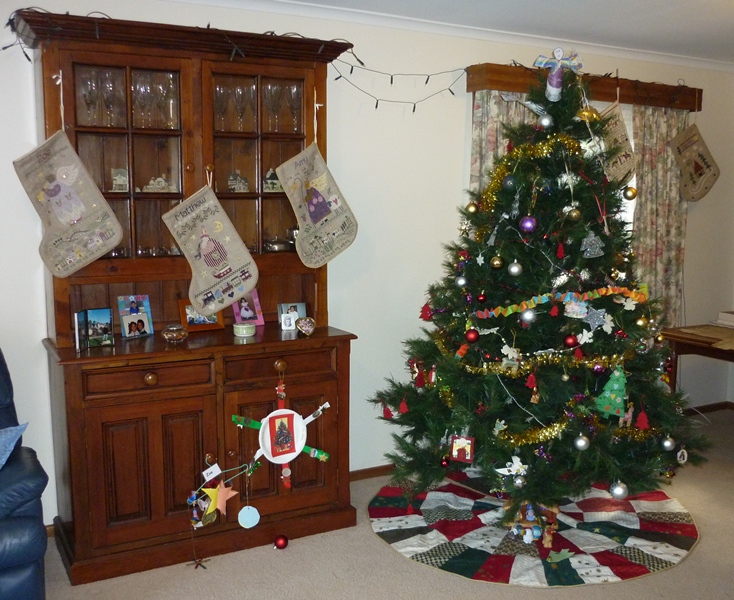
As we set up the tree yesterday and started advent today, I am thrilled that about 5 years ago I was not only excited about Christmas, but had time to put into it: hence the advent material, the embroidered Christmas stockings, the tree skirt, etc.  Now, I cannot begin to imagine where I found the time or energy!


Now that it is all set up, it's time to enjoy it.  So this year, when all the busyness of Christmas threatens to cloud over the reason for the season, I might just take myself off to the lounge room, turn on all the sparkly lights on the tree, and give thanks to God for the blessing of Christmas, where Christ came as a baby to save us all from our sins. 


Monday, November 28, 2011

Radical Womanhood - Chapter 8

Chapter 8: Feminine Faith

As this chapter begins, McCulley openly acknowledges it is an overview chapter designed to present some issues of feminine faith and to encourage us to be women fruitful for God’s glory.

Indeed it is an overview, and I found myself wanting more. As she says, there are other books on the subject – but I wanted more meat in this section. After reading about all the problems that feminism has given us, some more thoughts about how to proceed today would have been helpful.

Having said that, McCulley clearly says what needs to be said – we need to look to God’s word for our guidance in everything, and the gospel is all we need. We do not need to be recognised by the world’s standards, but loved and saved by Jesus.

I finish with the words of John Piper, which she quotes, which describe strong women, whom we all could strive to be:
…Strong women! I think they are magnificent testimonies to Christ. Because if they are complementarian…they are combining things the world can’t explain. They are combining a sweet, tender, kind, loving, submissive, feminine beauty with his massive steel in their backs and theology in their brains! (p187)
I feel this book touched on many issues and helped me understand history more and how it has affected the present, yet left me wanting more about how to live a feminine faith today. Did others feel this way?

Do any of you have any book suggestions that others who are still interested in this topic might find helpful?

Hope you have enjoyed this series, I have!

Friday, November 25, 2011

More Joanna Trollope

I have now read a few more Joanna Trollope novels and these ones I enjoyed as much as Daughters-in-Law and The Rector's Wife.

First one was The Other Family - the story of Chrissie, loved by Richie for 23 years, who was father of her 3 daughters and the love of her life. However, they never married for he never divorced his first wife, Margaret. When he dies, both families have to learn to cope with the loss and pain, and begin to deal with each other. I have discovered what I like about Trollope's books (or those I have read so far) is that everyone moves a step forward by the end. Each character is more aware of their own weaknesses and is making progress towards being better.

The second one, Second Honeymoon, I really liked. It's the story of Edie, Russell and their adult children (Matthew, Rosa and Ben). The children have finally moved out, and Edie is bereft, uncertain of who she is without children in the home. Russell, on the other hand, would like to have to wife back to himself:
'You talk about wanting Ben back. You talk about his energy and neediness and that way it makes you feel. Well, just think for a moment about how I feel. I didn't marry you in order to have Matt and Rosa and Ben, though I'm thankful we did. I married you because I wanted to be with you ... Edie - I want you back. I was here before the children and I'm here now.' He put his cup down with finality. 'And I'm not going away.' (p15)
This was a great book about the realities of life in a mature marriage, with adult children who return home with various issues. It's like Packed to the Rafters (the TV show), without all the ridiculous drama.

Thursday, November 24, 2011

Christmas rolls around again

When you have been blogging for a few years, the year develops a rhythm to it. For the fourth year in a row I find myself pondering a Christmas post. Yet also wondering if I can be bothered! After all, you can all press the button to the left --> the 'Christmas' label.

So, in brief: for those that are interested, our Advent calendar will continue again, now set as a feature of our Christmas tradition.

After two years doing the 'Birth of Jesus' advent material, we are now switching back to the 'Genesis to Jesus' material. After being asked by a number of you dear readers for it, I am now making both available* as a pdf file: Birth of Jesus or Genesis to Jesus.

We continue with the boxes, which include bible verses, but this year there will be very few treats in the boxes. Instead, I am planning more activities related to the stories. When the treats became the highlight, it was hard for all to concentrate for the bible readings.

For those that would like to take a easier option (which I highly recommend!) - better to do something than nothing at all - the Good Book Company is having a 20% off sale for their Christmas resources, including all the material I reviewed last year. I think our older two will do the Christmas Unpacked booklet, might as well keep doing these things while they still love it!

Next week the tree goes up and we start Advent - can you believe it's nearly Christmas!?


* Update from 2017: the resources tab now contains the most-up-to date versions of these materials. 

Monday, November 21, 2011

Radical Womanhood - Chapter 7

Chapter 7: Raunch Culture Rip Off

This chapter is the one that many of us will find the most distressing, and yet also the most relevant. McCulley explains where the third and current wave of feminism has brought us – to today, a sex-saturated, porn-filled world where women mistakenly believe that by treating sex and their bodies as a commodity they are empowered in the process.

McCulley has done a good job of presenting the relevant issues in a discreet way. She even warns that young girls should not be reading the chapter.

A backlash has developed over recent years over this issue, and it’s not only Christians who are speaking out against it. Many others are appalled at what they see happening to women (and men), as a result of widely accessible pornography, the ‘hook-up’ casual approach to sexual intimacy, and the prevailing opinion that modesty equals shame.

One of the ways to combat this as Christians is to be open about the wonderful blessing sexual intimacy is, but within the framework of marriage alone:
We need to combat any false notions of sexuality and piety by presenting a clear and unblushing portrayal of marital intimacy. A generation that is well acquainted with the physical variations of sex needs to hear about the powerful security, attraction, and emotional freedom that attend monogamous marital fidelity. (p178)
Mothers and older women need to speak to younger women openly about the wonderful gift of intimacy in marriage and how, with the benefit of hindsight, they know the damage caused by sexual activity outside of marriage.

This is one of the issues that worries me most with my own children. We live in a sex-saturated society. I want to protect my son and daughters from it as much as possible. I know that God is in control, and some days, that is all I can cling to, as I see the world they are growing up in. I know that God is good and sovereign, but sometimes, I just want to keep them locked up until they are 25!

Things to think about:
  • How has the ‘raunch culture’ affected you and the way you feel about yourself?
  • What message do you want to pass on to younger women? Who could you pass it on to?

Next week: Chapter 8: Feminine Faith

Friday, November 18, 2011

Courageous

Are you a dad? Go and see see this movie.
Are you married to a dad? Take him to see this movie.

Courageous is a rare thing in Australia - it's a Christian movie, full of gospel truths encouraging men to step up and be the fathers God wants them to be.

We saw it yesterday and at first even I felt uncomfortable. It is so unusual to hear Christian values championed on the big-screen that I was thrown for a while. Yet once we got into it, it is clearly a very good movie about being a man, a husband and a father who is willing to lead his family. Of course there are a few cliched moments, but we can all cope with that. It was good to see a movie that values men and the role they can have, rather than denigrating them.

Five men (4 are police officers) are close friends. When tragedy strikes one of their families, the man is forced to evaluate his role as a father. He turns to God's word and encourages his friends to step up and be good fathers. As challenges come for each man, they must choose whether to honour God and their family with their decisions, or not.

I wouldn't recommend it for non-Christians, I think it would be too full-on. I also suspect that if you are a Christian mother doing it tough without a supportive husband, it may not help with being content in your personal situation.

But I highly recommend it for all Christian fathers and fathers-to-be.


* If you want to see it, you should go soon, I can't imagine many cinemas will keep this one on for long. If you are in Adelaide, it is only at Hoyts Tea Tree Plaza. Cinema listings across Australia can be found here.

So Much For That

I decided to try another Lionel Shriver book after The Post Birthday World.

I was not disappointed.

Shep, age 48, has always planned for his Afterlife. That is, he has spent his whole life saving in order to retire early to a Third World Nation, where he will be able to live comfortably for the remainder of his life, on much less money than it currently costs in New York.

On the day he finally decides to go, with or without his family, his wife Glynis announces she has mesothelioma (cancer) and he cannot leave, for she needs his health insurance.

As her cancer progresses and various treatments are attempted, we see Shep caring for his wife, all the while watching his life savings disappear.

While some might say, "what value can you place on human life?", when you live in a world where all treatments cost money, and some exorbitantly so, it is a real question when everyone only has a finite amount of money.

It is a dark and harsh book, not only due to the subject matter, but because of the characters Shriver has created. Shep's best friend Jackson constantly bemoans his life. Glynis is often bitter and nasty. Their extended family are awful, including the standard over-the-top portrayal of Christians. (I do get the feeling the Shriver is pretty anti-Christian).

Having said that, I liked it. It was real. It didn't skirt around hard relationships or death. I like her insights into many aspects of life. I came away absolutely thrilled we don't live in the US and our health system is not the same.

In the end though, what is striking about this book is what it shows about people that have no hope. If you have no hope of heaven, this life is all there is. Therefore, extending this life for as long as possible, no matter how sick you are, is crucial. At the same time, enjoying every minute you can for yourself is very important, because that's all you have to live for. When your idea of the 'Afterlife' is living cheap in Africa, you really have no idea how good the real afterlife will be.


Monday, November 14, 2011

Radical Womanhood - Chapter 6

Chapter 6: The Mommy Wars

McCulley addresses the devaluing of both women (as wives/child-raisers/homemakers) and children that has occurred over the last two centuries.

It’s a long chapter and well worth reading yourself. In brief, the concept of motherhood being less valued than all other pursuits has occurred in three stages:
  • It began in the 19th C when the bulk of economic activity moved from farms and homes into factories. Therefore the household was no longer the workplace, but rather a place of replenishment for workers.
  • It continued as a form of social Darwinism, when it was claimed that child-rearing should become a professionalised collective activity. This followed from the idea that most women were unproductive and indolent.
  • The third stage was with Margaret Sanger, the founder of modern birth control, who believed that large families, especially from parents she deemed unfit were the cause of most evils. She believed in the possibility of a superior race and eugenics, a cause later promoted by Nazi Germany.

Then, McCulley moves from women to children:
of the myriad changes created by second-wave feminism, the most pronounced would be the movement’s unwavering commitment to abortion. (p132)
What is also clearly a result of abortion becoming legalised (or at least tolerated) in most societies, is that female feticide (the aborting of female fetuses) has cost millions of women’s lives. It is estimated that over 100 million girls should have been born in the world, but have not. 50 million of these in China and 43 million in India. For cultures that value a son much more highly than a daughter, there is now a huge disproportion between the sexes.

I remember reading an article about this a few years ago –this first generation of selective sex children are now reaching adulthood. But there are not enough wives to go around. So, you have a large group of men, with no prospective wives and a lot of excess testosterone in society. Not a recipe for peace.

McCulley then turns to briefly address some other issues, including:
  • surrogacy, egg and sperm donation and implications of such technology
  • fertility and that refusal of many to acknowledge it’s limited window

I think, as I watch younger women and the choices they make, fertility is one area where few are prepared to think about it honestly. Many women (and I include myself in this) fell for the line “You can have it all”, yet
those of us who have tried, however, know that it is not true. It may be possible to have it all, but not at the same time. (p138)
Yet I continue to watch young women in our churches mapping out their future with little idea of the reality of fertility or lack of it: “I’ll develop my career till my thirties, and get married in there, then sometime in my mid-thirties we’ll have children.”

I often have to ask young (married) women now, “Do you want to have a family, and if so, when do you plan to fit it in?” And this is not just women who would like a career, this is also women planning their life of ministry service, but thinking that having a family would be the end of their ‘ministry’. Please hear me correctly, I am fully supportive of women in jobs they like and find satisfying. It’s just that the message of ‘I can do it all’ has so permeated us as women, that often we do not stop and think ‘maybe I can’t’ until it’s too late.

She finishes the chapter with words of encouragement to mothers currently ‘in the trenches’:
I think it is easy for mothers to lose sight of the big picture when they are consumed with the daily ‘ordinariness’ of life. I hope that this chapter has helped you… to take the long view of what you are doing in training the next generation to be worshipers of God.’ (p140)
and also to older women. She encourages ‘empty nesters’ to start thinking of themselves as ‘open nesters’ – open to ministering to other people. Younger women need advice, help, guidance and instruction – from God’s word, as well as how to love their husbands, train their children and manage their home (Titus 2). There is a dearth of godly wisdom out there – for those of you who have lived it, please share it with the rest of us!


Things to think about:
  • If you are a mother, do you value it as a role? Why or why not?
  • If you are not a mother, do you value it as a role? Why or why not?
  • Do you / or did you think you could have it all – husband, kids, career, personal satisfaction, etc? Have you managed to?
  • If you are an ‘empty nester’, are you prepared to become an ‘open nester’?

Next week: Chapter 7: Raunch Culture Rip Off

Friday, November 11, 2011

Life of Pi

Life of Pi, Yann Martin

I remember hearing numerous accolades about this book when it first came out (2002), but for some reason I never read it then (probably college exams & morning sickness had something to do with that.)

Yet I seem to be surrounded by good books at the moment - what a delight it is to be reading lots of fiction again.

This one is clever, original, interesting, funny and insightful.

A teenage boy, Pi, is the son of a zoo owner in India. The family decide to emigrate to Canada. Their boat sinks in the middle of the Pacific Ocean and Pi finds himself the sole human survivor of the tragedy. His companions aboard a fully equipped lifeboat include a hyena, a zebra, an orangutan and an enormous Bengal tiger. The premise sounds ridiculous and impossible, yet it breathes possiblity as you read it.

Yann has a wonderful writing style, his turn of phrase, dry wit and humourous asides made reading this book a delight. It's partly a primer for zoo keeping. It has very insightful comments on religion, including Christianity, Hinduism and Islam. And all the while it's a great story.

I read it twice in the last month, as the first third of the book makes much more sense the second time through.

Read it - you'll be in for a treat.

Monday, November 7, 2011

Go Back To Where You Came From

Go Back To Where You Came From

This SBS show was shown in June, but it's taken us a while to get around to watching it.

It's compelling, absorbing and very emotional.

Six Australians with strong views on illegal immigration, boat people, detention centres and people from other nations take part in a 25 day experiment: to experience the life of a refugee in reverse. There are 5 stages:
  • to live with recently resettled refugees in Australia (either from the Congo or Iraq)
  • to set out on a boat from Darwin (made to look like an asylum seeker boat)
  • to live with a minority illegal immigrant group in Malaysia, waiting to move on to another country
  • to visit a large UN resettlement camp in Kenya, or the slums of Jordan
  • to visit the source countries of DR Congo and Iraq
Over 3 1hr episodes you see people's pre-conceived ideas exploded as they meet, talk to and share life with people and families living lives of squalor, fear, uncertainty and avoidance of the authorities.

This is crucial viewing for all Australians. Immigration (especially illegal immigration) is a complex issue that deserves greater intelligent, informed public debate in this country. This show goes a long way to addressing the issues involved. For those of us in comfortable homes with jobs and safety, we cannot imagine risking everything to get on an illegal boat to go to Australia. A show like this helps us realise the plight of many of the world's refugees, and that nothing is so simple or black and white as it seems from our position of relative safety and security.

It would be available in any public library, you can buy it from SBS, and you can still watch all the episodes online (1, 2, 3), including Episode 4 - The Response, filmed a week later. If you want to see a quick summary of what happened, or to whet your appetite - watch the first 2 minutes of Episode 4.

As an aside (and it's something that might require more thought at a later time) it did make me wonder how our government possibly came up with the 'Malaysian solution', and thought it was truly a solution.


Radical Womanhood - Chapter 5

Chapter 5: There’s no place like home

This chapter paints a picture showing how our idea of home has changed over time. Beginning in the time of Abraham, we are given an idea of how people lived. From those times, until the Industrial Revolution of the 19th century, the home was where both work operated from and where the family lived. Be it a farmhouse or a city dwelling operating a business; husband, wife and family would work side by side, sharing the load of supporting themselves and their business and raising their children. Our current notion of a separated home and work life would have been unheard of and unexplainable.

However, with the Industrial Revolution and increased urbanisation, men were drawn into employment into factories and offices and work and home life began to separate. Now the job of working fell to men and the job of raising children and maintaining the home fell to women. At the same time, early women’s movements claiming that women were the more loving, gentle and pious of the sexes were laying the groundwork for later feminists. Finally by the 20th C, women were the target of marketing campaigns to make their lives easier, more efficient and complete with modern appliances.
Thus the shift from the home as a place of production to a place of consumption was completed. In the new culture of consumption - bolstered by the age of advertising and the push for consumer credit - all vestiges of nineteenth century concerns with character, self-restraint, and sacrifice were gone. (p113)

The true heart of the home

McCulley makes some excellent points at the end of this chapter, so I will quote her at length:
The heart of the home is found in the relationships nurtured there and the comfort offered to one another - comfort we have first received from God, the Father of compassion, and then share with one another. (p115)

More importantly, the home is a foretaste of the eternal heaven that awaits us when Jesus returns. He did not leave us to prepare another cubicle in His Father’s office - thanks God!... It is the refuge of a home- with a place in it for each of us - that Jesus promised. (John 14:1-3) (p115)

And a final quote to encourage the many of us who consider ourselves housewives:
“Just a housewife” is a phrase our culture uses to undermine the importance of the private sphere. Though the marketplace does not value the home beyond the goods that can be purchased for it, the ministry to be found there is of immense value to the Lord. The stability of family relationships, the care of elderly or disabled family members, the discipling and training of children, the warm reception of guests, the making of a lifetime of memories, the daily modelling of biblical instruction, the fresh nourishment in an age of processed foods that contribute to our general ill health, the joy of a Christ-centred marriage - all of these have long-lasting, if not eternal, effects. (p115-116)


Things to think about:
  • Do you say “I’m just a housewife”, or are you able to say with pride “I’m a wife and mum”
  • Even if this world does not value your role, do you see the inherent value in your role?
  • Do you risk making your home a ‘safe haven’, rather than a welcoming home?

Next week: Chapter 6: The Mommy Wars

Friday, November 4, 2011

The Post-Birthday World

The Post-Birthday World, Lionel Shriver

I have been planning to read something by Lionel Shriver for a few years, hearing so many positive reviews about her books. At the same time I suspect that emotionally I may not be up to We Need to Talk about Kevin, the story of parents as they cope with a child who has committed a school massacre. So I was happy to grab this one off the library shelf in order to 'give the author a go'.

It's based on the classic premise - 'what if?'

Irina has a long term partner, Lawrence - life isn't perfect, but it's comfortable. They have a friend, the hard-living snooker player Ramsay. One year, Irina and Ramsay have dinner for his birthday. After drinking too much they end up back at Ramsay's place and Irina is faced with a choice. Does she lean forward and kiss Ramsay, setting off one chain of events? Or does she stop herself, go home and therefore live out a different life?

We read matching chapters of each scenario, as they play out side by side over about 15 years. For those that remember the movie Sliding Doors, with Gwyneth Paltrow - it's exactly the same idea.

I enjoyed it. Shriver writes realistically about people, their choices and foibles. I enjoyed her writing style and her use of language. It's gritty at times, and if you don't like a lot of talk about intimate relations, you might be uncomfortable at a number of points.

I might have a look for some of her other titles, like So Much for That and give them a go too.


(If you would like to read the first few chapters online, go here)

Monday, October 31, 2011

The Next Story - conclusions

Final Thoughts

In the epilogue, Challies talks about one area he has been challenged in each of the 6 topics he has covered. It was helpful and instructive to hear how he has made decisions in light of his life, which is prominent online. I’ll leave you to peruse it at your leisure.

However, it’s time for the rubber to hit the road for me. This book has challenged me in every area he covered. I live a lot of my life online, interacting through mediated methods and drowning at times in a sea of information. I like my online life, yet at times feel trapped by it, only too aware how little privacy I retain.

Here are some of the things I have come to realise:
  • I have tended to prefer mediated communication. It’s easier to send an email than to make a phone call. To catch up with someone in person often takes 4-8 weeks to find a free spot in my diary. However, I am more now committed to less mediated forms of communication. I hate texting, so I avoid that already. But now I am trying to call people to talk, rather than emailing. What I have found? Most things are quicker in person or on the phone. Emailing takes a number of bounces back and forth, checking details, clarifying comments, etc. A phone call is often faster, more efficient and I feel I have actually talked to the person properly.
  • I am easily distracted. I check messages when they come in, and my emails and Facebook page regularly – much more regularly that necessary. Not having a paid job means I do not have to be in constant communication with people. Few emails need to be answered within 24 hours, and texts, while seeming urgent, rarely are.
  • I am surrounded by information. I am now unsubscribing to many email lists and am regularly reducing the blogs I read. I hide many people on Facebook. I ensure I don’t get spam texts by not providing my mobile number where possible.
  • I am more aware that when I blog, Facebook, search and email, the data trail I leave behind is potentially permanent. I want to be careful how I speak at all times and what I spend my time doing.
  • I have gotten into the habit of skim-reading the bible. I want to break this quickly and completely. I want to study God’s word in detail, not skim over it because I have already read it so many times before. I am realising this takes real commitment – both of time and energy.

In the end, the biggest change that reading the book has encouraged me to commit to is a break from the online world. I am now trying to commit to 2 days a week with no internet connection.
  • Thursdays because Husband & I have decided to have a regular day off again (no kids)
  • Saturdays because that is really the ‘kids day off’ and I want to be with them more.
At this stage that means that on those days, I check no email, do not log on to Facebook, do not read any blogs and try not to reply to any texts. I try to keep my mobile on silent or away from sight. A few weeks in and I am actually loving it. I feel the pull of the computer, but enjoy the decision to stay away from it. I am already finding it incredibly freeing and it has helped me see what is a distraction and what excesses of information I need to remove from my life.


What about you? What has challenged you in this series?


If you want to keep thinking about some of these things, here are a few ideas: