Friday, March 15, 2019

Nancy Mitford

I decided to try Nancy Mitford after having heard vague references to her for years, most recently in my reread of The Uncommon Reader. She wrote in the 1940s-50s and while I don’t know anything about her, a brief search has suggested she is a well known British author who both delights and annoys readers depending on their bent.

I suspect that at the time her writings were quite daring*. The Pursuit of Love is mainly about a woman’s search for affection and love through numerous husbands and relationships. Spanning the late 1920s through to WWII, it charts the lives of the Radlett family told through the narrative voice of their niece, Fanny. Harsh Uncle Matthew presides over Alconleigh with his vague, gentle wife Sadie and their numerous children. Fanny has been raised by her Aunt Emily, but spends holidays with the Radletts. Her own parents have been not been on the scene, her mother moving from man to man and hence called Bolter by the rest of the family. The first half of the book charts their life and history to her twenties and then gives the story of the various relationships Linda, Fanny’s cousin, embarks on.

It’s a meandering read, at many times there is no clear idea where the story is going, it just seems to be a string of various accounts of family life. It also requires some ability to read French, or in my case, to use google translate while reading the iBook (much easier!) At the same time, it is engaging and eminently readable, with funny anecdotes and descriptions showing Mitford’s skill with words and expression. I enjoyed my time in it.


Next was Love in a Cold Climate, still narrated by Fanny with the same cast of Radletts hanging around, and her aunt Emily and Uncle Davey. Part 1 centres on Polly Hampton, only beloved child of Lord and Lady Montdore, one of the richest families in England. Polly is a close friend of Fanny’s, and they spent their later teen years often together. This book had some details of how Fanny met her husband Alfred, but really the details here are about Polly, who shows no interest in love at all to the despair of her mother. Until, horror of horrors, as soon her aunt is dead and buried, she reveals an enduring love for her uncle Boy Dougdale. The final section of this makes for odd reading as up to this point Boy has been dismissed as the Lecherous Lecturer by the Radlett children, his being known for being quite ‘handsy’ with young girls over the years. This is flippantly dismissed as a bit of a joke throughout the book, but in our current climate adds a definite feeling of distaste and unease that one assumes was not intended by the author. In Part 2 the Montdores have found the new heir, Cedric, a distant family member, who they feared would be a provincial hick from Canada, but is in fact a stylish, gay man from Paris, who completely turns their lives upside down. The story gets even odder from this point.

What was surprising was how quickly each novel finished. They both meandered for hundreds of pages and then ended quickly and abruptly almost as if she got sick of writing them. There is no doubt that Mitford wrote quite devastating critiques of English aristocracy, and her turn of phrase, all through the narrator Fanny, is light, cheerful, gossipy and interesting. At the same time, while it very readable and I was keen to see how it played out, it wasn’t as enjoyable for me as The Pursuit of Love.


*or as I am beginning to suspect, as my literary education on English writers in high school was mainly limited to Shakespeare, Chaucer, Austen and a few others, I really don’t grasp the range of what is out there.

Monday, March 11, 2019

The Library Book

The Library Book, Susan Orlean

“Worldwide, there are 320,000 public libraries serving hundreds of millions of people in every country on the planet.” Susan Orlean has written an ode to those libraries with an account focussing on Los Angeles Library. Orlean remembers a childhood spent with her mother at the local library:
“On the ride home, my mom and I talked about the order in which we were going to read our books and how long until they had to be returned, a solemn conversation in which we decided how to pace ourselves through this charmed, evanescent period of grace until our book were due.”
After years away (spent purchasing rather than borrowing books), she rediscovered the joy of the library with her young son, and realised that much is the same in libraries as it ever was.
“It wasn’t that time stopped in the library. It was as if it were captured here, collected here, and in all libraries – and not only my time, my life, but all human time as well. In the library, time is dammed up – not just stopped but saved. The library is a gathering pool of narratives and of the people who come to find them. It is where we can glimpse immortality; in the library, we can live forever.”
Yet, libraries have also changed vastly, dealing with digitisation, and becoming of one of the last free, safe public spaces available to all people, which now often provide children’s story time, ESL classes, genealogical services, assistance with government support and help for the homeless.
“The publicness of the public library is an increasingly rare commodity. It becomes harder all the time to think of places that welcome everyone and don’t charge any money for that warm embrace... One of the few places homeless people are welcomed, given access to computers and the Internet, and permitted to dally all day (unless they act out) is a public library. Libraries have become a de facto community centre for the homeless across the globe. There is not a library in the world that hasn’t grappled with it issue of how – and how much – to provide for the homeless. Many librarians have told me they considered this the defining question facing libraries right now...”
By focussing on Los Angeles library she deals with the major fire that damaged almost 1 million books and items in April 1986. So there are many details about how the fire spread, the damage done and the investigations that followed. One man in particular, Harry Peak, was always a suspect, but never convicted. It was interesting to read about a major fire and loss that I never heard about (we were even living in the USA at the time) partly because it was overshadowed by the Chernobyl disaster.

Woven throughout is the history of the library to date, from its humble beginnings, moving around various buildings and finally the construct of the landmark building it is today. She introduces us to the various librarians who have held the post with their quirks and foibles, and gives the reader an insight into the massively complex job it is to now run a major library network in a modern city,

She also talks about the role of books in general, and since this is a book about massive damage to a library, also considers what war and a decision to burn books does to the public record and says about the values of a people.
“Taking books away from our culture is to take away its shared memory. It’s like taking away the ability to remember your dreams. Destroying our cultures books is sentencing it to something worse than death: It is sentencing it to seem as if it never lived.”
Obviously I love books, love reading and love our library system. Not only do I love the actual books I get from it, we also borrow numerous DVDs, and every single book I read on long service leave (including this one) was a digital loan on an iPad, administered by our local library. I am getting to know our librarians personally and expressed my concern to them recently that a new automated borrowing system would not affect their employment. They assured me they have plenty to do elsewhere!

An interesting and insightful read about libraries and books, and the place they hold in our society.

Friday, March 8, 2019

Cosmic

Cosmic, Frank Cottrell Boyce 

Cosmic is about 11-year-old Liam Digby who is unusually tall for his age and often mistaken for an adult. This, combined with his reckless nature, is often a recipe for disaster. He has managed to stay at the fairground without his school group, to test drive a Porsche and has impersonated a new school teacher.

He wins a prize for a Father and Son trip to the “Infinity Park”, of which the main attraction is the Rocket, a real space rocket, ready for its debut launch. Rather than taking his own father, he pretends to the father of school-mate, Florida Kirby. As things unfold, it’s clear that only the children get to go into space, so will Liam still be selected after all?

Miss 10 really enjoyed it – she said it was funny and silly. Husband enjoyed reading it aloud to her, especially when Liam finds the parenting book his Dad has been reading about talking to your kids, and he realises that all the things his Dad does to start a conversation have come from that book. The silly accidents and scrapes Liam gets into are amusing, and he teaches the other kids new games and ways to have fun, when previously they have always been pushed to only succeed academically.

Recommended for age 9-11, for kids that like a bit of fun and to imagine what it would be like if they could go into space.

Monday, March 4, 2019

Leota's Garden

Leota’s Garden, Francine Rivers

Leota has lived for years in her home seeking sanctuary in her beloved garden. Now age works against her and she struggles to get through each day. Estranged from daughter Eleanor who thinks her mother abandoned her, and a son who only cares about making money, Leota is lonely.

She contacts a help agency, and is sent Corban, a sociology student who needs a case study for his term project on aged care. Corban is struggling to get to know Leota, wondering why old people are so much work.

Meanwhile Eleanor is bitter and angry and having problems with daughter Annie, whose life she has completely controlled in an effort to ‘give her everything’. Annie moves out and is led to seek out Grandmother Leota to understand what it means when Eleanor accuses Annie of being just like Leota. What follows is a beautiful relationship between Annie and Leota, two women of very different age who both follow Christ and want to serve him.

I enjoyed it. Rivers is very good at writing about women, and grasps well the potential complications of their relationships. This book had very little romance, which appealed to me. Annie longed to look after her grandmother. Leota longed to be reconciled to her children. Her daughter longed to be understood.

The themes centred around the value of life, how we see our side of the story and how much we want to be in control. There were some minor themes about pro-life and euthanasia, which were thought provoking and at times a little disturbing. This book also didn’t end neatly, which I liked. Not everything was tied up with a neat ribbon. The relationships were not all sorted out and characters had to live with disappointment and regret. I found it a little more real than some of her other books.

Friday, March 1, 2019

Flowers for Algernon

Flowers for Algernon, Daniel Keyes

This brilliant book by Keyes was written in 1966 and charts eight months in the life of Charlie Gordon. Charlie, age 32, has a very low IQ (68). He can write and spell minimally and keeps a job doing deliveries at a bakery. He attends the Beekman College Centre for retarded adults in the evenings, under the caring tutelage of his teacher Alice Kinnian.

Written in the form of daily diary entries or progress reports, Charlie reveals he is about to be the first human experiment for an operation to increase intelligence. A mouse, Algernon, has been successfully given this operation and now the trial is turning to humans.

The writing itself shows the pace of change, early entries have poor spelling, grammar, and punctuation with a clear demonstration that Charlie really does not know and understand much of what goes on around him. After the operation it is clear within days that changes are occurring; he is learning how to write, spell, and edit his entries. Within weeks he is mastering high-level theories, mathematics, numerous languages and has overtaken the experts who have subjected him to this experiment.

In addition, he is now recalling incidents in his past, childhood memories, and experiences, and is able to re-interpret them with a fuller understanding of what really happened. He develops romantic feelings and has to learn how to manage them.

Much of the book is really about what it means to be human and how much value we place on people with intelligence. Those who are performing the experiment seem to feel that they have created Charlie, forgetting to acknowledge that he was a man previously.
“it may sound like ingratitude, but that is one of the things that I resent here – the attitude that I am a guinea pig ... How can I make him understand that he did not create me?… He doesn’t realize that I was a person before I came here.”
Charlie’s personality also changes, he once was a friendly, happy man, but now he becomes proud with an air of superiority, unable to cope with all the people around him who cannot grasp everything on the level that he can.
“I’ve learned that intelligence alone doesn’t mean a damned thing. Here in your university, intelligence, education, knowledge, have all become great idols. But I know now there’s one thing you’ve all overlooked: intelligence and education that hasn’t been tempered by human affection isn’t worth a damn.”
As Algernon’s health decreases, Charlie begins to see what also may happen to him. It’s a very powerful description of both gains and losses and how that affects how we view ourselves.

This is a great book that will stay with you long after you finish it. Highly recommend for middle teens (Mr 15 found it) and up.

Thursday, February 28, 2019

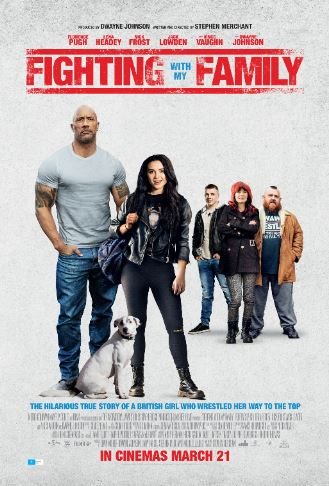
Fighting With My Family


I had the privilege of seeing an advance screening of Universal Pictures new release Fighting With My Family last night.

It's based on the true story of Paige, one of the WWE (World Wrestling Entertainment) superstars.

The Knight family are family devoted to wrestling, Mum and Dad met though wrestling and the children have all grown up in the ring, fighting each other and running the local club, giving young kids something to do in Norwich, England. As they say “you’re a Knight, wrestling’s in your blood, like hepatitis.” Brother Zak (Jack Lowdon) and sister Saraya (Florence Pugh) dream of getting into the WWE and winning the title belt. When the opportunity of a trial comes up, to their surprise Saraya is chosen, but Zac is rejected.

What follows are the parallel stories as Saraya heads off to the USA to follow her dream, and Zak deals with the disappointment of failure, struggling to find meaning even with a loving girlfriend and newborn baby.

It’s a charming story in a grungy format. World champion wrestling is definitely not an area I know anything about, my only awareness of anyone in the sport is Hulk Hogan, from the 1980s. I would be one of those people who ask the question, “but isn’t it all fake?” The answer from the family seriously being: it’s not fake, it’s fixed. I didn't realise how much of wrestling is about selling yourself and acting, as well as staged fighting. This also explains how Dwayne Johnson 'The Rock' has apparently moved so seamlessly to acting after his successful wrestling career. He is the producer as well as playing himself, and the few scenes he is in are both humorous and heartfelt.

The real highlight of this film is the family, they love each other dearly and support one another through financial challenges and jail time. The mother says to Paige (Saraya's new stage name), “You are the spark in our lives, no matter what you do with yours.”

Paige and Zak have to work through their own jealousies and insecurities. Paige tries to convince Zak that running the local club for kids, including reaching a blind boy to wrestle, is still meaningful, saying “just because millions of people aren’t cheering you on, doesn’t mean it’s not important”.

There is a lot of swearing. Not so much four letter words, but more casual slang referring to genitalia and actions with them, and there is a reasonably high level of crassness especially in the conversations between family members. It did fit with the British working class setting and I suspect was rather representative of the world the Knights live in. There are some drug references. While there is no nudity, there are definitely some very skimpy outfits that the wrestling women and men wear, not leaving much to the imagination. Considering the content, there is of course a fair amount of violence, but with the exception of one real fight, the rest is in the wrestling arena.

While this is probably not my usual movie fare, I enjoyed it, it definitely fits the category of a “feel good movie”. My friend and I were both a little teary with emotion at the end.

There are a lot of good fictional stories out there, but a good true story is always compelling. This is a good (mostly) true story shaped into a fun and enjoyable movie experience.


I was a guest of Universal Pictures.

Monday, February 25, 2019

Cold Comfort Farm

Published in 1932 by Stella Gibbons this amusing book is set ‘sometime in the near future’ (after the Anglo-Nicaraguan wars of ‘46) and reflects life in England in the 1930s. I must admit to my lack of knowledge of literature of this time, but even I can tell there is a fair amount of satire here and poking fun at various English classes, rural life and authors in general.

Flora Poste is orphaned at 19. This is not a situation that greatly troubles her as she hardly knew her parents. The education bestowed on her by them was “expensive, athletic and prolonged” and she “was discovered to possess every art and grace save that of earning her own living”.

She swiftly decides the only course of action to her is to turn to extended relatives and live off them, for, “I have already observed that, whereas there still lingers some absurd prejudice against living on one’s friends, no limits are set, either by society or by one’s own conscience, to the amount that one may impose on one’s relatives.” Enquires to the available relatives turn up only one real option at Cold Comfort Farm, home of the Starkadders, in Sussex. Her London friends are appalled by the thought, convinced they will be awful people, including either a Seth or a Reuben who will undoubtably be all on about sex.

Not surprisingly, when she arrives there is both a Seth and Reuben in the household who early impressions suggest will live entirely up to her fears. Father Amos is a hell fire and brimstone preacher, mother Judith is constantly grieving over Seth, Elfine runs wild across the hills and Aunt Ada Doom masterly keeps the entire family in her control by pretending madness whenever necessary.

Rather than being depressed about the problems of the household, Flora sets about to fix them all. She wants to make Elfine a lady and marry her off, Amos to get out the way by going on a preaching tour, and Seth to learn some manners and control. There is a local writer who is determined to fall in love with Flora and keeps describing all the local fecundity in an attempt to woo her.

Gibbons starts the book with an imaginary letter to a friend editor, introducing her novel. What is charming here is the way she indicates that she has asterisked certain passages (like a travel guide would) so the reader, or indeed an book reviewer, would know they were onto something really impressive. In reading the novel, the location of an asterisk meant you were about to read a particularly florid description of something:
“Dawn crept over the Downs like a sinister white animal, followed by the snarling cries of a wind eating its way between the black boughs of the thorns. The wind was the furious voice of this sluggish animal light that was baring the dormers and mullions and scullions of Cold Comfort Farm.”
Things like this, plus the impossible descriptions of the farmhouse and the cow’s names (Aimless, Graceless, Feckless and Pointless with the bull Big Business) help to note much of it is meant to be lighthearted. This is further demonstrated by the tidy way everything works out, and how two mysteries raised throughout the book are never solved.

For modern readers it may seem gentle and somewhat simple, even though quite amusing. I think many of us would not get most of the references. I read an review by Lynne Truss (author of Eats Shoots and Leaves) and that helped me see that some of what I had taken as real was all made up or designed to be irony or satire. Good to learn these things!

It was an enjoyable read and pushed me to continue reading older English books. I even turned to the DVD adaptation from 1995 with Kate Beckinsale and Joanna Lumley, which while enjoyable would probably only interest those who had read the book.

Friday, February 22, 2019

Everything I've Never Said

Everything I’ve never said, Samantha Wheeler

This great tween book is about Ava, an 11 year old girl with Rett Syndrome, which means she cannot speak, move her head or feed herself, and has very limited muscle control. She adores her big sister Nic and her parents, but is also aware that they don’t really know her or what she is thinking because she can’t express herself.

School is a constant frustration because the teacher thinks Ava should be able to point to various communication cards, but Ava can’t get her body to do it right. When pushed really hard or overstimulated she screams uncontrollably or pinches, all the while longing to be able to express herself in ways people understand. When circumstances mean that another member of her family also can no longer communicate, people around Ava start searching harder for a solution to help her talk.

It is a heartfelt book, expressing what is must be like to be trapped with your own thoughts in a body that won’t do what you want it to. Author Samantha Wheeler has a daughter with Rett Syndrome so she is writing from personal experience and it shows. There are some wonderful characters who help with children with disabilities, and also people who clearly shouldn’t. She expresses the frustration of dealing with disability services (this book is based in Queensland) and trying to get the assessments needed to qualify for assistance.

In many ways there are very similar parallels to Out of My Mind but in an Australian context. Highly recommended reading for anyone age 9-10 right through to adults.

Monday, February 18, 2019

How to Stop Time

How to Stop Time, Matt Haig

I really liked this story of a man who seemingly does not age, or rather he ages very slowly so that one of his years is equivalent to 15 normal human years.

For those who enjoyed The Time Traveler's Wife or The 100-year-old man who climbed out the window and disappeared there will be much to interest and entertain here as well. Tom Hazard was born in 1581 and now in current day he looks in his low 40s. In his youth he realised it was dangerous to look so young for so long and he learnt the art of hiding and moving on. In time he found other people like him, through the Albatross society headed by Hendrich, named such because the albatross was the longest living bird when the society was founded. In contrast, normal humans are disparagingly referred to as mayflies by the Albas because of their short life span.

Hendrich has gathered people into his society to protect them and so all members have to move on every eight years, as well as finding other albas or disposing of people who discover them. But Tom is always searching, once he had a daughter (Marian), she is like him but he cannot find her. What happened to her? Does she still live?

He settles in London and becomes a history teacher. He tries to reach out to students with the reality of what the past was like but it becomes increasingly hard to hide his true identity. The French teacher, Daphne, is intrigued by Tom and cannot figure out where she knows him from.

The story is told alternating through different timelines sometimes in the present day and other times reflecting back on Tom’s past. In his lifetime he has met Shakespeare, Captain Cook and so many historical facts are woven into the fictional story. While there is some mystery and tension along the way and there is a climax to the ending, in essence it’s a great story based on an intriguing premise. An enjoyable read that makes you think and wonder.

Friday, February 15, 2019

The Hunger Games

The Hunger Games, Suzanne Collins

This fast paced book charts the death by elimination reality show that is the Hunger Games in the country of Panem. Each year two entrants (aged 12-18) are chosen by chance from each of the 12 districts and required to fight to the death in a specially made, climate managed arena. This is the way that the Capitol shows they remain in control of the regions.

Katniss, aged 16, lives in mining district 12, surrounded by poverty and has learnt from an early age how to provide for her mother and sister by hunting in the woods. Once she and Peeta are chosen for the games, they travel in luxury to the Capitol and are fed, pampered, beautified and interviewed to make them appealing to the masses who watch the Games.

Once they are released into the arena, every contestant must rely on their own skills to survive. But what happens when people decide to work together or choose to care for one another? Katniss knows that only one can survive but it gets harder and harder to play the game, knowing that every move made and every word spoken is on camera for the world to see. Is what anyone says says real? How does she make decisions? Does she play the game to win or does she follow her own moral code?

I don’t watch reality TV, but this is clearly meant to be like Survivor on steroids. This is truly a fight to the death, yet what does it say about a society that pits children against each other for entertainment?

Book 2 Catching Fire picks up 6 months after the last book. I won’t go into much detail all but it is certainly fast paced, action packed and full of various intrigues. Needless to say it also kept me glued to it for about a day.

Book 3 Mockingjay covers the civil war that erupts around the country as the Capitol tries to keep power and rebels try to take over. But are the forces who oppose each other actually that different from one another?

In my opinion, the best was probably The Hunger Games, containing the sharpest ideas and most challenging concepts. Two is also very good, with similar themes running through it. Three became even more violent, and really seemed as though she was almost just coming up with more nasty creative ways for people to inflict pain and death on each other.

All is all this is another good addition to the young adult dystopian fiction genre, and would be suitable for about ages 14 and up. It will make you think about your values, what you would do if faced with impossible choices, and how society values people.

Monday, February 11, 2019

Bridge of Clay

Bridge of Clay, Marcus Zusak

What a wonderful, evocative tale of family this is.

This is the story of the Dunbar boys, “once in the tide of Dunbar past”, the five sons of Michael and Penelope Dunbar. The narrator Matthew is the eldest, with Rory, Henry, Clay and Tommy following close behind.

The story covers multiple time frames, the earliest being the childhoods and early years of Michael in a small country town, and Penelope growing up in the eastern bloc and fleeing as a refugee to Australia at 18. At present day, Matthew is about 31, married with children and writing the story, while living in the family home at Archer St in Sydney. But the bulk of the tale happens around the years that Penelope falls ill in his teen years and then the aftermath of her death when their father leaves and Matthew is about 20.

It’s beautifully written, with snippets of details revealed at certain points, only to be expanded on later. Why do their pets have such expansive names such as Agamemnon and Achilles? Why do they call their father The Murderer. Why does Clay always carry a peg around in his pocket? Why does he run constantly and all the others wait to beat him up? Why is there is a typewriter buried in a backyard?

Zusak has written a compelling story that meanders and centres around Clay and how he impacts his brothers and father. There are occurrences of major loss and grief, stories of joy and hope, and the grimy reality of a family of five boys, all interwoven together in a compelling mix.

I love his style of writing. He packs a lot of meaning into a few short words:
(Speaking about final Yr 12 results for country kids):
“At the end of school, both he and Abby made good scores, they made city scores, and they were numbers of escape and wonder.” 
“How could he know that Carey - this girl who lay across him, and whose breath drew in and out on him, who’d had a life, who was a life - would make up his trifecta, or triumvirate, of love and loss?”
It sat with me for days afterwards, in a similar way to one of his other novels The Book Thief. Very few books make me teary but this one did, not only because of the content, but the way it was expressed. Highly recommended when you want a more thoughtful read, especially one that explores family in depth and from an Australian context.

Friday, February 8, 2019

Fiction re-read

I took the opportunity while on holidays to re-read a number of books I had enjoyed in the past. They included:

  • The Guernsey Literary and Potato Peel Pie Society. Still charming 8 years later, I thoroughly enjoyed this the second time round. A novel written in the form of letters, it drags you in immediately and the characters take a hold of you.
  • The Uncommon Reader, Alan Bennett. An endearing short book about the Queen who takes up reading. Only takes a hour or so to read, but is a lovely escape into what might happen if the Queen found herself absorbed in books to the detriment of her duties.
  • The Mark of the Lion trilogy (Francine Rivers) was enjoyable to return to again: the story of epic love and sacrifice in the Roman Empire in the first century. It was more complicated than I recalled with characters facing real challenges to live faithfully in the brutal world around them. The story of Hadassah, faithful slave girl, and Artretes, German gladiator keep interest and also provoke thought about how we live out our own faith. Some aspects of Rivers writing don’t always sit quite right, but it’s still a good thought provoking read.
All worth trying if you haven't gotten to them yet!

Wednesday, February 6, 2019

Year 7 Daughters and Dads

We kick off the year with a post written by Husband about a graduation event he and some other dads ran for their Yr 7 daughters at the end of last year. 

Continuing the tradition which we began with our son, the end of 2018 was Miss 13's turn to mark this significant rite of passage - finishing primary school, and starting high school.

She has been looking forward to this ever since her big brother's occasion, and so it was with great excitement and anticipation that we gathered with nine other Christian Dads and Daughters.

The afternoon activity was outdoor laser-tag - the Daughters insisted that they be teamed against their Dads! Suffice it to say that whatever they might have lacked in overall strategy, their small size and superior speed definitely helped ...

Afterwards we had a lovely BBQ dinner and dessert back at our place. Some of the girls even braved the pool (having been promised a swim, mere 19 degree temperatures weren't going to stop them!)

The highlight of the night were some brief formalities - every Dad had a few minutes to share some of the ways they were thankful to God for their daughter, as well as offer a piece of advice (with a bible verse) to all the girls as they begin high school. Every daughter also received a "memento" of some description to accompany that piece of advice, and a "treasured memories box" to store them in.

All in all it was a wonderful night, and Miss 13 is already asking about what we will do next year!


Monday, February 4, 2019

Back online

We have just returned from long service leave and a wonderful break as a family. For us, it brought home two truths. Firstly, we need rest. Unlike God, who is Sovereign, humans need to rest and doing so is a reminder of that. Secondly, it is a generous gift of the people of God (and our co-workers) to give us that rest by enabling us to take that amount of leave. So, we are very thankful for the reminder and God’s good provision, and are now excited about getting back into the usual life pace and ministry again.

As it was holiday time, my reading was almost exclusively fiction. Some were re-reads of those previously enjoyed, others were a dip into classics I hadn't read, and some were more modern options. I did seem to read a fair bit of Francine Rivers. I think it’s because it fits the ‘holiday reading’ category quite well – it is easy, but still with insight and depth and as it is Christian, it is generally encouraging and honest.

So the next few months will be mainly fiction reviews, and then as my reading for the year gets a bit meatier, so will the reviews that match them! Thanks for reading.

Sunday, November 25, 2018

Summer Shutdown

Musings will be on holidays for the summer. I'll be back with more thoughts and book reviews from February.

Hope you have a Christ-filled Christmas and a joyous New Year.

Thanks for reading this year.

Wendy  

Friday, November 23, 2018

Dry

Dry, Neal Shusterman and Jarrod Shusterman

What happens to a community when the water runs out? Do people work together, turn against each other, find ways to turn it to their advantage, or just seek to survive? This is the premise of Dry, by Neal Shusterman and his son Jarrod.

After years of drought, water restrictions and warnings, the water in Southern California is running out. Key farming areas have turns to dustbowls, states upriver have taken the water for themselves and stopped the flow downstream. What was once called a drought, then called the flow crisis, is now the ‘Tap Out’, where all water flow has ceased.

The book unfolds over five days, starting from the Tap Out and shows quickly and realistically what could happen to a population with no water.

Alyssa’s family are oblivious at the beginning, assuming the authorities will fix the problem quickly. Taking a few hours to respond, they soon realise all the shops have been emptied of bottled water. A bathtub full of melted ice can only last so long. Once there is absolutely no water, what do you do? Their parents head off to find water leaving Alyssa (16) with her brother Garrett (10).

Next door neighbors, Kelton (16) and his family, have been preparing for something like this for years. Having set up their house to be fully off -grid with high levels of security, they are ready for anything. All of a sudden, the end-of-the-world loony neighbours aren’t so crazy anymore. But what happens when the rest of the neighborhood is unprepared and comes looking for help?

Within days the whole region has come to a standstill. The sewerage system cannot work without water, the electricity goes down, and as the chapter heading suggests, it takes only three days for humans to start behaving like animals. The worst behavior comes out very quickly – mobs moving together, destroying water machinery that might have helped them, profiteers who trade water for people’s most valuable possessions, and those violently fighting over the last water supplies. At the same time, there are glimpses of hope as some people work together, share supplies, use ingenuity to solve their problems and care for those most in need.

As Alyssa, Garett and Kelton realise they cannot stay in their homes, they head out and pick up Jacqui (an unpredictable 19-year old loner) and teen Henry (always looking out only for himself) along the way. The interplay between all of them shows a depth to the characters and the realistic ways that people work together (or don’t) in a crisis.

In many ways, this is a highly frightening book about something we all suspect could happen. Shusterman's Scythe was fascinating, but not likely to occur. Everything you read about in Dry certainly could, and in our lifetime. The Shustermans have a very real insight into human nature and the various ways people can behave under pressure. Like Scythe, it’s a great story, but requires some level of maturity from the reader. Some younger readers could find it quite distressing, and it will stay with you for some time as you consider the implications of such an event. At the same time, it’s good for our youth to be challenged to think through the impacts of environmental change and policy on society, and how they might behave when really put to the test. Recommended reading for about 14 years and up.

Wednesday, November 21, 2018

Child Proof

Child Proof, Julie Lowe

Many parents seek a one-size-fits-all solution. We want simple answers to complicated problems and we want them to work every time.

Yet each family is different, each child is different, each circumstance is different. Our personalities vary, our temperaments differ. Each parent has their own sins, gifts and tendencies, and each child has their own sins, gifts and tendencies.

We fool ourselves into thinking there could be the same solution for every problem.
“It’s what all parents want, right? Safety and a guaranteed good outcome. We want that so much that we are easily persuaded to reach for a parenting formula or recipe—Do this! Don’t do that!—that promises to “childproof” our homes. But parenting formulas not only don’t deliver the promised outcome (safe, happy, never-in-trouble kids), they keep us from parenting by faith. So we miss out on a rich life of trusting God to guide us in knowing and loving our children and guiding them toward love for God and others in ways that are specific to their unique gifts and needs.”
Thankfully Julie Lowe has come to the same realization and shared it with us in her book Child Proof. Lowe is a counsellor with the CCEF, and a mother of six. Right away you feel she knows what she’s talking about and she comes at parenting from a slightly different angle: she first fostered two children when single, fostered two more once married, and then later two more were added to their family.

The book is broken into two parts, the first is where the principles lie: The Foundations for Parenting by Faith.

She starts by freeing parents from the trap of thinking there is only one right way to parent:
“The thing to remember is that, while the biblical principles remain universal and unchanging, the way they are applied in specific ways is unique to each family’s personalities, gifts, difficulties, and circumstances. The way God has structured it, there is much more liberty in how we live out godly principles in marriage and family life than we often give ourselves.”
In fact, what God calls us to is not a formula but faith:
“The answer we need as parents is not a formula for our families. I believe we should be looking at something far more challenging. Instead of providing a parenting recipe, God calls parents to think biblically, wisely, and carefully about what love looks like in their unique family. This calling requires an absolute dependence on godly wisdom, on spiritual discernment regarding my family, and on personal holiness to be what my family needs me to be. The goal is a home centered on Christ.” 
“This means that my ultimate goal is not even the good desires I have for our family, things like peace and quiet and obedient, moral children. My ultimate desire is to be a parent whose life rests on what has been graciously been given to me by the Father, modeled to me in Christ Jesus, and supplied to me by his Spirit.”
We are called to love God and love our children and that will impact the way we parent more than any structure, routine, guideline or expectation:
“But when we are motivated by a love for God and our children, our parenting choices are no longer driven by our need to attain particular results. My parenting is no longer controlled by my personal motives, agenda, fears, or hopes, even when those desired outcomes are good things. When we focus on what our role should be in our children’s lives and on knowing them personally, we focus less on their behavioral improvements and more on how the Lord is calling us to shepherd them.”
She calls us to consider what our families could be like:
“Instead, envision a family where there are imperfect people, many trials, and unwavering love. Imagine a home where brokenness and hope, temptations and forgiveness coexist. Where failures meet mercies that are new every morning. Where all members are in equal need and receive an equal measure of grace.”
There is so much gold in this first chapter. To whet your appetite, it is available online
via the New Growth Press website. Give it a try, I can almost guarantee you will want to continue reading the rest of the book.

The rest of this section addresses how we need to parent centering on Christ – cultivating his character and love in our family life, with the assurance that what he calls us to can never be accomplished by sheer human determination:
“A Christ-centered home means that we are emptying our home of personal agendas, striving to image the Lord before our children. We are striving to love sacrificially, to engage with one another meaningfully, and to pour forth God’s character in all we say and do. It does not mean perfection; it means humility in weakness. It means we give ourselves to him, and his strength is made perfect in our weakness. We become a channel of his life to others.”
Following chapters talk about becoming an expert on your family:
“God has established you as your child’s counselor, educator, discipler, and mentor. As a parent, you are perfectly positioned for this task. Although outside help and professionals can be useful, you are the expert.”
We are to study and understand our children: their skills, gifts, tendencies, weaknesses, fears, behaviors and areas requiring growth.
“It is not enough that we commit to knowing them well. We also want to help them know themselves. We want them to grow in understanding their own heart, their motives, their temptations and tendencies, their strengths, weaknesses, aptitudes, giftedness. We want children to know themselves, to know how to live well before God, and to trust him as Savior, Lord, and helper.”
She addresses how to parent according to the needs of your family: both knowing our children and their situations and how God’s word speaks to that. Discipline and rules are covered and she gives helpful principles for forgiveness, disciplining, and establishing the difference between moral rules and rules that teach life skills. We want to help our children develop discernment and character. Finally, we need to prioritise building bridges to our children and strengthening our relationship with them:
“This means we laugh with our children, we play with them, and look to affirm them and show that we like them. We demonstrate that we know them well and help them to know themselves. We point out their gifts and strengths, and the things we love seeing in their lives. And we gently, graciously show them their weaknesses, sins, and blind spots that they might see their need to depend on Christ. It is always our responsibility to build these bridges; we should never assume that it should fall on the child. They lack the position, the maturity, and the sense of purpose to do so.”
The final section: Parenting by Faith Applied, deals with particular situations, some which will only apply to some, and some to all. She covers:

  • Parenting a Difficult Child. This chapter finished with some excellent encouragement for parents from God’s word.
  • Parenting an Anxious Child. This chapter closes with thirteen ways to help comfort children from God’s promises.
  • Parenting a Child with Disabilities.
  • When Your Child Says, “I Don’t Know”. An excellent chapter dealing with an issue I had never fully identified, but face regularly: “children learn that this response keeps them from having to do the hard work of critical thinking or personal self-reflection. They may even avoid accountability, honesty, and vulnerability.” She has some great ideas to encourage conversation when kids claim, “I don’t know”, with the very first being: “Well, if you did know, what would your answer be?”!
  • When Your Child Says, “I Am Bored”
  • When Your Child Isn’t Thankful
  • The Importance of Role Playing and Practice
  • Technology and Your Child
  • When Your Child Breaks Your Heart

The real benefit of this book will be seen in how we choose to apply it. You could read it, think, “that’s great” and move on to the next book of wisdom that is released. Or, you could stop, work through her instructive questions and suggestions at the end of each chapter, and in God’s grace and wisdom, consider how to parent your children by faith in God and his good plans, despite our sins and weaknesses. That’s where I will turn next – figuring out ways to put some of these principles into practice in my own family.


I received an e-copy of this book from New Growth Press in exchange for an honest review.

Monday, November 19, 2018

Pastoral Theology in the Classical Tradition

Pastoral Theology in the Classical Tradition, Andrew Purves

This is one of those rather specific books that won’t have a large audience, but those who persist will find treasure within. It is highly recommended for pastors who long to see how a strong theology links with their pastoral care. In addition, there would be great benefit for students of both theology and biblical counselling to appreciate their history and the importance of having a strong understanding of both disciplines.

Purves writes to show the strong historical link between theology and Christian pastoral care. They should not be divided, and it is only in recent times that they have been. In the past, the strongest pastor was a theologian and a counsellor. Pastoral work has a specific Christian identity,
“for the grace of God in Christ for us exposes the depth of the human condition in its separation from God in a way that no human science can. This same grace offers a remedy which leads to healing, blessings, and salvation to eternal life in union with Christ. The strongest possible connection exists between pulpit and counseling room, and between the study of Christian theology and the practice of pastoral care.” (p2)
Purves has selected five men of history and examines their pastoral and theological teaching and draws links for the reader today. There is some original source material included, but much of it is Purves’ explanation of the person’s work and thinking, with some application. As such, it is really a primer on the subject, but it is all most of us need to whet our appetite considering the teaching of these figures of the past who were committed to holistic Christian soul care with some modern implications.

Please note that this book was required reading for a recent CCEF course (Counseling in the Local Church) and some of my reflections will show that it was read for that purpose. (We were meant to consider how the reading changed how we think about our life within the body of Christ).

With Gregory of Nazianzus, there was a strong reminder of the seriousness of the call to ministry and the acknowledgment that we should feel ill equipped to do it well. We should feel the burden of the souls under our care and that God will hold us to account. Husband & I view our ministry as a joint vocation: we’re both committed to serving God together, and I take the warnings to those in ministry as applicable to myself as well. I recall with clarity his ordination in 2004 and the weight of responsibility I felt as he made promises before God and others to care for the people of God and to maintain his own life with integrity.

But I also think that while we should expect a high standard in ministry, we need to allow for experience and wisdom that continues to grow. Real wisdom to help the people of God comes after formal training, years of bible study and teaching, and experience in ministry. We should ask those we minister to forgive us for our mistakes as we learn, and emphasize that we’re always learning. We’re not sinless and need to ensure our congregations know that as well. It’s also true that people are responsible for their own choices and lives. We have a God-given duty to model, teach, exhort and encourage, but they ultimately make their own decisions before Him.

I appreciated the summary of the difficulties of pastoral work and particularly the reminder the people are different and require different approaches. This is a challenge: to recall details of people’s lives, their situations and struggles, and to speak in a way that’s helpful. Some need encouragement, some correction, some thrive under a gentle word, others need a bold exhortation. The wisdom to discern requires skill, and so it can be tempting to avoid hard topics and conversations.

The chapter on John Chrysostom highlighted the danger of separating the word of God from counselling, for preaching and teaching has a central place in the care of souls. Much counselling today does not give eternal help, but rather stop-gap solutions to survive this life. Theological conviction needs to go hand in hand with pastoral care. Yet often the two are divided: we think, here is the pastor who preaches well and here is the pastor who counsels well. They should be one and the same. Much study, devotion, time and energy is required to grow both in the things of God and our understanding of people.

The suggestion that theological training needs to include moral formation as well as spiritual formation was very apt. It is so saddening to see moral failure take apart a ministry.

Gregory the Great’s main message was that there needs to be a balance between the life of inner contemplation and outer activity. A pastor must have both, and avoid neither. It is his responsibility to tend to his own spiritual, moral and theological maturity. So, we are led to consider, which of these three am I likely to avoid?

Much of pastoral ministry is a matter of balance. Where do we tend to be unbalanced? Perhaps it is too much compassion and so avoiding speaking truth. We want to remain compassionate and caring, and willing to listen, but also explore ways of gently pointing people to God’s truth and promises, rather than just agreeing or seemingly to tacitly approve their statements.

The chapter on Martin Bucer gave the challenge for our pastoral care to be overtly Christian, for if the way I speak would just echo the words of pagan counsel, how am I helping eternally? If our ultimate goal is growth in Christ, we must be speaking Christ, both knowledgeably and with confidence. Sin must be addressed, for if we do not acknowledge sin, we never grasp the true need for our saviour. In addition, we are to see pastoral care as evangelism, bringing the truth of Christ to those who do not have hope.

Richard Baxter reminded that the pastor’s relationship with God is crucial. Purves notes that warnings today are more likely to be about pastors’ mental health, and while we do need to be aware of mental health, spiritual health is also key.

Purves’ conclusion does a masterful job of drawing all the threads together and he gives the reader several propositional statements which are explained and considered, these include:

  • Pastoral theology is a discipline, and pastoral care is a practice, deeply rooted at all points in the study of the bible.
  • God will hold pastors accountable for the exercise of the pastoral office and the care of God’s people.
  • Pastoral work demands taking heed to oneself to the end that he or she is theologically, spiritually, and ethically a mature person.
  • Pastoral ministry is contextual and situational

This book is a helpful and instructive read about the history of some men highly committed to both a strong theology and teaching of the word and high view of pastoral care of people. It should help anyone in any type of pastoral ministry to identify areas they should consider more strongly and how to unite their theology of God with their practice of care.

Monday, November 12, 2018

Good News for Little Hearts

The faculty of CCEF have teamed up with New Growth Press to produce a series of children’s books which deal with the heart issues that affect us all: anger, pride and fear. Aimed at children aged 5-10, each is edited by David Powlison or Edward Welch, both authors of excellent books for adults. The story creation for each is attributed to Jocelyn Flenders as her first published work for children.

All three books are beautifully illustrated by Joe Hox, who brings animals engagingly to life in situations we all can understand. Children will love to see the captivating touches that Hox has woven in: families live in houses with buttons and stamps for wall hangings, rulers for skirting boards, tables with clothes pegs for legs, and mini pot plants or corks for chairs.

In Buster’s Ears Trip Him Up (When you fail), Buster is super excited about camp and the big running race. Last year he won and he’s keeps telling everyone he will be the fastest again this year. As the family get ready for camp, Mama bunny leads the family in prayer, asking that all the family will come to know God better in the week ahead. On race day, to his great embarrassment, Buster’s ears cover his eyes and he falls flat on his face (literally discovering how pride comes before a fall!). Big sister Ivy takes him to one side and tells him a story about her own failure in a school project, showing that even when we fail, God’s love never fails. She explains pride got in her way, just like it did with Buster, and that sometimes we have to fail before we can understand how much we need God’s help.
“Before you did anything right, God loved you. God doesn’t love you because you win a race. He loves you because you belong to him.”
They pray together before they go back to camp and Buster learns to laugh at his failure.


In Zoe’s Hiding Place (When you are anxious), little Zoe mouse always has her head in a book failing to hear what is going on around her. Upon hearing of a school excursion where she got lost last time, Zoe is filled with fear and worry. Mama brings these words of wisdom: “Worry wants you to believe that you are all alone and God isn’t with you protect you. But that’s not true. Jesus is with you. He cares for you.” She advises Zoe to turn each fear into a prayer. When Zoe ends up getting lost again on the excursion, she remembers Mama’s words, pulls out a note from Papa which says “The Lord is near” and prays for help know what to do.


In Jax’s Tail Twitches (When you are angry), it’s acorn gathering day for the squirrel families. Jax gets angry at his brother for always being first, Papa gets angry at the neighbours who gather their acorns, and Mama gets angry when the dinner burns. The whole family makes mistakes in this one, as Papa says:
"'When I am angry, I need God to help me. I need Jesus to forgive me and show me where I am wrong too. The Great Book says that God is always there to help in times of trouble. Let’s ask God to help us now." And right then and there, the whole Squirrel family bowed their heads, folded their paws and asked God to forgive and help them.'

They go on to apologise to each other, and also to their neighbours for how they behaved.


Each book contains notes and guidance to help parents as they teach children about managing fear, failure and anger, which many parents will appreciate and hopefully realise to apply to themselves as well. There are also tear out bible verses for kids to keep in their pocket to remember God’s truths (families may have to figure out how to share these as well!)

One great feature of these books is the strong parental figures. They guide their children in the truth, acknowledge their own faults and listen well (Zoe’s mama “had good listening ears”). They bring their children back to God’s word as they guide and instruct, and are corrected by it themselves.

This is an excellent new series for children helping them to see that anger, fear and failure are things we all struggle with, yet we can trust God for his help as we do so, by his grace.


I received an e-copy of these books from New Growth Press in exchange for an honest review.

Monday, November 5, 2018

God Counts

God Counts, Irene Sun

What type of counting books do you read with your little ones? Usually books count animals or people or trains or colours. If they are faith-based books, they might count the numbers of animals in Noah’s ark or the flowers in the field that Jesus speaks about. Those are all fine, but they don’t really teach much except numbers.

This new book (released today) by Irene Sun, God Counts, proactively teaches children about God and his character while also teaching about numbers.

With soft, engaging, detailed illustrations by Alex Foster, Sun links each number to an overarching statement about God and his redemptive plan, providing a bit more detail with a bible reference.

It starts with:
“In the beginning God created numbers. Numbers declare the glory of God.
One tells us that God is the first and best”
With the smaller writing saying:
“The Lord, he is God, there is no others. God is the one and only, the only one.” (Deuteronomy 6:4)
Later there is:
“Three tells us God is love.
God the Father, God the Son, God the Holy Spirit.
Three in one, one in three,
They love one another, like a family.”

Other ways numbers are used include: “Nine tells us to be like God” and then lists the nine fruits of the spirit.

“Eleven tells us God forgives us” and then shows how 11 of the disciples came back to Jesus after leaving him.

It’s both instructional and thought-provoking for young ones that she does not just stop at number 12, but also includes infinity. “Infinity is a symbol for something that has no end. God is infinite. He is beyond numbers, beyond time, beyond space.”


And finally, she finishes with a wonderful encouragement to little children:
“God Counts…
God counts every hair on your head, every tear you cry.
God counts all of your steps until you walk with him side by side.
God counts all of your days until you see him face to face. God created numbers to declare his glory."
We always enjoyed counting books when we had pre-schoolers, everyone liked reading them. I would have loved to have had this one so that the counting also taught about God. If you have little ones, get this book. It will expand their minds to know God better while they learn the early numbers.


I received an e-copy of this book from New Growth Press in exchange for an honest review.