Friday, April 29, 2011

Home by Nathan Tasker

Having heard that Nathan Tasker's new album Home was recently released, I rushed out to get a copy. Having been a friend of Nathan and fan of his music since his humble beginnings with a demo tape around 1993, it's been exciting to see his music ministry grow over the years.

This latest CD has quickly shot to the top of our favourite music in the house - it's on almost repeatedly in the car (especially when I need a break from kids music!).

This album is centred around the idea of home, that we wait for heaven while we continue to live here now, in a broken world. The title track Home, is my favourite, a beautiful song about the end of our lives, and that we will indeed be going home. I also love Something Beautiful and Find my Way Home.

If you want some music to lift your gaze out of the present and help you think about things in light of our future hope, you will do well to try this.

Monday, April 25, 2011

The Busy Christian... Chapter 11

This series was originally posted on In Tandem, a blog for ministry wives

The Busy Christian’s Guide to Busyness,
Chapter 11: I’m busy because I need the money – the liberating joy of God

The lie: material possessions can satisfy
Our culture says that wealth, possessions and shopping are the route to satisfaction and fulfilment. But it’s a lie. (p139)
And so easily we buy the lie. We replace “I want” or “I desire” with “I need”. I need more money. I need the latest iPhone. I need a new TV. Do we really?
Our culture is characterized by the question: ‘How can I get more?’ Christian culture should be asking the opposite question: ‘How can I give up more?’ Think about the possessions you own and the activities you are involved in. Which could you give up to release time, space and money for God’s kingdom? How could you declutter your life and your home?... We need to think of luxury as the carefreeness of having too little rather than the burden of having too much. (p143, my emphasis)
With consumerism, Christians often ask ‘What is it OK to have?’ Why instead don’t we ask ‘What’s the least I can manage with?’

For those in full-time ministry, these can just as easily be our issues. With our up-to-date gadgets, nice clothes and houses full of pretty things, sometimes we hardly look different from the pagans around us. Or, sometimes it works the other way. We justify what we have and do, knowing that it’s less than others around us – yet fail to see our own materialism. Perhaps we even tend to pride that we are “not like them”. Or do we whinge that we don’t have what they do? Yet, we are still incredibly wealthy.

Do we ask ourselves “What is the least I can manage with?”
Do you compare yourself with others (to justify yourself), or do you ask what God wants of you?


The truth: the liberating joy of God

Perhaps our problem is not that we have desires we want to satisfy, bit that we are too easily satisfied. We are far too easily satisfied with the things of this world, instead we need to believe “that we find fulfilment, satisfaction, joy and identity in knowing God, and nowhere else.” (p143)

The antidote to materialism is the promise that our true treasure is in heaven. Materialism seeks to find meaning in this world. True faith has hope in the world to come.

Some of us fall into the trap of thinking if we have more, we will be happy. Others want security, to whom God will say “You fool! This very night your life will be demanded from you (Luke 12:20).

And we Christians fall into both camps – we look forward to treasure on heaven, yet we also like the treasures of this world too. So we are even busier, chasing after both.

Chester issues a challenge to think about having less. This may mean choosing to work less hours or not take the promotion, in order to have more time outside of work. It may be choosing the smaller house over the larger one, so that we don’t have to work so hard to pay for that larger mortgage. It may mean no longer reading “Better Homes and Gardens” or similar, and learning to be satisfied with the home that you have.

I think this is something that those of us in ministry should be striving to model. Consumerism is so rife we hardly notice it anymore. But we need to find ways to model it that are honest. If people think we have less because we cannot afford it, we are sending the wrong message. Ministers (at least those in the Western world) are generally not poor, we are paid enough to live on (and often much more than that). We need to be able to explain why we choose to spend less on some things, it’s a choice. Most ministry families who cry “poor me” have little understanding of true poverty.

How do you explain your financial choices to others?
How do you explain your financial choices to your children? (ie. We can’t afford it, or we choose to spend our money on other things?)
How can you remind yourself that our true riches are in heaven? Do you truly believe it?


A pure heart

The Psalm for this chapter is Psalm 73 – a meditation on a pure heart.
1 Surely God is good to Israel,
to those who are pure in heart.
2 But as for me, my feet had almost slipped;
I had nearly lost my foothold.
3 For I envied the arrogant
when I saw the prosperity of the wicked...
16 When I tried to understand all this,
it was oppressive to me
17 till I entered the sanctuary of God;
then I understood their final destiny...
25 Whom have I in heaven but you?
And earth has nothing I desire besides you.
26 My flesh and my heart may fail,
but God is the strength of my heart
and my portion forever.

Next week – Chapter 12: I’m busy because I want to make the most out of life


Wednesday, April 20, 2011

A praying godparent

We have 6 godchildren, and we are often thinking about how to remain involved in their lives, especially for the four that live interstate. When I think about what we promised their parents, a key part of being godparents was an ongoing commitment to pray for them, and wherever able - to be involved in their lives.

We definitely have prayed for all our godchildren since we became their godparents, and will continue to do, but as each child has gotten older, we want to let them to know that we pray for them.

A few of them are at school now, and can read and write, and so we have entered a new stage, actually asking them for prayer points. At the beginning of the year we sent a letter asking about them and what they would like prayer for - they filled it in and posted it back to us. Our Mr 8's godparents did the same with him this year and he was delighted to be able to fill in the sheet they sent him too.

Perhaps you also have godchildren, nieces and nephews, or grandchildren far away. It could be adapted to suit any child and situation, here are some things you could ask:
  • What year are in at school?
  • What is your teacher's name?
  • Who are some of your friends?
  • What do you like doing at school?
  • What do you find a bit harder at school?
  • What do you like doing at home?
  • What do you want to thank God for?
  • What would you like us to pray for?
  • What are some things Mum & Dad would like us to pray for? (this could be the section where the parents tell us some more specific things)
We also included a little letter telling them we pray for them, that we love hearing from them, and some simple prayer points they could pray for us.

We are only just starting this, and I suspect it will change and adapt as the years go on. Perhaps I'll try write notes a few times a year as well. But for now, I feel a little bit better informed and more able to pray specifically for some of the children whose lives we are especially a part of.

If you want some more ideas about godparents and godchildren, I referred last year to this series by Meredith.

Monday, April 18, 2011

The Busy Christian... Chapter 10

This series was originally posted on In Tandem, a blog for ministry wives

The Busy Christian’s Guide to Busyness
Chapter 10: I’m busy because I prefer being under pressure – the liberating refuge of God

The lie: I work better under pressure

Do you tend to operate under this assumption? “I need the deadline to get motivated, I do my best work at the last minute.” Yes, sometimes, there’s a crisis and we just have to attend to it, but most of the time, we work to the last minute because we procrastinate.
Sometimes our procrastination is obvious like when we play solitaire on the computer. And sometimes we spend our time doing good things. We answer letters. Visit friends. It looks like we’re being diligent. We note all the important things we’re getting done. But if we would only be honest with ourselves, they’re all ways of putting off the task before us. (p127)
Procrastination tends to have three stages:
  1. It’s not due yet – I have plenty of time
  2. It’s crunch time – I have a right to neglect all my other responsibilities
  3. I’ve finished the job – I have a right to reward myself
Do you recognise this pattern in yourself?

One of the things that adds to procrastination is that we tend to confuse urgency with importance. We deal with things according to urgency rather than importance. An ability to judge between the two will mean that important tasks are prioritised over unimportant urgent ones. I do like his point here:
Spend your time contributing to God’s kingdom the things God has equipped you to do. At the same time, be servant-hearted. Just because something is unimportant to you doesn’t mean it doesn’t matter to other people. (p129)
The common excuse of “I work better under pressure” ignores the reality that we have no problem doing the tasks we enjoy.
More importantly, it ignores the harmful impacts of our procrastination. Children go without parents, wives without husbands. Corners are cut. Co-workers are stressed. Others pick up our responsibilities. Our bodies are strained. And tired minds make us more susceptible to anger, resentment, jealousy and frustration. (p129)

There are two underlying causes of procrastination:
  1. My pleasure – we procrastinate because we prioritise our pleasure. We avoid doing what we don’t want to do.
  2. My pride – we procrastinate because our pride is threatened. Faced with a difficult task, we avoid it and to easier things to bolster our self-confidence. So procrastination can be a form of escapism.
Do you tend towards procrastination? What do you do when you procrastinate?
Is it your pride or your pleasure that tends to cause procrastination?

Do you tend to confuse urgent with important?

Is this an issue in your ministry? Does sermon preparation in your home always happen on Saturday nights? Do you always miss days off because tasks have not been completed earlier in the week? Can you address this issue with your husband?


The truth: God is my refuge

What should we do:
  1. Repent “Acknowledge procrastination for what it is: self-deception, selfishness, escapism, pride...Turn from self back to God. Accept your responsibilities as he has given them to you” (p131)
  2. Place your faith in God as your refuge. “We take refuge in all the things that make up our procrastination when we should take refuge in God.” (p131)

Another lie: Busyness is a refuge
We can be busy in one area of our lives as a way of hiding from problems in another area... We fill our lives with commitment and activities to avoid facing issues. (p132)
More work can seem attractive when life at home is hard. We can have a very-full diary to avoid having that difficult conversation. We need to make sure we are not using our inherent busyness to avoid things in our lives.

Are you using the excuse of busyness to avoid dealing with other issues?


An unshaken heart

The Psalm for this chapter is Psalm 62 – a meditation on an unshaken heart.
Find rest, O my soul, in God alone;
my hope comes from him.
He alone is my rock and my salvation;
he is my fortress, I will not be shaken.
My salvation and my honor depend on God;
he is my mighty rock, my refuge.
Trust in him at all times, O people;
pour out your hearts to him,
for God is our refuge. (v5-8)


Next week – Chapter 11: I’m busy because I need the money

Wednesday, April 13, 2011

Easter - part 3

I have looked at how we prepare for Easter with our family, and considered some resources you might like to use at Easter time. This post gives some ideas as to what you could do on the Easter weekend itself.

i) A Passover meal on Thursday night

We have an extremely simplified version of a Passover meal on Thursday night. We:
  1. Wash one another's feet, to remind each other that Jesus washed his disciples' feet and read out John 13:5-17.
  2. Sit down together to eat a meal. During the meal, which includes include roast lamb with herbs, unleavened bread and juice/wine, we explain that this was the type of food that was eaten on the night that the Israelites were saved by God and rescued from Egypt. They had to eat it in a rush, which is why the bread had no yeast in it. God commanded them to celebrate the Passover every year in this way, reading Ex 12:24-27.
  3. After the food, we talk about how Jesus celebrated this same meal with his disciples, the night before he died, using some bread and a cup of wine/juice; reading Matthew 26:26-29.
So, in having this meal together, we will remember how God saved his people the Israelites through the Passover and the exodus and we remember how Jesus has also saved us by dying for us at Easter time.


ii) Go to church on Good Friday

This may sound obvious, but I have observed many Christians (myself included in the past) don't seem to bother with church on both Good Friday and Easter Sunday. However, you really do appreciate the sacrifice of Jesus' death more by pausing on Good Friday, going to church and hearing the accounts of Jesus' death read out. It is a time for reflection on the seriousness of our sin and the price Jesus had to pay.

Our church has developed a tradition of having an event for internationals on Good Friday, usually lunch after church and a bushwalk. For people coming from a culture that has no Christian background - the idea of a holiday for Good Friday is very odd, and it's even stranger that the city shuts down completely on that day. Why not use that day to welcome others?


iii) Easter Saturday

Noel Piper (in Treasuring God in Our Traditions) suggests that Easter Saturday should be a day of waiting, with not too much excitement or fun things, to get an idea of how the disciples felt knowing that Jesus was dead and buried and unsure as to what would happen next. I like this idea.


iv) Easter Sunday

Go to church again - celebrate that Christ is risen!

In our house when we celebrate birthdays, we wake up to balloons and streamers around the house in honour of the special day. On Easter Sunday, we will also wake to balloons and streamers, to celebrate Jesus' being alive again, and because of that, our 'new birth' to eternal life.

You could have a little egg hunt on Sunday morning. We explain to our kids that "an empty egg, an empty tomb - they both remind us of good news" (thanks to Veggie Tales, see last week's post)

You could also have a 'Jesus is alive' cake with a smashed open chocolate egg to symbolise the empty tomb.

***

I hope you have a lovely Easter, remembering Christ's death for us and celebrating his resurrection.

Monday, April 11, 2011

The book that changed the world

Last week I had the privilege of attending the opening of a new exhibition in Adelaide. The Book that Changed the World celebrates the 400th anniversary of the King James Bible. Hosted by the Bible Society Australia and currently in the Barr Smith Library at Adelaide University, it is a fantastic exhibition.

It contains some historical bibles of Australia, including Captain John Hunter's Bible which came with him on the First Fleet in 1788, bibles for convicts (early 1800s), a bible to mark federation in 1901 and various bibles for wartime.

For me though, the main attraction of the exhibition are the very old bibles it contains, which show the development in translation and language:
  • There are 2 printed Latin Vulgates (the bible first brought to England), from 1495 and 1537
  • A 1571 volume of a Saxon bible - showing Saxon printing and writing (the language spoken in England)
  • A number of illustrated bibles
  • 1551 Tyndale Bible - one of the first printed English Scriptures
  • 1607 Geneva Bible -widely used bible of the English Reformation. The one on display belonged to William the Shakespeare
  • 1611 First Edition of the King James Bible
Rev Dr John Harris spoke on the night, giving a wonderful history of the King James Bible, especially how it came to be produced, the language of English at the time, and how the King James Bible has impacted the English language for 400 years. Most people of my parents generation or older grew up hearing the King James Bible, and while I did not, it is amazing how familiar the language is. If you have ever:
  • escaped by the skin of your teeth (Job 19:20)
  • had a fly in the ointment (Ecc 10:1)
  • noted that your cup runneth over (Ps 23:5)
  • walked through the valley of the shadow of death (Psalm 23:4)
  • seen the writing on the wall (Daniel 5)
it is thanks to the King James Bible.

Of course the bible is not only a wonderful document of history, but God's living word given for all people at all times. The Bible Society have done an excellent job of creating an exhibition which clearly shows not only the historical significance of these bibles, but the real impact the bible has made in the lives of so many people.

If you are in Adelaide, it's worth making a visit to see this exhibition, it will be here until April 28. Thankfully for others, it is then touring the Eastern states. It will go to Parliament House in Canberra, and then onto other major cities. Tour dates can be seen here.


The Busy Christian... Chapter 9

This series was originally posted on In Tandem, a blog for ministry wives

The Busy Christian’s Guide to Busyness
Chapter 9: I’m busy because otherwise things get out of control – the liberating rule of God

The lie: I can be in control

In this modern age, we tend to believe we are in control. We control nature – managing crops, healing diseases, the date of our baby’s arrival. We control our time – with planners and schedules.

The lie we fall for is that we can do everything and solve every problem, we just need to squeeze it all in. Yet,
The reality is that we are finite. Only God is infinite. Only God is truly in control. We think the solution is a course on time management. But the solution is recognizing that we are human and God is God. (p113)

The truth: the liberating rule of God

Why do some people get work so out of perspective? It could be because deep down they think that God either cannot or will not provide. Jesus warns of the same lack of faith in Luke 12, where he says the lilies do not work, yet God clothes them.
Labour is good, but labour which betrays a lack of trust in God’s ability to provide for his children is idolatrous. (p114)
Are you busy because you worry life will get out of control? Jesus says “Who of you by worrying can add a single hour to his life?” (Luke 12:25)
Constant work is the behaviour of someone who things everything depends on them. Rest is the behaviour of someone who looks to God to provide. (p115)

A note about sleep

Chester challenges the assumption in Christian circles that it is more godly to get up early to pray that it is to sleep. He rightly asserts that we want to be prayerful people and those who turn to God’s word. However, why is it that we have decided that sleep is what should be sacrificed for prayer? When you lose sleep regularly, you are tired and when you are tired, you are grumpy, irritable and less patient – in essence, more sinful. A little suggestion from Chester – if you want to pray, turn off the TV.

I found this point extremely helpful. For years I have felt I should get early up every morning to pray, and have tried it from time to time. However, I cannot sustain it and I just feel guilty. Thanks to this book, I have embraced my need for sleep, and yet still found time in the day to pray. What do you think?


Trusting God for others

Another version of I’m busy because otherwise things get out of control is this: I’m busy because people need me. However, the reality is, we cannot solve everyone’s problem, nor are we indispensable. The simple fact is – I am not the Messiah and I am not anyone’s Saviour.

We do have a responsibility to serve and love others. We are to give until there is nothing left to give. But, then we are to stop. We cannot do more than we can do. And, we must remember that conversion is God’s job. Yes, we preach the message and we do it faithfully and wholeheartedly, but salvation and judgment are God’s work.


A restful heart

The Psalm for this chapter is Psalm 127 – a meditation on a restful heart. I’ll leave you with verses 1-2:
1 Unless the LORD builds the house,
its builders labor in vain.
Unless the LORD watches over the city,
the watchmen stand guard in vain.
2 In vain you rise early
and stay up late,
toiling for food to eat—
for he grants sleep to those he loves.

Things to think about:
  • My guess is that this is a prevalent reason amongst ministry wives – the feeling that ‘If I don’t do it, it won’t get done’. Do you feel this way?
  • Do you try to be other people’s saviour?
  • Do you truly believe that you are not indispensable?
  • Do you find it hard to trust that God really is in control?

Next week – Chapter 10: I’m busy because I prefer being under pressure


Friday, April 8, 2011

Ella

Ella, Madeleine Witham

A friend lent me this book recently, and as I am always happy to receive recommendations, I was eager to read it.

Ella is the story of Madeline Witham and her daughter, who was born 14 years ago with Cornelia de Lange Syndrome, a syndrome which is identified by particular physical characteristics and often includes intellectual disabilities.

It was confronting reading, there was so much raw emotion from Witham as she speaks of the joys and challenges of caring for Ella. It was definitely worth reading though for many reasons. It challenged me to think about the language we use when one is pregnant:
I go a little paler every time I hear someone say all they want is a healthy child, I experience a physical ache because it is so obvious that nobody wants a child who isn't "normal" or "perfect". Nobody wants a child like mine. (p19)

The frustrations many carers have when dealing with the medical profession:
There was much I was going to learn about how appallingly the health system cares for children who step outside the happy and self-satisfied label of "normal". (p25)

How hard mother's groups can be when your child isn't the same as everyone else's:
...no mother brags about a baby that is delayed in every way. I would take Ella to our mother's group meeting and my heart would just ache. I would feel physically torn to hear and see their babies and how normal they were. But you don't cry at mother's group. You cry when you put your little scrap in the car seat with her eyes focussed far away and wonder, "why you, and why her?" (p42-43)

The false idea that God gives parents of children with special needs extra patience, or a special ability to cope:
I am no different from any other parent. I don't have any training in Special Needs. I don't have a larger heart and a more patient disposition. I do what I have to do because I have no other choice. I am no saint. (p101)

And what she has learnt about love:
It is true that this child has taken away much that I thought I needed, but she has also brought me a great gift. She has taught me the meaning of unconditional love. It hasn't been an easy lesson to learn, but it has been by far the most valuable. (p45)

In the midst of her raising of Ella (and her older daughter), she was converted by the faithful ministry of a friend and minister. It seems that this has become her anchor over the years, and it was encouraging to read of her continued faith through the good and hard times:
Ella has been fearfully and wonderfully made by God, and she was born so the word of God might be displayed in her life. Amen to that. (p122)

It was an emotional and a challenging read, but I'm glad I did.


Wednesday, April 6, 2011

Easter - part 2

Last week I looked at preparing for Easter, now here are some resources that you could use to help your family or you celebrate Easter.

i) Books

Dave the Donkey, Dave McDonough


Dave the Donkey (by Andrew McDonough of the Lost Sheep series) has written a fantastic book about Easter for children, told by the donkey who carried Jesus into Jerusalem and his Grandpa donkey. It is well-written, tells the story with appropriate seriousness, but also ends up celebrating 'Long live the King!'


Chris, a reader, has recommended Jesus is Alive! for little ones (under 3-4 years). I haven't seen it, but we have the Christmas one, which is also very good. There is also an activity book to go along with it.


Meredith has been recommending this book - Jesus, Keep me Near the Cross, edited by Nancy Guthrie. There are twenty five readings. I am keen to hear her opinion after Easter.


Fifty Reasons Why Jesus Came to Die, by John Piper is also well worth a read. I read my way though it 2 years ago and found it very helpful.


ii) DVDs


Prince of Egypt - This is a Dreamworks production, but it's pretty good and surprisingly accurate. I have often though it would be good to watch it on Maundy Thursday to enable us to think a bit more about the great act of redemption that the Passover and the Exodus was.


iii) Music

One of the CDs we have enjoyed listening to this year is A Very Veggie Easter, a Veggie Tales Production. We bought this one last year and really like it. It's has equal measure of fun and silliness, and seriousness about Easter - the kids love it and even G & I find the songs pretty catchy.


For more serious music reflection, I have collated my own collection of songs about Easter, mainly downloading specific songs from iTunes. These include:
- Easter Song (He is Risen)
- Christ the Lord is Risen today
- The Glories of Calvary
- See What a Morning
- The Power of the Cross
- When I Survey the Wondrous Cross
- Crown Him With Many Crowns

These are wonderful to listen to over the Easter weekend.


It seems there just aren't as many resources for Easter as there are for Christmas.

Monday, April 4, 2011

The Busy Christian... Chapter 8

This series was originally posted on In Tandem, a blog for ministry wives

The Busy Christian’s Guide to Busyness
Chapter 8: I’m busy because of other people’s expectations – the liberating fear of God

We feel expectations from other people – our bosses, our friends, our family, our church. We have a mental list of all the things we should be doing, and we feel either guilty or too busy (and most likely both).

Chester refers to the 80/20 rule – that is, we get 80% of our output from 20% of our input. Why not settle for most things being 80% fine, instead of spending a lot more time increasing things to 90 or 100%.

He issues a challenge for the preachers amongst us. Let’s say you take 4 hours to get a sermon 80% as good as it could be. Yes, more time will be a better sermon, but it make take another 4 hours to get it to 90%, and even longer to get to 100% (if you could get there!).
Why not settle for 80% and spend those hour hours doing something else? We should give God 100% of our lives, but that doesn’t mean every sermon has to be 100%. We need to view the ministry as a whole and think about how our time is best used. The point is we are finite and cannot do everything at 100%.... So, why don’t we settle for 80%? Because we fear other people’s disapproval. And so we become perfectionists and perfectionism makes you very busy. (p102)
What do you think about this? I’m not sure I fully agree, but I do see his point. I would not be keen for my husband or the other preachers at our church to consistently think that 80% good is good enough. Not all the time anyway. But note he only say 80% as good as it can be, not 80% as true or biblical as it can be! I suspect each would have to analyse your own reaction to this. If one tends to perfectionism, this could be exactly what they need to hear. If one tends toward under-preparing sermons, this would not be for them!


The lie: other people matter more than God

If I am doing more that I can to meet other people’s expectations then we are saying that other people’s approval matters more to me than God’s.

The bible calls this the fear of man.
Fear of man will prove to be a snare,
but whoever trusts in the LORD is kept safe. (Prov 29:25)
Fear of man can have many symptoms including susceptibility to peer pressure, a concern with self-esteem, comparing yourself to others, fear of being exposed and telling small lies to make yourself look good. But another symptom can be over-commitment and finding it hard to say ‘no’ when wisdom suggests you should.

What is the real lie here? The underlying idol is self – when we need approval and affirmation from other people, in effect we are wanting them to worship us.

Do you worry about what others think about you?
Do you say ‘yes’ because people expect you to? Do you do so that that people might like you, respect you and trust you? Do you do it to feel important?


The truth: God alone is my master
The answer is repent of our idolatry and turn to God… We need to fear God… To hear God is to respect, worship, trust and submit to God. The fear of God is the response to his glory, holiness, power and wrath. The fear of the Lord is recognising that he is so awesome, powerful, holy and good that we should serve and worship him more than anything else or anyone. (p104)
The fear of God is actually liberating:
  1. When faced with a choice between pleasing a person and pleasing God, we know that we will want to please God. (Matthew 10:28). We are no longer controlled by other’s expectations, but the expectation of God. Of course we still serve other people, but we are not slaves to them.
  2. God promises to care for those who fear him (Psalm 34:7-9, Psalm 27:1-3). No one is bigger than God.

A victorious heart

The Psalm for this chapter is Psalm 18 – a meditation on a victorious heart. This Psalm helps to remind us that the Lord is our rock (v1-3), that God is a powerful and amazing (v6-15) and he cares for us (v16-19), and that, in the end, we are on the side of victory (v28-50).
God can set you free from the tyranny of other people’s expectations. He can set you free to live with him alone as your Master. (p111)

Do you fear men more than you fear God?


Next week – Chapter 9: I’m busy because otherwise things get out of control.

Wednesday, March 30, 2011

Easter - part 1

Easter is coming up in just over three weeks (in case you hadn't noticed all the chocolate in the supermarket...).

For our family, that means it's time to consider how we remember Christ's death and celebrate his resurrection.

Some will recall that our family does Advent readings in the lead up to Christmas. In an effort to reclaim Easter in the same way, we also do family bible readings in the lead up to Easter Sunday.

We have a 14-day plan, all from Matthew's gospel, each day has a bible reading, a few questions and a prayer. In addition each day matches to a colourful egg which is opened to reveal a special verse for the day and an item to remind us of the bible reading. See previous posts here and here if you would like more details.

If you would like to do something for your family, there is still time to design your own - we don't start our readings for another 10 days. If you would like to use my material, I'm happy to share - have a look at the resources tab.

If you would like to consider other material, try Easter Unscrambled, a resource by the Good Book Company. It's 3 weeks of daily bible reading notes for children (XTB) and also material for families (Table Talk) to do together. We have used this material before and it's always very good. The XTB part would be good for competent (or almost competent) readers who still like activity books, and the Table Talk would be suitable for all.

Monday, March 28, 2011

Angelina Ballerina

Angelina Ballerina, Katharine Holabird, ill. Helen Craig

Some people tend to avoid the books which have become TV series, often I suspect because they have seen the TV series first and aren't that impressed.

Thankfully, we discovered Angelina Ballerina in book form first, and we quite like her (I don't like her as much in the various TV series).

With two girls after a boy, it took us a long time to move out of the Thomas the Tank Engine book phase and find girly books. Angelina adds a very girly dimension to any household. The idea of someone (or somemouse) growing up to be a ballerina appeals to most little girls at some stage, and these books are lovely.

While the stories themselves are good, I think the real strength of these books is the illustrations. I doubt they would be as popular without Helen Craig's brilliant, detailed drawings. They capture Angelina's whole life and details of her home and village.

Our Miss 3.5 currently loves Angelina's Birthday so much we read it every night and she can recite almost half of it - how lovely she is to listen to!


The Busy Christian... Chapter 7

This series was originally posted on In Tandem, a blog for ministry wives

The Busy Christian’s Guide to Busyness
Chapter 7: I’m busy because I need to prove myself – the liberating rest of God

The lie: justification by work

In removing God from society, we have forgotten grace. We no longer work (and rest) to glorify God, rather we work, and find value in, the work itself.
“The pressure of time in everyday life is not primarily the result of the development of clocks and watches. More significant were changes in world-view leading to a less God-centred and grace-based approach to life in favour of a more man-centred and work-justifying attitude.” (quoting Robert Banks). This creates the drive to work and work and work. Your identity depends on it. And so we work on, even though it is harming our health, our families and our relationships. (p90)
The concept of the purpose of work has also changed, one used to be able to measure work by the service it brought to God and others. No more, it is now measured by the self-fulfilment it brings, the satisfaction I get from it:
Work is judged not by the service it renders to others, but by the service it renders to me, the worker. (p91)
We are supposed to seek jobs that satisfy us and meet our needs. We are somehow driven to feel that unless we are busy, our lives are not worthwhile or important enough.

Chester then makes some helpful points for those of us in ministry. He notes that those who work the longest hours are often the most insecure, they feel the need to prove themselves. He also gives a warning:
Don’t tell people you are busy. If you tell people you’re busy what they will hear is, ‘I don’t have time for you.’ (p94).
How true that is. Do you find people say to you, “I didn’t want to bother you because I know you are busy.” Partially it’s a misguided assumption that you are important, so you must be busy (which Chester talks about on p93). However, some of it is our own fault – we project busyness, we look busy, we tell people how tired we are, and we struggle to fit them into our diary for 2-3 weeks.

How do you manage this? Do you find yourself hinting to people just how busy you are? Why – do you want to look important? Do you want people to think you are doing your job properly?
What risks are there in this lie for those of us in ministry?


The truth: justification by grace

Jesus offers rest from the burden of self-justification:
We are accepted by God… I am a sinner saved by grace and all I contribute to that identity is the sin bit. (p95)

A still heart

Chester goes on to examine what a still heart looks like in Psalms 130 and 131. At the end of each of these chapters, he turns to a Psalm and applies it to the passage. They are very helpful and I recommend you read them yourself to get the full value.
…with the Lord is unfailing love and full redemption (see Ps 130:7). Unfailing and complete. His love never runs out and his salvation is wholly adequate. Every act of self-justification is a denial that with the Lord there is full redemption. We act as if Christ’s death goes so far, but we somehow need to be busy completing the job with our petty attempts to self-atone. We act as if God’s love will fail if we are not busy proving ourselves worthy. Unfailing love and full redemption set us free from self-justifying busyness. (p97)

I leave you with Psalm 131 to reflect on:
1 My heart is not proud, O LORD,
my eyes are not haughty;
I do not concern myself with great matters
or things too wonderful for me.
2 But I have stilled and quieted my soul;
like a weaned child with its mother,
like a weaned child is my soul within me.
3 O Israel, put your hope in the LORD
both now and forevermore.


Next week – Chapter 8: I’m busy because of other people’s expectations

Friday, March 25, 2011

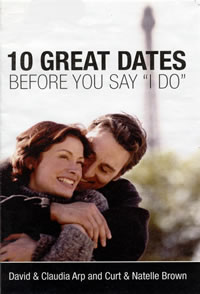
10 great dates before you say "I do"

10 Great Dates Before You Say "I Do", David & Claudia Arp and Curt & Natelle Brown

As we continue to help prepare couples for marriage, I find it helpful to have books to recommend. This has been a priority for us over the last few years. I have finally read all the books I bought 2 years ago, and I finish with this one.

Like 101 Questions to Ask Before You Get Engaged (see review here), this is a very practical book to help couples prepare for marriage. It is structured, as the title obviously suggests, around 10 dates or topics for conversation. It is meant to function as a workbook - you each read the chapter, rip out the page at the back for each of you to work through and then get together and discuss.

They cover most topics I would have thought of including:
  • sharing hopes, dreams and expectations
  • appreciating differences (helpful in highlighting different personalities and how they interact)
  • communication
  • problem solving
  • finances (this made me realise we should be more specific about financial issues with couples)
  • leaving and cleaving (this was a very helpful chapter)
  • intimacy
  • roles and children
For couples who are willing to put time into this book and treat it as a tool, there would be great benefits. Similarly, if are couple are unable or unwilling to do a marriage preparation course, this would be a good second choice. Combined with a tool like FOCCUS or PREPARE, it would certainly cover most issues. Ideally, if this book was the only tool used, one would encourage them to have another couple to talk to about issues raised.

Reading this book has highlighted for me the value of a book like Married for God, which fills a great void. In it, Ash does not deal with the how-to of marriage, but rather the why of marriage, what God's purpose is for our marriage and how we serve him through it. (if you want to read the whole series of posts on Married for God go over to in tandem).

Having said that - couples preparing for marriage also need the practical stuff. This book is another that does that job well.


Monday, March 21, 2011

God knows all about me

God knows all about me, Kate Toms

This book has become my new favourite present for newborn babies.

Kate Toms has created a delightful book perfect for little babies and toddlers. All the illustrations are hand-stitched so they are fun and interesting to look at. The verse is lovely:
From my fingers to my toes,
from my knees to my nose,
God knows all about me...

When I'm good, when I'm bad,
when I'm happy, when I'm sad
God knows all about me...

When I whisper when I shout
when I let my feelings out
God knows all about me...

Fun, and one of our more recent favourites.

The Busy Christian... Chapter 6

This series was originally posted on In Tandem, a blog for ministry wives

The Busy Christian’s Guide to Busyness
Chapter 6: Getting to the heart of busyness
People do not feel stressed simply because they have a lot on. Most of us enjoy doing lots of things. We only feel busy when we try to do more that we can. The problem is not expecting to do a lot, but expecting to do more than is possible. (p77)
Yet, the simple truth is God does not expect me to do more than I can. We all have limitations, be they time, energy, circumstances. So, if God does not expect me to do more than I can, the question for us is: Why am I trying to do more than I can?

The answer to that is comes from the answer to this: what are the desires of your heart? The most important step in dealing with busyness is: Identify the desires of your heart that make you try to do more than God expects of you.

The question all of us need to ask ourselves is – is our busyness rooted in sin? It is really idolatry?
We can spot idolatrous busyness because it will eventually cause harm – in our bodies, our families, our churches and our relationship with God. If your health, marriage, friendships, Christian service or relationship with God is suffering because of your busyness then you need to address the idols in your life. (p84)
For the next 6 chapters, Chester will look at some of the lies promoted by the world and the devil that lead people to be too busy. In each, he explores the counter truth – the liberating promise of God which repudiates each lie.
Our struggle with busyness is the struggle to believe God’s liberating promises for ourselves so that they shape our attitudes and actions. We may feel enslaved by our busyness and our schedules. But at the root of that slavery are the lies of Satan which are perpetrated by our culture. If we are to be set free, we must expose those lies and counter them with God’s word. More important than managing time is managing our hearts. (p86).

Next week – Chapter 7: I’m busy because I need to prove myself


Friday, March 18, 2011

Memoirs of an Ordinary Pastor

Memoirs of an Ordinary Pastor: The Life and Reflections of Tom Carson, D. A. Carson
I have been meaning to read this book for ages, I gave it to Husband for his birthday 2 years ago, and he both enjoyed it and found it quite sobering. D. A. Carson has written the book as a memoir of his father's life and ministry using his journals, letters, sermons and other written material. Tom Carson ministered in French speaking Canada for much of his life. It was a gospel-centred ministry, but one that (in human terms) was not particularly successful, he ministered to people without seeing much growth or many conversions. He didn't run a mega-church. He wasn't the keynote speaker at major conferences. However, he was a faithful man who preached the truth and desired to see people saved and grow in Christ. That is why Carson refers to him as an ordinary pastor. Rather than desiring to be the next big preacher, church-planter, speaker, etc - this is what those of us in full-time ministry should actually be aspiring to. A life of faithfulness for as long as God gives us. Actually, this is what all of us (paid ministry or not) should be aiming for. It's a humbling read of a man's walk with God as he sought to serve him all the days of his life - both in the ministry and his family. At times, Tom struggled with depression or at least despondency over his ministry and it's perceived lack of fruit. There are helpful chapters for others in ministry who feel the same way. The most moving part of the book is the account of the years where he takes care of his wife, Marj, as she declines with Alzheimer's:
"She looked after me all my life," he would say; "it's my turn to look after her. And it's a privilege." (p135)
Carson summarises his father and his life:
He never wrote a book, but he loved the Book. He was never wealthy or powerful, but he kept growing as a Christian: yesterday's grace was never enough. He was not a far-sighted visionary, but he looked forward to eternity... He was not very good at putting people down, except on his prayer lists... Dad won entrance to the only throne room that matters, not because he was a good man or a great man - he was, after all, a most ordinary pastor - but because he was a forgiven man. And he heard to the voice of him whom he longed to hear saying, "Well done, good and faithful servant; enter into the joy of your Lord." (p147-8)
By God's grace, so may we all.

Thursday, March 17, 2011

Calvin - Chapter 12

Chapter XII: How God Is to Be So Distinguished from Idols that Perfect Honor May Be Given to Him Alone

There is one God alone and nothing belonging to his divinity can be transferred to another:
unless everything proper to his divinity resides in the one God, he is despoiled of his honor, and the reverencing of him profaned. (I, xii, 1, p118)
When any other being, be it human, idol, saint or other is revered like a god, we are stripping honour due to God himself.

How might we strip this honour from God today?

Wednesday, March 16, 2011

How old are your spices?

Have you looked at your spice rack recently? I wonder if all spice racks accurately tell the time that the home was set up? (ie you moved out, got married, etc)

It turns out I have a number of spice jars that are 10 years past their use-by date.

Here is my suggested scenario:
  • you get married/move out and set up a home
  • you decide to try to learn to cook all sorts of new recipes
  • you try a range of new things, some work and some don't
  • the ones which you didn't like still required the purchase of ingredients
  • some of those ingredients, like spices, sit on a shelf for years to come

Which are mine?
  • Ground coriander seeds - expiry 03/02
  • Chinese five spice (used for one meal and one only) - expiry 08/01. Still a very full jar.
  • Ground cloves - expiry 07/01
And the winner is:
  • Sage leaves - expiry 02/01 - used once per year for the stuffing recipe for Christmas turkey, still only half empty
Have a look at your spice rack. Which ones are embarrassingly out of date? If yours are longer than mine, my guess is you set up a house before I did in 1999.

Who has the most out of date spice in their home? See if you can beat me.

Monday, March 14, 2011

Cecil the Lost Sheep

Cecil The Lost Sheep, Andrew McDonough

One of the best recent series of Christian books for young children is the Lost Sheep series, which starts with Cecil The Lost Sheep. This first book was only published in 2006, yet there are now 20 books (see the website).

Andrew McDonough has a real skill for taking bible stories and making them accessible for children, by using fun creatures, bright exciting illustrations and humour. They are great for groups, as they are fun to read out loud. Our children's programs at church has many of these books now and the children love them.

Cecil is based on the parable of the lost sheep in Luke 15:1-7. But he adds fun extra stuff to turn it into an exciting and interesting story for kids:
One day Cecil was daydreaming. "Boring, boring, boring. All I do is hang around with sheep, eat grass, wander down to the river for bit of a drink and eat more grass. Maybe I could run away and, and ...get a bike... or join a band!"

Cecil looked rght.
Cecil looked left.
He jumped over his rock and hid.
As with any book series, some are stronger than others and some you will prefer over others - we have really enjoyed this one, Jonah and the Whale, Basil the Branch, Bob the Bird and others. We haven't read them all.

They are cheap (~$5 per book) making them perfect for presents and gifts for larger groups of children. And one final plug for South Australians - they are produced in Adelaide, by a team (I think) of Adelaideans.

Good fun Christian books for kids.