Monday, February 28, 2022

The Hawk and the Dove

The Hawk and the Dove, Penelope Wilcock  

This delightful fiction series of 9 books is set in 14th Century Yorkshire and is about the monastery community of St Alcuins. The first book starts with the appointment of a new Abbot, Father Columba (which means dove). Acknowledging that their Abbot is hardly like a dove, this steely eyed, serious and devout though not compassionate man, continues to be known by the community by his baptismal name of Peregrine (the hawk):
“Of course, it’s one thing to love Jesus and quite another to follow him; and poverty, chastity and obedience sat about as comfortably on Peregrine as his hair shirt. Still, the brothers saw promise in him, and as much from stubbornness as anything else he grimly struggled through his novitiate year, finally making his vows and being professed as Brother Columba - a name which shows that either his abbot had a wry sense of humour or else that he had a greater faith than most men and no sense of humour at all.” (The Hawk and the Dove)
Each book explores a different aspect of the monastery or wider community. It is written in a lovely, winsome style, yet deals with some serious and sobering issues. The first book contains a shocking act of violence perpetrated on one man and how it changed him and his fellow brothers. Later books explore the realities of disability and the descent into needing loving palliative care, what true repentance and forgiveness can look like, and the impact of serious trauma and grief. I appreciated how the early books on monastery community life explored how the men learned (sometimes by trial and mistake) how to live graciously with one another with friendship and care. By removing romance from the early books, the focus was on other aspects of the Christian life. Later books did explore love and marriage outside the monastery, and these also showed a wisdom and depth of insight of the author. One quote was very amusing (although I note that this marriage improved with time and the gaining of wisdom):
“Married life... is like a precarious walk along the top of a hurdle never made to bear a man’s weight, while one person pelts you with cabbages and another intermittently takes you by surprise throwing a bucket of cold water in your face. Never dull.” (The Breath of Peace, p. 98).
The first two books are a collation of general stories, and Wilcock herself notes that she tried to make them similar to something like Chaucer’s Canterbury tales, which are from the same time. So, there are parallel stories, one in more modern times of Melissa with family life. Then the monastery stories are those her mother told her. From the third book onwards, Melissa’s mother no longer features as the narrator, it is just the chronological stories of the lives of the monks.

To call them charming makes them sounds light. They are not light - they contain significant emotion and experiences, expressions of God’s goodness and mercy, as well as despair at sin and failings. Yet they are also charming, written with skill, humour, and self-awareness. Highly recommended.

Monday, February 21, 2022

Gentle and Lowly

Gentle and Lowly: The Heart of Christ for Sufferers and Sinners, Dale Ortlund (Crossway, 2020)

This book has become popular quite quickly, and I can see why. With a gentle, pastoral tone that matches his subject, Dale Ortlund dwells on the character of Jesus as being gentle and lowly, anchoring his exploration in Matthew 11:28-30:
28 Come to me, all who labor and are heavy laden, and I will give you rest. 29 Take my yoke upon you, and learn from me, for I am gentle and lowly in heart, and you will find rest for your souls. 30 For my yoke is easy, and my burden is light.” (ESV)
Throughout the book, he considers who Christ is, rather than what he has done:
“You might know that Christ died and rose again on your behalf to rinse you clean of all your sin; but do you know his deepest heart for you? Do you live with an awareness not only of his atoning work for your sinfulness but also of his longing heart amid your sinfulness? (p. 15-16)
So he wants to bring us to the heart of Christ for us:
“It is one thing to know the doctrines of the incarnation and the atonement and a hundred other vital doctrines. It is another, more searching matter to know his heart for you.” (p. 16)
Each chapter considers an aspect of Christ, as given in Scripture, and then expounded, often with the input of some Puritan writers. These include:
  • his very heart being gentle and lowly. "For the penitent, his heart of gentle embrace is never out matched by our sins and foibles and insecurities and doubts and anxieties and failures." (p. 21) 
  • he is able to sympathise with us (Heb 4:15) 
  • he can deal gently with us (Heb 5:2). “Looking inside ourselves, we can anticipate only harshness from heaven. Looking out to Christ, we can anticipate only gentleness.” (p. 57) 
  • he will never cast us out (Jn 6:37). This was a chapter of great comfort and assurance. 
  • he is an advocate, a tender friend, and more. 
There is no avoidance of the reality of Christ’s wrath, anger, or desire for justice and judgement. Yet, Ortlund keeps stressing that Christ errs towards mercy, and that his righteous anger stems from his compassion, being a right response from the one who truly cares.

Then he turns to exploring both God the Father and the Holy Spirit to further round out the truth that our triune God cares, loves, and is merciful.

I appreciated his discussion of God as portrayed in the Old Testament and the natural progression to Christ: 
“When we see Christ unveil his deepest heart as gentle and lowly, he is continuing the natural trajectory of what God had already been revealing about himself throughout the Old Testament. Jesus provides new sharpness to who God is, but not fundamentally new content” (p. 135)
“…the Bible’s revelation of what God’s deepest heart is - that is, what he delights to is most natural to him. Mercy is natural to him. Punishment is unnatural.” (p.140)
This was an interesting discussion of the Puritan Goodwin’s conclusion that his mercy is God’s natural work, but judgment is his strange work. Judgment happens when it must, but his heart bends towards mercy.

I found this book to be both greatly encouraging and deeply comforting. I read only one chapter at a time, more as a devotional. Each gave food for thought, and another entry point into considering Jesus’ love for me and his mercy extended new every morning. As such, its gives great assurance. For those who struggle to know they are loved by Christ, valued by him, and a joy to him, this would be excellent. And for those who tend to focus on what Christ has done - rather than who he is, and how he comes near to us - this is a great reminder of who Christ really is, the one we worship and adore.

Monday, February 14, 2022

Is it Abuse?

Is it Abuse? A Biblical Guide to Identifying Domestic Abuse and Helping Victims, Darby A. Strickland (P&R Publishing, 2020)

This book falls into that sad category that while being excellent, Christ-centred, and extremely helpful, it is only because of deep sinfulness that it needs to be written and read. 

Darby Strickland is an experienced counsellor in the field of abuse, and brings her significant years of learning, helping, and writing to those who want to further understand domestic abuse, its impacts, and how to support those in the midst of it.

This is not for those who are experiencing domestic abuse, they would be better to start with her mini-book: Domestic Abuse: Help for the Sufferer. Those in church leadership who want to start the process of understanding this issue better would be well placed to begin with her other mini-book:

Domestic Abuse: Recognize, Response, Rescue


While this is highly recommended for all in church leadership and those in pastoral care, it is also for those who want to walk alongside women in these situations:
“I have written this book for anyone who desires to come alongside a victim, or victims, of domestic abuse. Maybe you are a church leader, friend, or counselor, and you find yourself dealing with the many layers of complexity that unfold as you encounter an abusive marriage.” (p. 15)
Strickland anchors abuse in the language of oppression:
“I want you to grow in your understanding of what is at the root of oppression and what the Bible says about it while also giving you the means to create pathways to safety and restoration for victims.” (p. 16)
She states her three goals are to prepare the helper to be able to:
  • pick up on cues that something is wrong, 
  • draw out stories to get clarity on situations and their severity, and 
  • be equipped to provide wise and Christ-centred counsel as you navigate this complex issue. 
The whole book is worded around a male perpetrator and a female victim, noting that is her area of expertise, and that statistics suggest is to be the case in >95% of situations. She does however, acknowledge it can be the reverse, and that the principles can be applied to male victims.

I’m not going  into deep level detail in this review, but will rather give readers a general overview, and some quotes. It’s a significant topic, and those that are interested in pursuing it would be much better placed to read the book.

Broken into three parts, Strickland begins by unpacking abuse: Part 1: Understanding Oppression

First, she considers “Is it Abuse?” and the complications of trying to know. One one hand “abuse is easy to miss, but it is even easier to minimise” (p. 15), yet we must go very slow, for much is at stake “for labelling something as abuse when it is not will do damage of a different kind” (p. 26). So, go slow, compile stories and examples of power and control.

At the core of abuse, she suggests, is oppression:
“Abuse occurs in a marriage when one spouse pursues their own self interests by seeking to control and dominate the other through a pattern of coercive, controlling, and punishing behaviours… I like to use the term oppression, seeing as it provides a framework for this behaviour that is addressed in scripture and captures the domination that it involves. No matter what form the oppression takes, its intended outcome is the same: to punish and wound a victim so that an oppressor gets their world the way they want it.” (p. 24)
In the end, the assessment is for coercive control, rather than based on specific incidents, many of which could be explained away.
“Abused women tend to ask somewhat veiled questions as they try figure out if what they are experiencing is normal and if you are a safe person to talk to” (p. 22).
To be the helper we need to listen carefully, offer gentle words, restore her ability to make choices, and bring her the truth that God loves her, honours her and delights in her.

She suggests that at the root of oppression is entitlement:

“While we all struggle with entitlement, oppressors exhibit patterns of demanding and punishing that are retrenched, unbending, and unrelenting”. This person:
  • Deflects all blame 
  • Admits no wrongdoing 
  • Renationalises punishing behaviours as being an appropriate response (p. 64). 

She considers six false beliefs of an oppressor, of which some or all might be present:
  • It’s all about me 
  • You and I need only to listen to me 
  • Rules are not for me to follow, they are to keep me happy 
  • My anger is justified 
  • Other people attack me 
  • I don’t have to appreciate what you do, but you have to appreciate what I do 
She then spends time considering the wide range of impacts of abuse on a victim, and how to help her speak.

Part 2 - Uncovering Oppression explores physical, sexual, emotional, spiritual, and financial abuse in detail, expounding on what they might look like, how they might impact her, and how to help someone in this situation. There are specific inventories included, which might assist both a victim and her helper to assess the severity of her situation, and how it might have escalated over time.

She notes that emotional abuse is the hardest to quantify:
“A broad category that encapsulates many forms of non-physical control. But we do not want to wrongly expand this label or over apply it. There are many good marriages in which cruel words are sometimes exchanged, and many bad but non-abusive marriages in which couples fight in detrimental ways.“ (p. 179)
The key is to look for patterns of control and dominance. She also considers extreme neglect and gaslighting, as they are two of the most difficult situations to detect.

Part 3 - Upholding the Oppressed has a chapter on helping mothers and children, noting the danger many children are in abusive households. Most children are aware of what is happening in the home, and some women might need to teach their children how to leave the house in a violent situation, or to call the police.

The final chapter, supporting steps towards freedom, confirms much of what Strickland said throughout - change is slow, it can take months or years for women to comprehend and face the abuse they are living with, and longer to choose what to do about it, whether challenge it, ask for help, or safely leave. She sagely notes that for all these situations, women will “have to pick their pain” - because every option is hard, challenging, and potentially dangerous.

The book finishes with some excellent appendices:
  • Safety plan - for a woman to fill out, especially in cases of physical abuse, which outlines what action she might take and when. 
  • Ten ways to educate your church, concluding a reference to this online course 
  • Detecting red flags during dating 
  • Premarital abuse assessment 
  • Abusive argument inventory 

Not surprisingly, this is a very sobering read. The stories included are heart-rending, and the detailed abuse inventories are awful to imagine someone living with. Yet, there is hope here too. Strickland deeply cares about women in these situations, she longs for them to experience freedom in Christ and to have a deep knowledge of God’s love for the weak, the vulnerable, and the mistreated. She calls on us to care for abused women and walk alongside them. She encourages the church to have a role in loving and caring for victims, as well as challenging and (ideally) calling perpetrators to genuine repentance. It's worth reading, but even more so, it's worth being better equipped to walk alongside people in these very challenging situations. 

Monday, January 31, 2022

Fiction mini-reviews

One Hundred Days, Alice Pung 

This is a pretty searing read. Set in the 1980s, sixteen year old Karuna writes to her unborn baby. She lives under the very protective eye of her Chinese mother from the Philippines, Grand Mar. Since her father Grand Pa left (an older Australian man who Grand Mar came to Australia to marry), they live in housing commission flats in Melbourne and struggle to make ends meet. One summer, almost because she is bored, Karuna ends up pregnant. Once discovered, it becomes a battle of wills with her mother, who tries to control every aspect of her life. Those who have Asian heritage might recognise the numerous comments Grand Ma makes about the impending risks to the baby with every thing Karuna might do, eat or think, and her ignoring of all medical advice. It’s funny, but also sad and depressing. Grand Ma is threatening to raise the baby as her own, and Karuna is figuring out how to stand up for herself. I began to wonder if there would be any positive resolution at all. Without giving the ending away, there is certainly hope that begins to grow as to how this might all be sorted out. Not a relaxing read, but an excellent book nonetheless. 


Sorrow and Bliss, Meg Mason

Like the one above, this also confronts some significant topics, but with humour and insight along the way. Set in the UK, Martha has just turned 40, and her husband Patrick has moved out after years of love and strife. The reader then travels back to Martha’s early years and her onset of significant depression and mental illness at age 17, which impacts her at points over the following two decades. Her bohemian mother is mostly drunk, her loving poet father is trying to write again, and she and her sister Ingrid are devoted to each other. Alongside their aunt, uncle and cousins, and Patrick, all the stories of their lives are woven together. Feeling the range of emotions more than most, Martha moves between ecstasy at the wonders of life, and deep despondence and despair. Patrick’s love stands as the rock alongside her waves. It’s an insightful view into mental illness, and how it can shape people but does not need to define them. I read Mason’s humorous biography of motherhood (Say it Again in a Nice Voice) 10 years ago, and really enjoyed it. I am keen to turn to her other book You Be Mother now too. 


Go Tell the Bees that I am Gone, Diana Gabaldon 

Long term readers will be aware I am a Gabaldon fan, having read all her books over the last 15 years or so. This is the ninth in a now intended series of ten, and it’s been seven years since the publication of the last. So fans have to be in this for the long haul, not only time wise between book publications, but for the length of book - this one is almost 900 pages, with small font. It picks up exactly where Written in My Own Heart’s Blood left off, continuing the story of Jamie and Claire, and numerous family members including Roger & Brianna, Fergus & Marsali, Ian & Rachel, William, Lord John, etc. There’s no point in giving more details for fans will be keen to read it, and those who want to start need to go right back to Outlander. I imagine Gabaldon has more fans since the release of the Netflix series, but there is so much more detail in the books than the TV series can manage. (As with the TV series, there is a fair amount of sex and violence, and sometimes both together). I enjoyed it, having been long invested in the series, and I partularly like the details she includes of history, medicine, and people. (The last two books are partially set in the American Revolution, with some overlap of events covered in Hamilton). Having said that, it is getting overblown and starting to feel a little indulgent. I’m hoping she doesn’t take another seven years to write the final! One particular quote that I did like: 
“One of the benefits of long marriage is that you can see quite clearly where some conversations are likely to lead - and occasionally you can sidestep the booby traps and choose another path by silent mutual assent.”

Monday, January 24, 2022

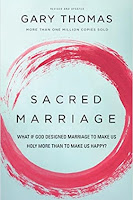
Sacred Marriage

Sacred Marriage, Gary Thomas (Revised ed. Zondervan, 2015)

Most marriage books fall into one of two categories:
Sacred Marriage is in the first category - exploring how marriage can make us more godly, and what it means to live in a way that honours Christ in our marriage. Thomas espouses a high, God-honouring view of marriage that esteems love, grace, forgiveness, and patience, as well as recognising the realities of sin, pain, and conflict.
“I believe that much of the dissatisfaction we experience in marriage comes from expecting too much from it.… God didn’t design marriage to compete with himself but to point us to himself.” (p. 27)
Christians are encouraged to see how God is using their marriage to grow them in Christ, in both the joys and the challenges.

It is not structured around the usual marriage topics (e.g. communication, conflict, intimacy), but rather around the ways we are shaped in marriage, e.g.:
  • marriage teaches us to love 
  • marriage teaches us to respect others 
  • marriage exposes our sin 
  • marriage builds perseverance 
  • marriage teaches us to forgive 
“What’s so fascinating about all of this is that what we need to develop to enjoy an intimate marriage – commitment, tenacity, perseverance – is exactly what scripture says we need to develop as faithful servants of God.“ (p. 103)
One things that struck me about this book was its applicability across the entire range of Christian marriage - new or mature, strong or struggling, growing well or close to shattering. It is relevant to each.

There are wonderful positive encouragements about what a God-honouring, long term, maturing marriage can be like:
  • “It’s wonderful when a husband and wife enjoy rich, fulfilling, and even exciting for sexual relations. And there is nothing wrong with having this as one of your goals. But alongside this goal – in fact, above this goal – should be the desire to become a better Christian. Use the marriage bed to learn how to serve another and how to deny yourself, and the spiritual benefits will be many“. (p. 181) 
  • “if we engage in marriage thoughtfully, purposefully, and with godly intentions, our wedlock will shape us in a way that few other life experiences can. It will usher us into God’s own presence.“ (p. 227) 
  • “It’s a journey that never really ends, but it takes at least the span of a decade for the sense of intimacy to really display itself in the marriage relationship.” (p. 102) 
  • “The stronger we grow as spouses, persevering and pressing further into our marriage, the more we’ll develop the very character traits we need to become mature believers” (p. 104) 
  • “If there is one thing young engaged couples need to hear, it’s that a good marriage is not something you find; it’s something you work for. It takes struggle. You must crucify your selfishness. You must at times confront and at other times confess. The practice of forgiveness is essential.” (p. 128) 
He is clear about how we are to treat each other, with love and respect, and is quite direct towards men (and women) who fail in this regard.
  • He argues that there is a case for viewing God as your heavenly father-in-law, because your spouse is a child of God. So, are we treating them that way? Aware of how much God loves them and cares for them, and notices how we treat them. 
  • In a marriage breakdown, to say “I never loved you”, is essentially to say, “I’ve never acted as a Christian”. (p. 41) 
  • “There are times when I must sacrifice my ambition to succeed in God service so I can be fully present and involved in the lives of my wife and children. Most assuredly, the tension should lead us to ask the question, “if I ignore God’s daughter (God’s son) to do God’s work, am I honouring God?”” (p. 231) 
His honesty about hard marriage could help those who struggle with whether it is worth it. He addresses many complex situations, including major conflict, betrayal, divorce and remarriage, and notes that a hard marriage can drive one to personal growth and reliance on Christ. He deals with these situations frankly but sensitively, also acknowledging that some marriages will rightfully end because of abuse, addition or adultery.
  • “Suffering is a necessary part of the Christian life… yet most of those who leave marriage and break its sacred history do so precisely because it’s tough… This tendency to avoid difficulty is a grave spiritual failing that can and often does keep us in Christian infancy.” (p. 124) 
  • “If your marriage is tough, get down on your knees and thank God that he has given you an opportunity for unparalleled spiritual growth. You have the prime potential to excel in Christian character and obedience.” (p. 125) 
  • The mature response “is not to leave a sinner (our spouse); it’s to change a sinner (ourselves). (p. 95) 
  • Second and later marriages are hard because “You’re not just marrying a new person; you’re neurologically trying to unmarry the previous spouse.” (p. 103) 
I realise these quotes might sound harsh, but they are not while reading in context. Some may want to hear that this season of struggle could still bear fruit.

While Thomas is real and honest about challenges, he overwhelmingly presents a positive view of marriage, hoping to increase our desire to serve Christ and grow in him, as we serve our spouse. It’s probably a touch on the long side, including numerous other writers and their opinions, sometimes at length. However, I found it easy to read, and very applicable. Obviously, it’s really only relevant for believers and those that are committed to their own spiritual growth as well as that of their spouses. Overall, an excellent encouragement that marriage is worth it, and that persisting through the joys and struggles will bear fruit now and into eternity.


Monday, January 17, 2022

Sensible Shoes

Sensible Shoes, Sharon Garlough Brown

Do you long for a fiction book to refresh you? To leave you desiring a deeper and closer relationship with God and understanding of what Christ has done for you?

You may find that the Sensible Shoes series by Sharon Garlough Brown could be that gift to you. It has been to me.

I have been interested in various spiritual disciplines and self-examination for a while, aware that while my faith is cognitively very strong, I can nervously steer away from the experiential. I think this is a tendency some evangelicals can have, which I suspect leaves us all the poorer for it.

Yet, I want to know God deeply, and the power of Christ’s resurrection in both my mind and my heart, and be challenged and encouraged in both.

The books are anchored around four main characters who meet in at a spiritual formation course at a retreat centre:
  • Meg, widowed young, now 46, whose controlling mother has recently died and daughter moved overseas for university. 
  • Mara, 50, struggling in a loveless marriage with two angry teenage sons 
  • Hannah, 39, pastor in a church who has worked so hard over 15 years to serve others she doesn’t realise just how spent she is, and 
  • Charissa, 26, newly married and a high-achieving doctoral major 
Over the weeks, they develop a friendship, open up and share their stories. All have their own challenges in trusting God in their situations, as well as coming face to face with their own areas of sin and struggle. I won’t expand on the storylines explored over the four books, lest I give it away to those who choose to read them, but everything is there - major illness, grief, relationship joys and breakdowns, friendships and family. (One major life experience not included in this series in mental ill health, although it is in her newer series Shades of Light).

The books weave the story with the various spiritual practices they are taught at the centre, and those readers who would like to engage with them could do at their own leisure. Each book contains different ones, some are a detailed bible study with reflection questions, some are a way of praying or bringing things to God, or a particular prayer to work through. I have been using some personally and finding them to be of great benefit. (It also seems that each book has a companion study guide for those that are interested).

My only frustration is that it is a female-focussed series. Yes, there are male characters, some wonderful and some not, but it’s not really about them. I suspect that could make it harder for some men to choose to read them. Which is a real shame, because one character Nathan models deep faith, humility and grace, and is a wonderful example of a man changed by such spiritual practices.

All in all, a lovely series. 

Monday, January 10, 2022

The Imperfect Pastor

The Imperfect Pastor, Zack Eswine (Crossway, 2015)

When we turn to books on leadership, including Christian leadership, we often expect them to be full of strategies, ideas, and inspiration. That’s what many seek: a way to do the job better, in a more organised way, with less conflict, assuming that we are loving others and bringing glory to God. As such, leadership books are usually not refreshing or restorative. However, this one is. Deeply so. It is also humbling, challenging and encouraging.

Zack Eswine encourages the pastor to slow down, take their time, get to know people well, allow for sin and suffering, serve faithfully, and essentially rest in Christ and his goodness. He espouses a view of faithful, servant leadership that is embedded in the congregation in which we find ourselves, not seeking to know it all, fix it all, or be all things to all people right now.

Divided into four parts, he begins by exploring the calling we pursue. He considers the desires that hound us and should motivate us, how we need to remember we are human, finite and fallible, and that much that we do is invisible.
“One can receive accolades for preaching Jesus, yet at the same time know very little about how to follow Jesus in the living room of their ordinary lives.” (p26)

“To the important pastor doing large and famous things speedily, the brokenness of people actually feels like an intrusion keeping us from getting our important work for God done.“ (p28)
The second part considers the temptations we face: being everywhere for all, wanting to fix it all, thinking we know it all, and considering everything to be immediate and urgent.

I appreciated this insight on believing that ‘right teaching’ will solve the problems people face:
“One of the first signs that we are approaching the borders of attempting omnipotence is this: we believe that another is choosing a course of action because he or she simply isn’t clear on what is right. Therefore, we believe that if we just work hard enough to explain what is right, then he or she will obviously and immediately do the right thing. No one was more plain, true, reasonable, and clear than Jesus, and they crucified him. Clarity matters a great deal. But clarity can’t always solve or fix the broken things.“ (p93)
“You were never meant to repent because you can’t fix everything. You are meant to repent because you’ve tried. Even if we could be God for people and fix it all, the fact remains that Jesus often does not have the kind of fixing in mind that you and I want.“ (p96)
He says the same about knowledge:
“We are tempted to something like omniscience - the ability to know everything. But you were never meant to repent because you don’t know it all. You are meant to repent because you tried.” (p104)
The third section considers reshaping our inner life: letting God speak, beholding God, and finding our pace.
“For many of us, it has been a long while since we’ve heard God in the quiet, knowing that it was his voice and not ours. We stare into our detox and begin to realise that we have been like a rude spokesperson in the presence of our host.” (p138)
I appreciated his comments on pace, considering watches of the day, then weeks, and longer seasons. He thinks abut four stages of the day, morning, afternoon, evening and overnight; which can each incorporate change, prayer, reflection, repentance, as well as days off, and time off in the year. I have considered this in terms of overcommitment in the past, but not in terms of restoration and shaping my day in ways that honour God, aware of his grace and mercies, but also my tendency to sin. Actively considering a change in ‘watch’ can help us to engage in the activity we are in, wholeheartedly and less distracted whether it is work, family time, pastoral visiting, or rest.

The final section looks at reshaping the work we do: caring for the sick, caring for the sinner, having local knowledge of our congregation and community, and leadership.

I found the local knowledge chapter helpful and a bit more pointed. We must get to know our people and their history and culture. This is often where new ministers find themselves at loggerheads with a congregation, for it takes time to listen to people and understand their desires and concerns, and from that to discern strengths and weaknesses. Eswine makes two comments about entering the culture of a congregation:
  • ideally a pastor is a change agent in God’s hands for the good of a congregation. 
  • But also (and he notes this is rarely cherished among clergy) - a congregation is a change agent in God’s hands for the good of a pastor (p225-6). 
Eswine writes with a gentle entreating voice, strongly pastoral and caring. He is not strident, even though he has strong things to say. He shares his own personal wisdom and experience learned through major challenges (marriage breakdown, church conflict). You can tell a person who has lived through tough times and come out of it strengthened through the grace of God, and this is the voice of one who has learnt hard lessons and wants to humbly share them, hoping to spare others the pain of his own mistakes. His written voice reminded me of a gentle old Puritan, with echoes of Marilynne Robinson. This might grate with some, for it is almost poetic at points. At times he entreats the reader to read sections again and dwell on them. I can imagine some might find that annoying or even a little condescending, but I did not. While not referred to explicitly, he is writing this to men in ministry, there doesn’t seem to be an allowance for female pastors, or even female leaders. That’s not to say women can’t learnt much from this book and I certainly did, but it’s worth noting.

While there is excellent wisdom for new pastors here, I think it will be of most benefit for those who have been in ministry for a while. Who have felt the burdens, the sin (their own and others), the relentless pace, the desire to stay on top of everything, the wanting to know it all, and be all things to all people. This gives space for repentance, mercy, grace and a chance to reset.

Monday, December 13, 2021

Even more Dee Henderson

Regular readers will be be aware I have enjoyed Dee Henderson’s writing this year (here and here). Now, we turn to a few more novels and novellas, and then to her two Evie Blackwell cold case novels - of which I hope there will be more!

In The Witness, Amy is on the run, being chased by a New York crime boss because she has access to his hidden money. Police Chief Luke Granger is slowly getting to know her, but when her sisters (who think she is dead) inherit large amounts of money, it’s clear that trouble will come after them all. This one has a bit more action, and some of the outcomes are a bit sadder.

Kidnapped follows the story of FBI agent Luke Falcon, whose cousin’s wife Sharon and son have been kidnapped. Sharon’s sister Caroline (who has been dating Luke) may also be a target. How will Luke track them down, and why were they targeted? I don’t think this has any character overlap with other novels. There is a bit more action in this one than some of the others.

In Before I Wake, Rae Gabriella has moved to Justice, Illinois, joining old friend Bruce’s Private Investigator business. Country Sheriff Nathan is pleased to have her on board, especially when young women start turning up dead in hotels. It looks like natural causes, but something is not quite right. The three work together to figure out what is happening. At the same time the town’s main job provider, a tile factory, is on strike and tensions are mounting. How will it be resolved when it becomes clear all are related? 

Then there are a few shorter novellas:

In Betrayed, Ann Silver’s random purchase of a box at an auction house leads to the discovery of a murder weapon. As Ann digs into the history, she is convinced that an innocent woman Janelle is in prison for a crime she never committed. I really liked Greg, the trauma psychiatrist, Janelle sees upon her release.

In Missing, police chief John Graham’s mother goes missing and Lieutenant Sharon Noble is on the case. Will they find her in this cold Chicago weather before time runs out?

Evie Blackwell cold cases

Traces of Guilt is chronologically after Taken (and some references to character and storylines overlap as a result). Paul & Ann Falcon are present, but the main action centres around Evie Blackwell, who is about to head up the governor’s new task force on cold-cases. She is spending two weeks in Carin Country, reinvestigating the abduction of a young girl and the disappearance of a family. The Thane family are central in this town, Gabriel is sheriff and is soon working closely with Evie. Joshua Thane’s old childhood friend Grace has returned with a large and painful secret that will soon be exposed. Meanwhile Will Thane is dating Karen who has her own troubled violent past. This is a creative storyline, with some lovely, caring men in the Thane family who long to care for and protect the people who are important to them.

Henderson includes numerous women in her stories who have suffered dreadful abuse and trauma. She doesn’t seem to include men with the same challenges. Rather, her male lead characters tend to be strong, protective types who want to love these women. It’s a lovely story, but at times it feels a little one sided. However, she is writing fiction, and it’s probably what appeals to her (presumably) mostly female readers.

Threads of Suspicion has Evie with the Governor’s new task force taking on a series of Illinois cold cases. Working with Dave, they begin to investigate two separate missing persons cases - a female college student and an older male Private Investigator. The cases begin to intersect as do their own personal lives.

All enjoyable reads.

Monday, December 6, 2021

The Good Girl’s Guide to Great Sex

The Good Girl’s Guide to Great Sex, Sheila Wray Gregoire (2012)

Warning: includes frank discussion of married sexual experience.

My recent reading of Gregoire et al’s The Great Sex Rescue, led me to explore her blog and then to her older book The Good Girl’s Guide to Great Sex.

Overall, this is a very helpful book aimed at women about sexual intimacy in marriage, covering early sexual expression and encounters in detail, and then ways to grow sexually in love, service, and pleasure with each other.

She starts with the beauty of sex, and it’s unique place in your marriage:
“You know you’re with this man till death do you part. You have time to learn. You don’t have to know what’s good to you; you get to learn what’s good for us.”
She explores how men tend to desire sex more often that women, yet acknowledges some women have higher libidos than their husbands. She encourages women to prioritise sex in a helpful way for their husbands. Here is where there seemed to be some difference from her current view in The Great Sex Rescue, where she is much more strident about the risks of seeing yourself purely as the outlet of your husband’s physical needs. (I’ll come back to this comparison point later).

She then goes on to explore three areas of discovery:

1. Physical discovery: fireworks. Detailed chapters on the basics and mechanics of sex, including contraception. She covers the wedding night in detail, dealing with expectations, and addresses whether or not they are virgins. It is sensitive, rational, detailed and helpful, encouraging couples to talk with each other and be honest about their own desires and personal choices.

She then discusses the female orgasm in some detail. I was surprised by her decision to make a distinction (as to value) between a vaginal and a clitoral orgasm. She then addresses the issues for a man who has a low libido.

2. Spiritual discovery: bliss. Here she talks about what it means to make love, rather than have sex, and the connection between the couple. This section looks at the realities of pornography use and how to proceed when either struggle with it, and also presents a range of sexual practices and gives her opinion on them.

3. Relationship discovery - laughter. These chapters encourage women to be more willing to initiate and enjoy sex with their husband, and what becoming best friends in marriage looks like:
"Sex isn’t the basis for our relationship; it’s the culmination of everything else, especially the friendship that we share"
Then she draws it to a close, basically encouraging women to enjoy sex and make it a priority.

As I flagged above, it’s interesting reading someone’s current views first, followed by their views 10 years ago. As such, my guess is there is some content in this Guide that Gregoire herself might alter if it was published now. Some things seemed a little different to the The Great Sex Rescue, and I suspect she has slightly altered her opinion over time. I don’t mind that, we all do it. But it makes it harder to read someone in reverse and then interact with what they are saying. They aren’t major things either, just some nuance. The largest difference is that this book encourages women to make good sex a priority as a way to love their husbands well. The Great Sex Rescue was much more honest about the challenges that such a message may send and removes the onus from women to be responsible for a couple’s healthy sex life.

A combination of both books together would be excellent, but as in any case - the reader should sift through and make their own decisions about what they do and do not agree with.

Personally, I didn’t like her designation of ‘good girls’ vs. ‘bad girls’, and it does certainly have a North American feel to it. She does clarify what she means, and for her ‘good girl’ doesn’t mean you are a virgin on your wedding night, or that you aren’t struggling with sexual problems, or your past that you had no control over (in fact she helpfully points out that some are actually ‘sad girls’). It’s not based on what you do, but who you are, and the fact that you are redeemed by Jesus: “if you choose to follow God, and his design for sex, you’re a good girl”. Even so, maybe it’s my age showing through, but being called a ‘good girl’ did feel a little condescending.

So, while there are minor things that I would nuance differently, and I suspect Gregoire would now also, overall, I mostly agree with what she says. Because it’s addressed to women, it is harder to recommend to couples, but men will get a lot out of it if they take the time.

I wish there was one book that covered everything about sex in Christian marriage: a truly godly and wise perspective, allowing for personal expression and experience, and helping couples to rejoice in the gift of intimacy. However, that’s unlikely. Yet this offering from Gregoire goes a long way to adding wisdom to the current collection, and as such, is now high up on my recommended reading list on this topic.

Friday, November 19, 2021

Resilient Grieving

Resilient Grieving, Dr Lucy Hone (Allen & Unwin, 2017)

This is an excellent book about grief, how it impacts and changes us, and how we learn to live with loss.

Dr Lucy Hone works in the field of resilience psychology. Living in Christchurch, she worked with people through major loss and disruption over the time of their earthquakes. Her life was then turned upside down when her daughter Abi (12) was killed in a car accident, along with two dear family friends.

As Lucy, her husband and two sons faced their devastating grief, she began to consider how her her work could interact with her grief experience. In the end, she decided she wanted to be proactive about her grieving, to take control of it.

Her reading, research and experience has produced Resilient Grieving (first published as What Abi Taught Us). She says “this book is less about what you might experience during bereavement and more about what you might do to enable the process of healthy grieving“.

The book is split into two parts.

Part 1: Recovery

This section is intended for the early days, weeks and months after a major bereavement. The first chapter suggests six strategies for coping in the immediate aftermath:
  • There are no rules, do what you need. 
  • Choose where to focus your attention 
  • Take your time 
  • Feel the pain 
  • Beware of the grief ambush 
  • Reestablish routines 
Further chapters consider ideas such as:
  • Accepting the loss 
  • Noting humans are hard wired to cope - death is normal and most people manage tragedy and trauma quite well, with time. 
  • Noting the secondary losses that come with any major loss - perhaps loss of role, income, dreams, etc. 
  • Choosing to find positive emotions 
  • The usefulness of distraction 
  • Habits of resilient thinking: realistic optimism, redefining hope, and mindfulness 
  • Managing exhaustion and depression through rest and exercise 
  • What family and friends can do to help. This chapter is very helpful for support people, and also includes comments about grief in children 
This was all very useful material. My only thought is that whether someone is likely to have this book and be in a state to read it in those very early days of grief, or able to process the content within. As such, this may be more of a tool for a support person, who can also put it in the grieving person’s hands when they are ready.

Part 2: Reappraisal and renewal

This considers the reality of your life after the loss, so chapters address:
  • Reappraising your brave new world 
  • Facing the future 
  • Continuing bonds 
  • Post-traumatic growth 
  • Rituals and mourning the dead 
The main reason I found this book so helpful was not related to a personal grief story. Rather, I have done a Theories of Grief course at uni this semester. And so forgive me, because this next sentence will mean nothing to many - but for those that have spent time in the field it should make sense. What Hone has managed to do is turn numerous grief theories (e.g., Worden’s tasks of mourning, Attig’s relearning the world, Stroebe & Schut’s Dual Process Model, and Neimeyer’s meaning making concepts); and combine them into an easily understandable explanation that grabs the key elements of each and applies them to her own situation. What I appreciate about the various grief theories is how readily they can interact with & build on each other. Hone has developed her own pictoral grief model - a jigsaw puzzle of interlocking pieces, not linear or circular, but something that keeps needing to be fit together in a way that works for her.

So, Hone has managed to tell her own story of loss and grief, and combine it skilfully with research, producing a book that is both deeply personal as well as being a learning and guiding tool for others - readily accessible for anyone in grief. Each chapter finishes with personal questions to consider for your own situation.

This could be a very helpful guide to those charting their own way through major bereavement. In addition, it would be a valuable addition to anyone who cares for or counsels those in grief.

Friday, November 12, 2021

Burnout

Burnout: A Guide to Identifying Burnout and Pathways to Recovery, Gordon Parker, Gabriela Tavella and Kerrie Eyers (2021)

At times, burnout seems to be the buzzword. It’s used often, yet hard to define or quantify. Are you burnt out or burning out? Is it possibly depression? Or exhaustion? Or is there an underlying medical condition? This is a timely book for anyone impacted by burnout, whether personally, or for family and friends, employers or health professionals; with the aim to explain, advance awareness and enable ‘nuanced management recommendations’. It is peppered with personal stories that give meaning and expression to the research and concepts within.

Part 1: What is Burnout? 

They begin by considering the place of burnout in ancient literature (including possibly Moses and Elijah) and its more modern history. They interact with the generally accepted definition of burnout and it’s three factors: energy depletion or exhaustion, negative feeling or cynicism about one’s job, and reduced professional efficacy (this may be the definition you have heard, it’s the one I knew about).

Based on the authors’ research (referred to as the Sydney Studies), they expand the factors at play and propose that the main features include:
  • exhaustion 
  • loss of empathy or perhaps loss of joy 
  • compromised work performance 
  • impaired cognition 
  • that it is different to depression, although there is overlap 
  • that perfectionism heightens the risk (it’s identified as probably the key predisposing risk factor) 
  • that it is a ‘diathesis stress’ condition meaning that some people are predisposed. 
This higher risk due to personality suggests that “escape from work or caregiving pressures may relieve some of the burnout symptoms, but failure to identify and modulate any personality contribution will not allow burnout to be so readily managed, while also increasing the risk of relapse”.

They consider other causes of burnout symptoms (what burnout is not: e.g. chronic fatigue syndrome, anxiety) with much time comparing the symptoms of depression. There is an extensive table comparing melancholic depression (that which arises from inside a person with no seeming trigger), non-melancholic (more responsive to a situation) and burnout. This could be very helpful for health professionals, as well as individuals seeking some clarification.

Part 2: Causes of Burnout

It seems universally acknowledged that a clear cause of burnout is work. But what work causes burnout? Certain professions are linked with high rates of burnout including doctors, nurses, police, lawyers, teachers, managers, and clergy. However, the high rate of burnout in caregivers is now also being more widely recognised.

Interestingly, there is a paradox relating burnout with how one views one’s job: “burnout rates appear lowest in those who work in simply a job, higher in those who view their work as a career and highest in those who whose work is at the level of a ‘calling’”. Let ministry workers have ears to hear.

Then attention is given to the predisposing factors that can increase the risk of burnout, the most prevailing being perfectionism. Others include: neuroticism, having an external (rather than internal) locus of control, a Type A personality, a low sense of self-efficacy and low EQ. They conclude that “the sad thing about burnout is that is more likely to afflict good people”.

Part 3: Overcoming Burnout and Rekindling the Flame

To resolve burnout, three approaches are helpful, with most benefit if all three are addressed:
  • resolve work factors 
  • learn and implement de-stressing techniques 
  • identify and address personality contribution 
Following chapters focus on managers and improving workplace conditions and culture, workers and caregivers (e.g. when to speak up at work, and when to choose to leave), de-stressing techniques (e.g. mindfulness, meditation), and managing perfectionism (with a recommendation for the use of CBT).

They draw all the threads together at the end, with numerous suggestions about how to manage burnout, pointing out that “burnout resolves better with a self-management model” and therefore people can take control and manage it themselves perhaps with some assistance along the way.

Appendices

The appendices include:
  • The Sydney Burnout measure - their proposed diagnostic tool to assess burnout which can be self applied. 
  • A checklist of workplace triggers 
  • A perfectionism scale 
  • An extensive list of various resources (mainly apps and websites) 
All in all, this is a very helpful & relevant book, taking a concept that is widely talked about, but less widely comprehended or qualified, and provides a scaffolding for our understanding, assessment, and treatment of burnout.

Friday, November 5, 2021

A Biblical Counseling Process

A Biblical Counseling Process: Guidance for the Beginning, Middle and End, Lauren Whitman (New Growth Press, 2021)

Whitman is a trained biblical counsellor with the CCEF, and has written this very helpful, succinct resource for those seeking to counsel biblically in a professional way, which also has application for those counselling more informally in pastoral care situations. It’s essentially a primer for newer counsellors, guiding them through the beginning, middle and end of a counselling relationship. In each section, Whitman covers both theory and practice in an easily implementable way. First the theory is outlined with the goals of counsel at that stage, a potential session structure, and topics for the counsellor to be considering. Then, through the use of one main case study throughout the book, she illustrates how to do it in sessions with a real counsellee.

Positive aspects include:
  • Her emphasis on getting to know the client, being personal and adaptable, and empathic. 
  • Working hard to confront any assumptions we might be making about the client, and being aware of our tendency to do so. 
  • Being aware of and acknowledging cultural differences we may have with a counsellee, and seeking to understand their experience. 
  • She models a natural and seamless way to integrate scripture and Jesus with someone’s life experience. (If you want another book that also does this well, try Mike Emlet's CrossTalk)
  • The approach seems to be similar to person-centred cognitive behavioural therapy, with the analysis of feelings, thoughts and responses, and encouraging people to do their own homework between sessions. However, it is integrated with a biblical perspective that acknowledges sin, forgiveness, potential for change and growth in Christ, and a desire to love God and others. 
  • A great reference list is at the end, mainly to articles in the Journal of Biblical Counseling & other CCEF faculty books. 
  • It’s well structured, and easy to read. I read the whole text in a few hours, but there is content I will return to again for reference. 
One note: this book should not operate as a stand-alone tool. It does not make the reader a biblical counsellor. Anyone training to be a biblical counsellor would likely be taught much of the content. So, it will likely function as a simplified reminder of what a counsellor in training would be learning or already know.

In saying that, I am in exactly that position (a trainee counsellor) - and I found it very helpful. It reminded me of much that I already know, but collated in a useful way for future reference and use.

So, this book is aimed at a rather specific audience - the new biblical counsellor - but for them, there is much of value within.


I was given an ecopy of this book in exchange for an honest review.

Monday, October 25, 2021

More by Dee Henderson

I have returned to some of Dee Henderson’s other books, having enjoyed her writing earlier this year. She has quickly become one of my favourite authors.

Full Disclosure introduces FBI team leader Paul Falcon and highly respected Midwest Homicide Investigator, Ann Silver. Ann brings Paul a case providing the first decent lead in a cold-case centred on a female assassin. Paul is also heir apparent to the Falcon dynasty, a large extended family business with ties throughout the country. Ann has her own personal history and secrets which are revealed throughout, but interestingly she also is a fiction writer who writes the love stories of her friends, like Dave and Kate. Here astute Henderson readers will note the suggestion that Ann Silver is actually Dee Henderson (as many of these couples are in the O’Malley series). Perhaps she’s leaving a clue as to how she writes and who she writes about. There is certainly very little biographical information available about her. It’s possible she does her research very well, but her depth of insight reads as if she is in law enforcement of some type herself.

In Undetected, Gina is a genius who has discovered ways to improve sonar in submarines, thus also protecting her brother Jeff, a submariner. However Gina longs to marry and has not found a a man who can cope with her intellect. Mark Bishop, submarine captain, widower and good friend of Jeff’s, becomes a close friend as they work on Gina’s new discovery, which will have startling implications for the US Naval fleet. They both dismiss the idea of romance, with 11 years between them, but just maybe this friendship could turn into something more. 

Unspoken turns to Mark’s brother Bryce and picks up a storyline alluded to in Undetected, and as such should probably be read first. (Paul Falcon and Ann Silver appear here as well). Bryce, a rare coin dealer is approached by Charlotte Graham to sell the inheritance of coins from her grandfather. As he moves into business dealings with her, he begins to grasp the magnitude of what she has inherited. Yet, at the same time, he figures out that she not who she seems. Charlotte has an awful story in her past, she was abducted and held for four long years when she was 16, and never speaks of it. 
 
I really liked this book. While what happened to her is truly horrible and it’s alluded to in her behaviour, but never actually named. So, while as a character she experienced dreadful evil and violence, as a reader you are not given details. Charlotte’s biggest challenge is accepting that a God who loves her would also have offered forgiveness to the men who hurt her, had they asked. As she and Bryce move towards a close friendship, things become more complicated as details of her life and inheritance emerge. I really liked the way Henderson dealt with major trauma, large amounts of wealth, and a complicated relationship. It’s the most mature yet gentle writing I’ve read on such topics: sensitive, realistic, and yet hopeful. Her characters have long term complex trauma and pain, and she doesn’t pretend there are simple solutions to such things, but moves them forward in a positive way. 

Taken begins with Matthew Dane, former cop and now PI, speaking at a law enforcement conference. Waiting to speak to him in the hotel is a young woman, who reveals she is Shannon Bliss, missing since she was 16, some 11 years previously. She has sought him out after some research, his own daughter was abducted at age 8 and released at 16 some five years ago. She slowly reveals a decade of being held by a crime family, involved in their ongoing child abduction and various thefts, crossing the entire US in a complicated network. She has enough evidence to bring them all down, but needs to take her time, both for her own safety but also for others still involved. Matthew becomes her confidante and safe person, who manages her return to her family and her interactions with law enforcement. Paul and Ann Falcon, Charlotte and Bryce Bishop and a few characters from other novels also appear. Yet again, a story with depth and interest, of someone who has survived a horrible ordeal, yet with little description of what it was really like. 

I continue to be impressed with how Henderson can write stories of dramatic and traumatic situations yet not give in to the temptation to glorify them in technicolor detail. There is nothing lost in power of her storytelling, in fact I think it is strengthened because of it. 

That’s enough for now! I’ll tell you about some more another time…

Monday, October 18, 2021

The Great Sex Rescue

The Great Sex Rescue, Sheila Wray Gregoire, Rebecca Gregoire Lindenbach and Joanna Sawatsky (Baker Books, 2021) 

Warning:

This is going to be a long review, and contains frank language about sexual expression.

For those that want the condensed version:


This is a challenging and insightful book that encourages Christian marriages to great, passionate, other person-centred sex that is enjoyable for both spouses. It includes lots of research about the things that Christian women experience, enjoy and struggle with in the bedroom, as well as tearing apart the teaching in a range of Christian books on sex and marriage.

Now for the much more detailed review:

The time spent reading this book, and many of the resources around it has been an interesting and eye-opening one. I had never heard of Sheila Wray Gregoire or read any of her books, but she is quite prolific and has an extensive blog & website (To love, honour and vacuum) which specifically addresses sex in marriage, amongst other things.

The Great Sex Rescue (2021) is trying to do three things:
  • give sexual and intimacy advice and instruction to married couples who are trying to live in honourable Christian marriages; 
  • explore in detail the results of a large survey on sexual intimacy collected by Gregoire of over 20,000 evangelical women, as well as the results of academic research and focus groups; and 
  • examine the bestselling Christian marriage and sex books to analyse their teaching and the messages given in them (mainly in order to point out the problems within them). 
These all have value, and need to be done. We need excellent books on sex in marriage, we need research to know and understand women’s (and men’s) experience of sexual intimacy to help us understand people’s joys and challenges. And we need to analyse critically what published resources are saying and hold them up to scrutiny. Having said that, it’s hard to do all three well. This one seems to start with the aim of tearing other arguments down, giving it a combative, polemical feel.

I wish they could have found a more balanced way to provide all the same information by focusing more strongly on the positive messages they wanted to explore, providing advice and insight for couples, while still pointing out the clear faults in some Christian teaching in this arena.

They come up with seven principles about what sex should be:
  • personal - so that two truly become one 
  • pleasurable - really good for both people 
  • pure - each person being responsible to keep themselves free from sexual sin 
  • prioritised - even while acknowledging different levels of desire 
  • pressure-free - freely given and never achieved through coercion or threat 
  • put the other first - considering the other’s needs before their own 
  • passionate - to be able to surrender to each other in trust and love 
The remainder of the book explores these principles in detail.

Two chapters explore ‘pleasurable’ in detail - one focussing on orgasm (mainly about enabling more women to experience it) and arousal (noting that sex cannot be pleasurable until you figure out arousal). They posit that:
  • no man should be satisfied unless his wife is regularly satisfied 
  • women’s sexual pleasure matters for her own sake, not just his 
The chapters on purity starkly and repeatedly point out that women are not responsible for their husband’s purity. Men (and women) are responsible for their own self-control, and their decision to view pornography. Wives have had unrealistic burdens placed on them with the assumption that men cannot control themselves and they are required to ‘keep the home fires burning’ so they do not stray. This message is as insulting to men as is it to women, reducing men to brute beasts, and wives to gatekeepers and receptacles for lust control.

Addressing differences in libido, they note that couples who manage them well “are naturally satisfied during sex and treat each other well outside the bedroom too”. Hardly rocket science! Considering further, they note:
"Perhaps frequency has been used as the main measure of satisfaction because it is easier to tell couples to have more sex than it is to help her reach orgasm or solve underlying marital problems or deal with the stresses of life. But what we’ve found is that when you work on marital satisfaction, reducing stress, and making sex feel pleasurable and passionate, libido difference usually take care of themselves."
They then turn to consider the sexless (or very low sex) marriage, and the main scenarios into which these fall:
  • The sexless marriage due to selfishness or brokenness - this is where either laziness or selfishness reigns, or deep seated problems aren’t being addressed 
  • The sexless marriage due to emotional protection. Here where one is refusing sex, it is the other’s ongoing behaviour that has prompted it. 
  • The sexless marriage in disguise (they are actually having regular intercourse, but for one partner it’s completely void of connection or pleasure) 
They propose five strongly contributing factors to a sexless marriage: pornography use, male sexual dysfunction, anorgasmia, vaginismus, and not feeling close during sex.

Some of the issues addressed very well and very openly in this book are the areas where few others dare to tread. These include:
  • the challenges and reality of vaginismus 
  • the reality of sexual pain for many women 
  • the sexless marriage (above) 
  • the concept of duty sex, and the problems it can create 
  • the sinfulness of sexual coercion and marital rape 
The final chapters are the better ones - with the exhortment to all to ‘just be nice’. It sounds simplistic, but they are right - if we longed to love the other as much as we love ourselves in marriage, there is so much that could be better, and so many problems that could be overcome. Jesus’ words may be simple, but we all know that doesn’t mean it’s easy.

They try hard to celebrate that there are wonderful men and husbands out there who long for a close, passionate, mutually enjoyable sexual experience with their wives. But a man reading this book could certainly feel like he is much to blame for intimacy problems. It certainly points the finger hard at the unhelpful and sometimes destructive messaging that the church, and certain books, have given to people. And there are elements where this is needed. Some of the quotes included from certain books made my skin crawl. They come down hardest on Love and Respect and Every Man’s Battle. One I have recently stopped recommending, another I have never read.

There is much more that I could say in more depth. Some things might be:
  • Just because books are Amazon bestsellers does not mean they are the best books on a subject. I would have liked to see analysis of some books written in the last 15 years, most covered are quite old. 
  • However, that’s also a reminder to re-read marriage books. I have certainly changed my views on some over the years (eg Sheet Music, Love and Respect
  • We need to encourage people to read critically. Just because an author writes it doesn’t make it true, biblical or wise. And this applies to Gregoire et al. as much as others. We need to be discerning. 
  • The use of statical data is varied. Sometimes it helps (it is helpful to know how many women are orgasmic, how many experience pain, how much sex people are having). But it also complicated information, and often the data tables weren’t clear. 
  • As mentioned above it is more combative that it needs to be. If you spend time on Gregoire’s blog, this is also evident. 

Who should read this?
  • Those who want to explore their own perspective on sex and pleasure, and how that may have been impacted by church teaching. 
  • Those facing sexual challenges in their marriage, and have uncertainty about where to turn (you could try her blog too to get an idea of the topics she covers, for while some posts are combative, some are very helpful) 
  • Those in marriage ministries or counselling Christian marriages (or engaged couples) - to consider what messages, even subtly we might be sending without meaning to 
  • Those pastoring marrieds could benefit from understanding more broadly the depth of issues marrieds face, and the challenges some will not openly speak about. 
  • NOT those embarking on marriage. This is not for newlyweds. Sadly, many of the issues she addresses do come up early in marriages, but I don’t think this is the best delivery format for that stage. 

Monday, October 4, 2021

The Unlikely Yarn of the Dragon Lady

The Unlikely Yarn of the Dragon Lady, Sharon J. Mondragón

I was invited to read this book as part of a blog tour, and very much enjoyed it. Sharon Mondragón has created a likeable tale about four women who meet to knit prayer shawls. 

I’ll be honest, I had no idea knitting prayer shawls was a thing. But I can see how it would naturally develop. Christian women who love to knit, gather together, and create shawls to give to people in situations of need. It seems they pray silently as they knit, and pray at the beginning and end of each shawl project. It seems to be a ministry of creative, thoughtful care.

In this novel, Peter McIlhaney, rector of Hope and Glory community church, has been told that his church is going to be shut down. He devises a last ditch effort to reach out to the community, by sending the Heavenly Hugs Prayer Shawl Ministry off site. To date they have happily met in silent tranquility in the prayer chapel.

Margaret, self appointed head of the group is outraged. How could they possibly go to the busy mall and pray while knitting? The other members of the group are a little more open to the idea. Rose has recently entered aged care, and is struggling to adjust to the changes. Fran’s husband died 18 months earlier, leaving her completely bereft. Jane struggles with a well-kept secret about her son as well as parenting two bickering, teenage daughters.

As they set up in the mall, they slowly become known to the shop staff and regulars who pass by. People start asking for prayer. Some want to learn how to knit. Some end up coming to church on Sundays. As they become more involved in the lives of all these new friends, they each have to face their own hurts of the past.

If I was going to be picky, I would say that the entire model of prayer seems to be supplication; all about things people want God to do for them. No praising God for who he is, what he has done in Christ, or how we receive salvation through him. Yet, it’s not all about passing tests and getting jobs, either. Some relationships are healed and restored, both with people but also with God.

An enjoyable book with a satisfying group of (primarily) mature female characters, who are complex yet long to serve others. I can imagine numerous female readers, especially those who knit or are Christian, enjoying this one.

If you want to enter a competition for a free copy - go here. And if you go to this post, I think you can link to read an excerpt.

Monday, September 20, 2021

The Church as a Culture of Care

The Church as a Culture of Care: Finding Hope in Biblical Community, T. Dale Johnson Jr. (New Growth Press, 2021)

Johnson is an experienced biblical counsellor, and he has written this book for church leaders and elders, seeking to re-establish the church as the central place of soul care. He challenges the perception that secular psychology has outdated the church, but rather proposes than God has equipped people for every function of the care of souls, placing Jesus at the centre of restoration. He states that “this book is intended to be an admission of our failure and an exhortation to arise and reclaim the church as a culture of care” (p. 4).

He starts by expounding that God made the church to care for people, and then outlines a biblical vision for the church to be a culture of care: because God first cared for us, it is for his glory and for our good.
“Every aspect of the work of the such intended to care for souls. Preaching, shepherding, one-anothering, church discipline, missionary proclamation, personal obedience - all are intended to awaken or strengthen the soul to live faithfully and peacefully in a war-torn and sin-cursed world.” (p17)
The third chapter (when the church doesn’t care) was one of the strongest, and one those in church leadership would do well to ponder. Johnson outlines how we have embraced secular psychology, abdicated discipleship, and we hesitate to obey and apply God’s word. He explores the costs that this has had, the one that struck me was our changed view of the church - with an aversion to church discipline, the specialisation of the pastorate, and the lack of discipleship. Another point rang true for me, based on my current study experience - eclecticism is now valued, rather than a over-arching systematic approach:
“What is in vogue at the moment is a smattering of methodologies used at the discretion of the therapist from an ever expanding toolbox” (p. 50).
The following four chapters continue to expand his biblical vision of the church as the centre of soul care:
  • Christ as the head of the church - we must submit to him and glorify him 
  • Christ as our good shepherd - because the rule and authority of Jesus is always “tethered to love and gentleness”. There is a detailed look at what it means for Christ to be our shepherd, and how we are to listen to him and depend on him in response. 
  • The care of under-shepherds - what it means for pastors and elders to minister and care, and to equip the saints for works of ministry. 
  • Equipping the saints - because pastors forget that God has called the whole church to care for each other. 
The final chapter (counselling in the local church) was also very good, with Johnson making the distinction between preventative and intensive soul care. Preventative care should be a normal part of the one-anothering life of the church:
“every believer is to be engaged in the care of souls within the body of Christ, and as such they will provide “counsel” or wisdom for living during the course of their normal conversations. Every member of the body is called to minister the Word to one another” (p. 145).
Intensive care is that which requires immediate attention through formal counselling or intensive discipleship. Formal counselling ministry is not intended to subvert or deter normal care within the body of Christ, rather: 
“it is the overflow of healthy biblical discipling and caring relationships that creates a demand for a more formal counselling ministry” (p. 149).
This is a helpful offering to assist church leaders consider why biblical soul care and counselling is an essential part of the the role of the church. I felt it was more wordy that it needed to be, and yet still didn’t get specifically practical, in terms of how a church or a pastor might go about making change. Some of the discussion questions might help people to get to that place on their own, but I imagine others might be left feeling, “I agree, but what do I actually do now?”

Having said that, he has laid excellent groundwork for churches to think through their own culture of care, what they may be missing, and the reasons for that. Numerous people would benefit if these principles were put in place in more churches.

An ecopy of this book was given in exchange for an honest review.

Monday, September 13, 2021

The Windsor Knot

The Windsor Knot, S. J. Bennett 

This lovely fictional book suggests that the Queen solves mysteries. A young Russian musician has been found dead after performing at Windsor Castle. While the head of British Intelligence thinks the Russians are up to something major, and the staff of the royal household are now suspects of a long term plot, the Queen knows it was nothing of the sort. Through her young, new assistant private secretary, Rozie Oshodi, she quietly starts her own investigation. Rozie discovers doors quietly open wherever she goes, as various people long to say what they know and to help Her Majesty. It’s written in a lovely, somewhat whimsical tone, with the Queen’s contemplations often involving “oneself” or “when one has to do something.”
“Of all her residences, if she had to pick a favourite, it would be this one. Not Buckingham Palace, which was like living in a gilded office block on a roundabout. Not Balmoral or Sandringham, though they were in her blood. Windsor was, quite simply, home. It was the seat of her happiest days of childhood… It was where one still came at weekends to recover from the endless formality in town.”
It’s set in April 2016, when the preparations are well under way for her 90th birthday, and the Duke of Edinburgh is still by her side.

I have enjoyed various other fictional books set about the Queen over the years, such as Mrs Queen Takes the Train and The Uncommon Reader (written by another Bennett!)

I’m pleased to see she has more books in the planning, I’ll be looking out for them.